


Government officials, academics, development partners and youth leaders called for stronger institutional support, climate financing and gender-responsive policies to ensure young people play a central role in Bangladesh’s climate governance.
Speakers have called for a major shift in climate governance, urging policymakers and stakeholders to move beyond symbolic youth engagement and ensure young people have meaningful roles in designing, implementing and monitoring climate solutions.
Despite contributing a very small share of global greenhouse gas emissions, Bangladesh remains one of the countries most affected by climate change, making inclusive climate governance and locally led adaptation increasingly critical. As one of the world’s most climate-vulnerable countries, Bangladesh is emphasizing youth leadership as a critical driver of climate resilience, adaptation and sustainable development.
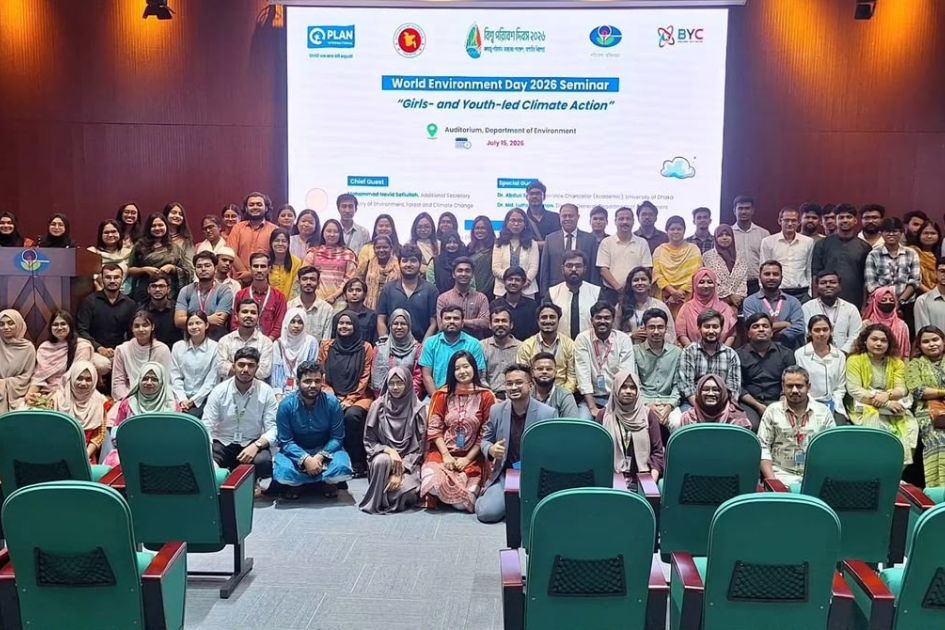
The call came at a seminar titled “Girls and Youth Led Climate Action,” organized to mark World Environment Day 2026 at the Department of Environment auditorium in Dhaka.
The seminar was jointly organized by Plan International Bangladesh and the Bangladesh Youth Coalition (BYC), bringing together government officials, diplomats, development partners, academics, researchers, civil society representatives, climate experts, youth leaders and media professionals to discuss inclusive and locally led approaches to climate action.
The seminar highlighted the importance of empowering adolescent girls and young people as climate leaders, innovators and partners in shaping solutions. Participants stressed that young people, who often face disproportionate impacts from climate change, must not be viewed only as affected communities but also as key actors in building climate resilience.
Mohammad Navid Shafiullah, Additional Secretary at the Ministry of Environment, Forest and Climate Change of Bangladesh, attended the event as chief guest. Professor Dr. Abdus Salam, Pro-Vice Chancellor (Education) of the University of Dhaka, Bangladesh’s oldest public university, and Dr. Md. Lutfor Rahman, Director General of the Department of Environment, the country’s environmental regulator, attended as special guests. Marjan Noor, Climate and Environment Adviser at the British High Commission in Bangladesh, also delivered remarks.
In his address, Shafiullah highlighted Bangladesh’s commitment to building an inclusive and people-centered approach to climate resilience. He said climate adaptation is not only about infrastructure development but also about empowering communities, strengthening institutions and developing future leadership.
“Climate adaptation is not only about building infrastructure; it is about empowering people, strengthening institutions and developing leadership. Today’s young people, particularly adolescent girls and young women, have a crucial role in shaping a climate-resilient Bangladesh,” he said.
He stressed the importance of ensuring meaningful youth participation in national climate planning, decision-making processes and community-based adaptation initiatives.
Moving Beyond Symbolic Participation
A key discussion at the seminar focused on closing the gap between youth representation and actual influence in climate governance.
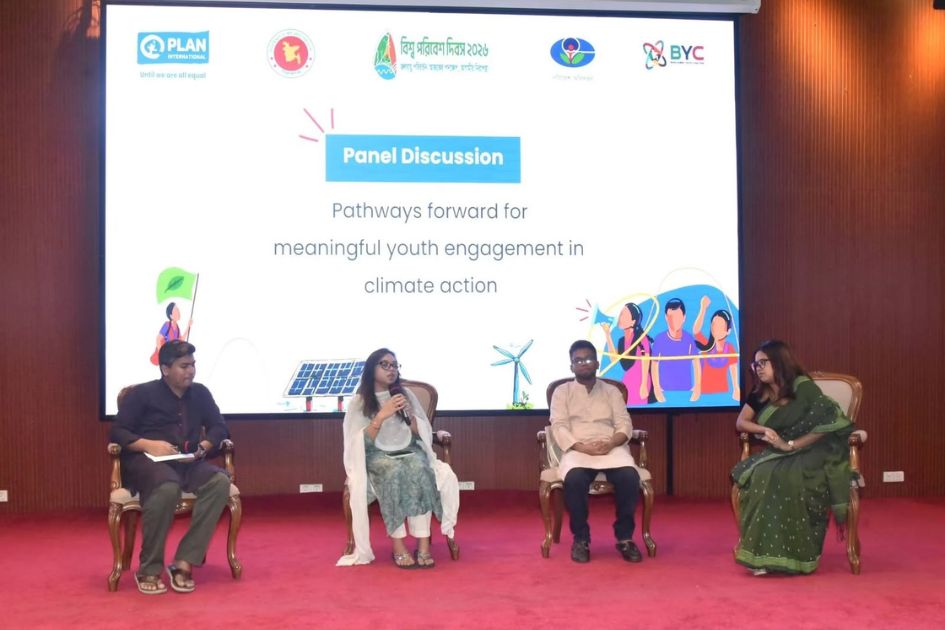
The panel discussion featured Mahmuda Akhter, Co-Coordinator, Climate and Resilience at Plan International Bangladesh; Farah Anjum, Lead at the Global Strategic Communications Council (GSCC); Sohanur Rahman, Executive Coordinator of YouthNet Global; and Dr. Md. Golam Rabbani, Director of the Center for Climate Change and Environmental Research (C3ER) at BRAC University.
Panelists observed that although youth participation in climate movements has reached unprecedented levels globally, young people are still frequently limited to symbolic representation rather than being included in institutional decision-making processes.
They called for stronger mechanisms that enable youth to participate throughout the entire climate action cycle, including policy development, program design, implementation, monitoring and evaluation.
“Meaningful youth engagement requires moving beyond symbolic presence. Young people must be recognized as implementation partners and decision-makers in climate governance, with access to resources, institutional support and financing for youth-led climate solutions,” Sohanur Rahman said.
Sohanur Rahman emphasized the need to establish institutional pathways that allow grassroots youth climate leaders to contribute directly to policy processes and local adaptation strategies. He also called for greater investment and financing mechanisms to support youth-led climate initiatives.
He noted that frontline communities and youth-led organizations should be placed at the center of climate implementation to ensure solutions respond to realities on the ground.
Connecting Climate Science with Community Action
The seminar highlighted the importance of evidence-based policymaking, scientific research, strategic communication and innovation in addressing the climate crisis.
Panelists emphasized the need for stronger collaboration among universities, government institutions, development organizations and youth groups to bridge research gaps and improve locally relevant adaptation solutions.
Dr. Md. Lutfor Rahman stressed the importance of data-driven policies, research and innovation to strengthen Bangladesh’s climate response and environmental management.
Strategic communication emerged as another key priority, with experts highlighting the role of digital platforms in transforming climate awareness into public engagement, advocacy and stronger policy action.
The seminar also featured youth-led initiatives on renewable energy, climate education, locally led adaptation and digital technologies for environmental monitoring, showcasing how young people are contributing to practical climate solutions.
Investing in Youth-Led Green Solutions
Professor Dr. Abdus Salam highlighted the importance of stronger partnerships among educational institutions, development partners and youth organizations to advance sustainable environmental management.
He also called for greater investment in youth-led green enterprises, innovation and technical capacity building to support a just and sustainable transition.
Plan International Bangladesh Country Director Kabita Bose, in her welcome remarks, said adolescent girls and young people are among those most affected by climate change but also have enormous potential to lead transformative solutions.
“Investing in their leadership and ensuring their participation in climate planning and local-level action is the need of the hour,” she said.
Participants also highlighted the importance of addressing gender inequalities in climate action, recognizing that climate impacts often deepen existing vulnerabilities faced by girls and young women. They called for gender-responsive policies and greater investment in women- and youth-led climate solutions.
A Global Call for Inclusive Climate Governance
The discussions reflected a broader global conversation on climate justice, where vulnerable countries are advocating for inclusive decision-making, equitable access to climate finance and stronger recognition of frontline communities and youth voices.
Participants emphasized that Bangladesh’s climate experience demonstrates the importance of a whole-of-society approach, bringing together government, communities, civil society, the private sector, research institutions and youth leaders.
As Bangladesh advances its long-term climate strategies, empowering youth leadership will be essential for achieving a just, green and sustainable future. The country’s experience also offers lessons for climate-vulnerable communities worldwide seeking to strengthen resilience through inclusive governance and locally led action.
Participants agreed that empowering young people as climate leaders is essential for achieving a just transition and building resilient societies. They emphasized that Bangladesh’s experience demonstrates how youth leadership, community knowledge and institutional collaboration can contribute to global efforts to address the climate crisis.
The seminar concluded with a collective commitment from government representatives, development partners, academic institutions, civil society organizations and youth leaders to strengthen girls’ and youth leadership in climate action, expand their role in policymaking and work together toward a climate-resilient and sustainable Bangladesh.




