




As the Ganges treaty nears expiry, Bangladesh seeks a fair, climate-resilient deal with India, making water sharing a defining test of renewed bilateral trust and regional cooperation.
Bangladesh seeks a revised agreement that reflects present-day climate and hydrological realities, noting that fairness and climate resilience must guide any future framework.
A critical river treaty affecting millions in Bangladesh’s drought-prone southwest is entering a decisive phase as political shifts and renewed Dhaka-Delhi engagement reshape negotiations over transboundary water sharing and regional cooperation.
The 30-year Ganges Water Sharing Treaty, which governs dry-season water distribution at the Farakka Barrage, is set to expire in December 2026, placing one of South Asia’s most sensitive water agreements under renewed diplomatic and environmental scrutiny.
The development comes amid broader political transition in Bangladesh, evolving India-Bangladesh engagement and renewed focus on restoring trust after a period of strained relations.
Political reset in Dhaka-Delhi ties
The treaty was signed in 1996 when the Awami League was in power in Bangladesh. Following the July 2024 mass uprising and subsequent political changes, relations between Dhaka and New Delhi reportedly cooled during the interim administration period.
After the BNP came to power through elections in February 2026, both sides have signalled gradual normalization of bilateral ties.
Foreign Minister Khalilur Rahman said restoring people-to-people connectivity is essential for rebuilding trust between the two countries.
He said visa restrictions imposed over the past one and a half years had significantly disrupted mobility, particularly affecting medical patients and business travellers.
“Blocking movement between two countries disrupts trust building and mutual understanding,” he told reporters in New Delhi.
Bangladesh restored visa services for Indian citizens within days of the new government taking office and Dhaka expects reciprocal easing from India in the coming weeks, especially for critically ill patients and essential business travel.
Water sharing as a defining test
Khalilur Rahman described the upcoming negotiation on the Ganges as the first major test of whether Bangladesh and India can rebuild their relationship on a foundation of fairness and climate resilience.
Speaking in an interview with India’s NDTV, he said the proposed renewed agreement would be a key benchmark in the evolving bilateral relationship.
The interview was broadcast on Saturday. He gave the interview during a visit from Mauritius after travelling from New Delhi, where he held high-level meetings with senior Indian officials.
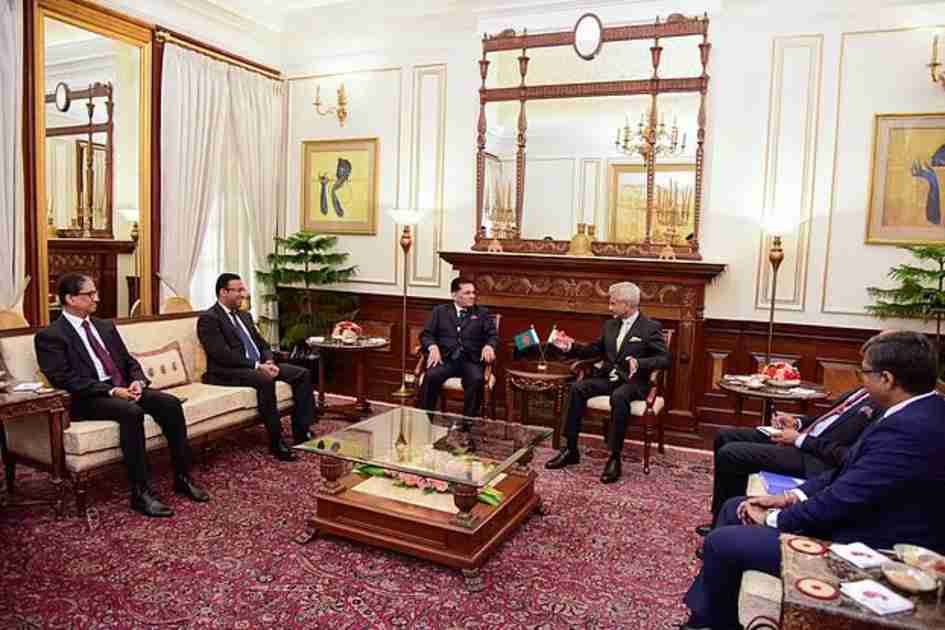
During his April 7 and 8 visit to India, he met Indian External Affairs Minister S. Jaishankar, National Security Advisor Ajit Doval and Petroleum and Natural Gas Minister Hardeep Singh Puri.
He later attended the Indian Ocean Conference in Port Louis, Mauritius, organized by the India Foundation on April 9 and 10.
He stressed that water availability in the Ganges basin is directly linked to Bangladesh’s agriculture, livelihoods and food security.
“Our entire civilization and livelihood depend on its availability,” he said.
He further said the upcoming agreement would be the “first test” of the broader process of rebuilding bilateral relations.
Structural concerns and environmental stress
Water experts say long-standing structural imbalances in upstream flow regulation have shaped outcomes under the existing arrangement.
Reduced dry-season flows continue to affect irrigation, fisheries and freshwater availability in Bangladesh, while salinity intrusion in coastal areas has intensified environmental stress.
Experts also point to limited ecological safeguards and uneven monitoring systems as key weaknesses in the current framework.
These issues reflect not only technical gaps but deeper structural challenges in transboundary water governance.
Push for adaptive treaty framework
Experts recommend that any renewed agreement should move toward an adaptive governance model.
Key proposals include legally binding minimum flow guarantees, climate-responsive allocation mechanisms, periodic review clauses and emergency provisions for droughts and floods to address increasing hydrological uncertainty.
They also emphasize the need for a joint monitoring system at Farakka with real-time data sharing and equal participation from both sides, potentially supported by neutral technical institutions to strengthen transparency and trust.
Environmental flow requirements are increasingly seen as essential in modern river governance frameworks.
Analysts argue that Bangladesh’s negotiating position would be strengthened by a broader basin-based approach that includes other shared rivers such as the Teesta River, Dharla River, Dudhkumar River, Manu River and the Muhuri River.
Such a strategy could improve leverage while promoting more comprehensive and sustainable river governance.
High stakes negotiation ahead
Analysts say Bangladesh’s approach should be grounded in international water law principles, climate cooperation and broader regional engagement.
They emphasize that water sharing should be framed not as a zero-sum contest but as a shared challenge requiring cooperation and adaptation.
At the same time, they warn that failure to secure a meaningful renewal could create a legal and political vacuum, increasing the risk of unilateral actions and weakening regional river governance.
Such an outcome could deepen environmental stress, undermine livelihoods and affect long-term national resilience.
As negotiations approach, the renewal of the Ganges Water Sharing Treaty is increasingly viewed as a defining moment for South Asian water diplomacy.
For Bangladesh, it represents both a technical negotiation and a broader test of diplomatic resilience, climate preparedness and regional balance.
The outcome is expected to shape not only water distribution but also the broader trajectory of Dhaka-Delhi relations in a rapidly evolving geopolitical and climate landscape.
Youth climate leader and Executive Coordinator of YouthNet Global, Sohanur Rahman, said the moment carries wider implications beyond diplomacy.
“This is not just a water negotiation. It is about climate justice, regional equity and the survival of a vulnerable delta. The decisions taken in 2026 will define resilience for generations,” he said.




