

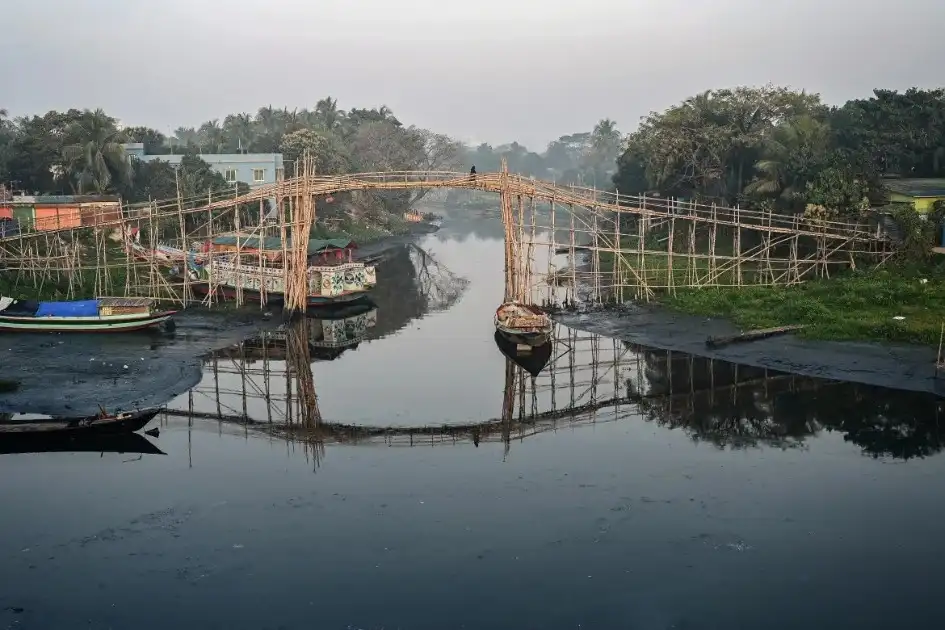

Once Dhaka’s lifeline, the Buriganga River now runs black with industrial waste, toxic sludge, and human neglect. Choked by pollution and encroachment, it mirrors a nation’s governance failure, where profit drowns accountability and the poor bear the cost of a dying river.
Reading about the Buriganga feels like watching the deliberate killing of a river and pretending it’s normal. Once the lifeline of Dhaka, the Buriganga carried people, goods and fish, even serving as a source of drinking water. Today, its water runs thick and black, emitting a foul stench year-round. River workers now refer to it bluntly as “dead.” During the dry season, oxygen levels drop so low that fish cannot survive. Scientific data back this up: the Buriganga’s Biological Oxygen Demand (BOD) averages 82.3 mg/L, sometimes soaring as high as 109–163 mg/L, far beyond the 1–8 mg/L considered normal for a healthy river. It even exceeds acceptable irrigation and drinking water limits (IJCJ, 2023).
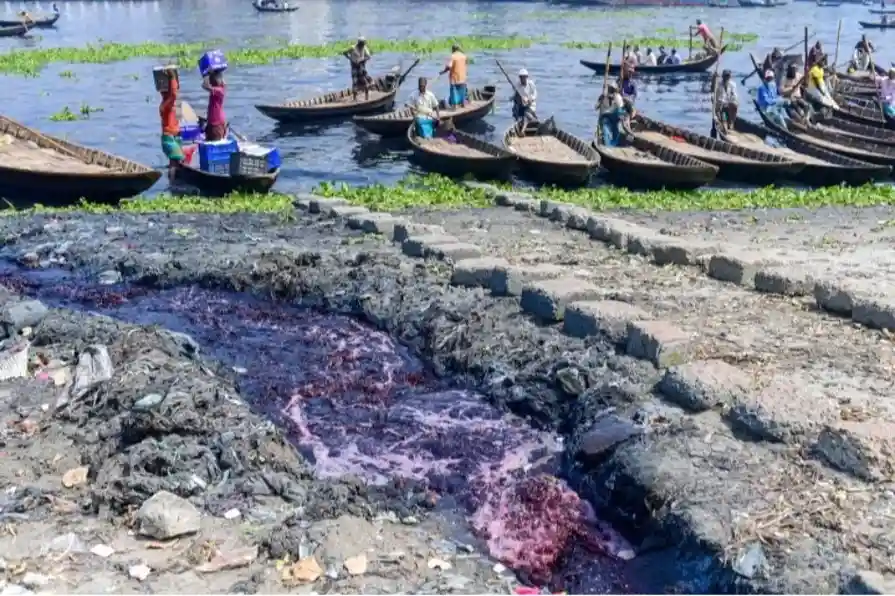
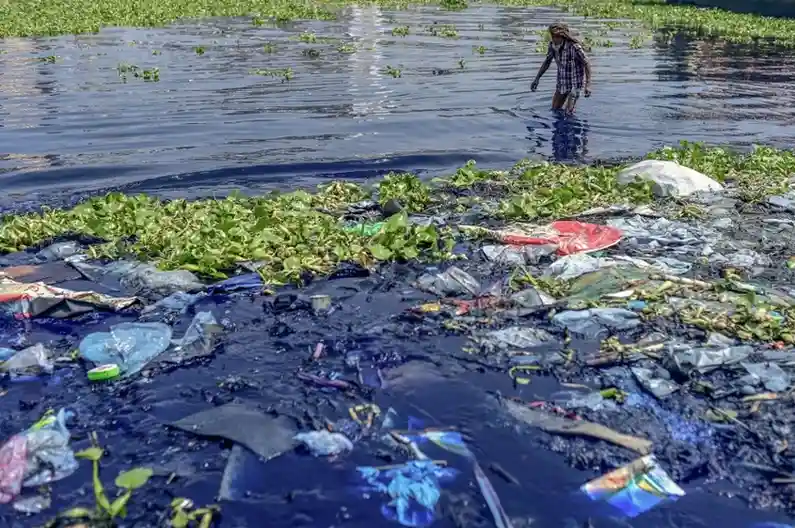
This is no accident of nature. Every single day, huge volumes of untreated industrial waste, chemical dyes, human sewage and plastic trash pour into the Buriganga and its feeder canals (EcoHubMap, 2024).
According to the Ministry of Environment, tanneries alone discharge over 21,000 cubic meters of toxic waste daily. On top of that, Dhaka’s residents dump about 4,500 tonnes of solid waste into the river each day. Add to this the sewage lines that drain directly into the river and the dye-stained wastewater from textile factories and the result is industrial abuse on a scale that dwarfs individual littering.
The burden, however, does not fall on factory owners or the city’s wealthy neighborhoods. It falls on the poor families who live and work along the riverbank, people with no other place to go. Ferrymen, boat-dwellers and day laborers live on boats that double as their homes, kitchens, and bathrooms. Many report skin diseases like scabies and burning eyes from bathing in the contaminated water yet they have no alternative source of clean water (Hossain, 2023).
The crisis is not only ecological but economic. A 70-year-old former fisherman recalled that just two decades ago, the Buriganga teemed with fish that sustained his family. Now, he can’t find a single catch and sells snacks by the riverside to survive. His story embodies how environmental destruction silently transforms into economic ruin for the poor, with no compensation, no justice just quiet loss.
Meanwhile, the river is being physically strangled. Sections of it have been illegally occupied by influential people who built concrete structures within the river channel and claimed the land. Once wide and flowing, many parts are now narrow, shallow streams clogged with plastic, silt, and encroachments. Authorities frequently announce eviction drives and mark river boundaries with pillars, only to see the same structures reappear. Encroachers often brandish “old documents” to justify what is essentially the theft of a public river (EcoHubMap, 2024).
A clear pattern emerges: the Buriganga suffers because it belongs to “everyone,” which in practice means it belongs to no one. Factories have been legally required to maintain effluent treatment plants (ETPs) since the 1990s to clean toxic water before discharge (Hossain, 2023). Government officials insist they inspect regularly, and industry groups claim full compliance with international standards. But the river’s reality still running with colored dye water and untreated sewage exposes these statements as hollow. Even officials acknowledge they lack sufficient staff for round-the-clock monitoring, and many factories exploit that gap by dumping waste at night or through hidden drains (Hossain, 2023; EcoHubMap, 2024).
This is not merely an environmental tragedy it is a collapse of governance. Enforcement exists mostly on paper. In practice, it weakens in the field and vanishes entirely when powerful interests are involved. The same pattern applies to both industrial pollution and illegal river occupation.
It is also a public health emergency hiding in plain sight. Nearly four million Dhaka residents are exposed daily to the toxic effects of Buriganga’s pollution. In slum communities along the banks, people report fever, stomach ailments, respiratory issues, and chronic skin irritation (EcoHubMap, 2024). Yet their suffering remains invisible, treated as background noise by the rest of the city.
Despite everything, many still hold on to hope. Environmental activists have formed river patrols; city officials periodically announce plans to “reclaim” the river; and new pledges appear every few years relocate tanneries, build treatment plants, bring in cleaner water, remove illegal structures, and install river boundary pillars. But most of these initiatives are delayed, half-finished, or abandoned. Locals have heard “Save Buriganga” slogans for decades, yet the river remains black.
Ultimately, the Buriganga is not dying because we lack knowledge it’s dying because we refuse to act on what we already know. We know who the polluters are. We know which lands are grabbed. We know which agencies are responsible. But pollution yields profit now, while restoration benefits everyone later and in our system, “later” always loses.
The Buriganga is more than a river; it is a mirror of our collective failure. It reflects how Bangladesh treats its poor, its public resources, and its natural heritage. If the nation cannot save the river that runs through its capital a river that shaped its history, economy, and identity then we must confront a painful question: who, exactly, are we planning to save this country for?




