

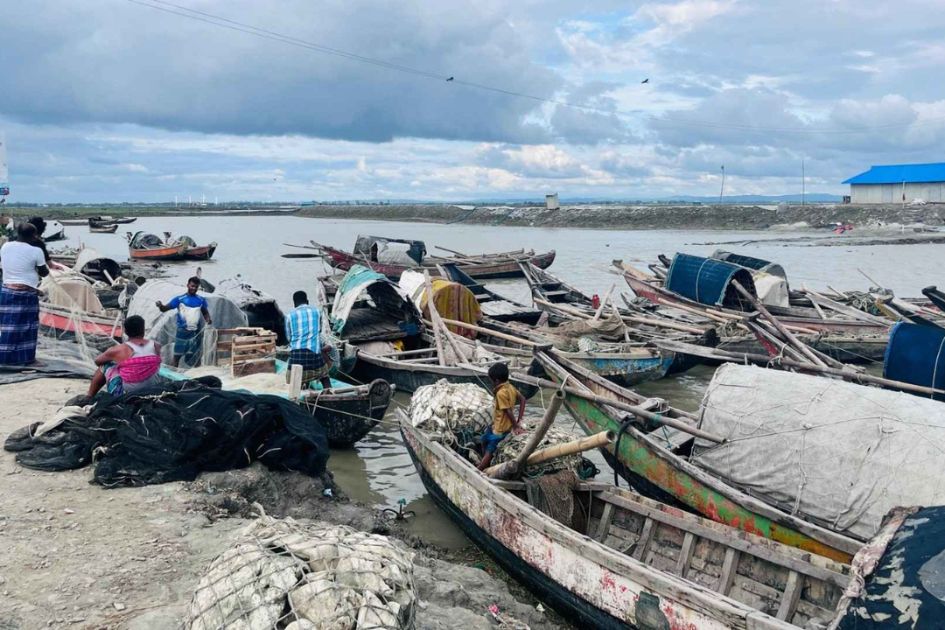



Bangladesh’s climate transition is reshaping livelihoods, as fishing bans, solar projects, and conservation policies converge, raising urgent questions about fairness, equity, and who bears the true cost of change.
As global conversations on just transition accelerate, a persistent gap remains between policy language and lived reality. From climate summits to national planning rooms, transition is often framed as technical and sectoral. But in Bangladesh, it is something far more immediate. It is about whether people can fish tomorrow, cultivate land next season or continue living on the rivers that have shaped their identity for generations.
Across coastal, riverine and wetland landscapes, climate action, energy expansion and conservation measures are unfolding at the same time. Each is justified on its own terms. Yet for communities on the ground, these processes are not separate. They converge into a single lived experience of shrinking access to land, water and ecosystems that sustain life.
The central question is no longer whether Bangladesh should transition. It already is. The question is who bears the cost and whether that cost is being distributed fairly.
A transition already underway, but unevenly experienced
In Bangladesh, fishing bans are enforced during breeding seasons to protect species like hilsa and ensure ecological sustainability. At the same time, solar parks, coal-based power infrastructure and large development projects are expanding across coastal and wetland zones.
These are often treated as distinct policy domains. But for small-scale fishers and farmers, they produce combined pressure. Access to rivers is shrinking, grazing land is disappearing and wetlands are increasingly regulated or converted. Whether framed as conservation or development, those most dependent on ecosystems are carrying a disproportionate share of transition costs.
This is not an argument against conservation or renewable energy. It is a call to confront a harder question. How do we design transitions that do not deepen inequality in the name of progress?
When support does not match reality
During the current 58-day fishing ban in Bangladesh, affected fisher households typically receive 80 kilograms of rice as one-time assistance. For families who can earn around 1,000 taka or more per day during peak fishing seasons, this does not reflect real income loss. It reduces an entire livelihood system to symbolic relief.
In Sonagazi Upazila of Feni district, there are 1,997 registered fishers, yet only 275 households receive support. Many eligible families are excluded entirely or receive assistance after the ban has already begun, weakening its effectiveness.
Haradhan Jaldas, a small-scale fisher from Sonaigazi Sadar, describes the gap between policy and lived experience clearly:
“Before the ban, I could earn two to three thousand taka a day by selling fish. Now I have nothing.”
Despite being officially listed as a beneficiary, he has not received assistance in time. Like many others, he is pushed into survival strategies that undermine long-term ecosystem health, including the use of fine-mesh nets to catch shrimp fry in river systems.
Field research conducted by Coast Foundation (2024–2025) indicates that 30 to 35 percent of fishing households resort to illegal or destructive gear during ban periods due to income pressure. At the same time, 93 percent of fishers report limited awareness of the ecological damage caused by these practices.
This is not simply a behavioural issue. It is a structural contradiction produced by policy design that restricts access without providing viable alternatives.
Invisible communities in transition
Among the most overlooked groups in this changing landscape are the Manta fisherfolk, a floating community who live entirely on boats and depend exclusively on fishing. Their identity, mobility and livelihood are inseparable from water systems.
Yet declining fish stocks, pollution and restricted access are making their way of life increasingly fragile. Earlier this year, 200 fishing families received temporary food assistance. But the deeper question remains unresolved. What happens when that short-term support ends while vulnerability continues?
For many Manta families, the crisis is not only economic. It is cultural and generational. When fishing declines, knowledge systems, skills and identity also erode. Despite this, they remain largely outside formal social protection systems, leaving them exposed to seasonal bans and ecological shocks.
In any credible just transition framework, communities like the Manta cannot remain invisible.
When solar energy meets wetland ecosystems
In the Haor region of Moulvibazar, including villages such as Athangiri, Mokambari and Noapara, plans for solar expansion are underway, requiring changes in land classification and conversion of agricultural land within the Eastern Haor system.
These wetlands support thousands of farming and fishing households whose livelihoods depend on seasonal water flows. In earlier projects, around 100 acres of fertile land were converted for solar installations. Local communities were assured minimal disruption, yet significant agricultural loss has already occurred.
Now, further expansion raises serious concern. In a country with limited arable land and fragile wetland ecosystems, such trade-offs are not marginal. They are structural decisions shaping food security and rural resilience.
Double pressure in coastal ecosystems
In Patuakhali, Shyamnagar of Satkhira and Sarankhola of Bagerhat near the Sundarbans mangrove forest, communities are facing combined pressure from climate change and governance constraints. Rising salinity, cyclones and ecosystem degradation are reshaping fish availability and agricultural viability.
At the same time, stricter access rules, higher permit costs and reduced fishing windows are limiting livelihoods. Illegal shrimp fry collection continues, where juvenile fish are discarded while larvae are harvested using fine-mesh nets, further weakening marine ecosystems.
Here, environmental stress and policy restrictions reinforce each other. The result is not transition alone, but compounded vulnerability.
The global pattern behind local realities
These tensions mirror broader global debates observed in the 5th Global Dialogue on Just Transition in Yeosu, South Korea. Three recurring challenges stand out.
First, emission reduction versus food security, where land and water-based mitigation measures can restrict access to productive resources.
Second, conservation versus livelihoods, where protected areas and bans create immediate income shocks without adequate alternatives.
Third, efficiency versus equity, where technological gains often benefit larger actors first while small-scale producers are left behind.
Across contexts, one truth is becoming clearer. Climate action that ignores inequality risks undermining its own legitimacy.
What a just transition must include
A meaningful just transition in Bangladesh and beyond requires three shifts.
First, rights-based climate action, where access to food, land, water and participation is treated as central, not peripheral, to climate policy.
Second, climate-adaptive social protection that moves beyond short-term relief and provides predictable, adequate and inclusive support for those most exposed to transition impacts.
Third, locally led governance, where affected communities are not only consulted but have real decision-making power in shaping conservation, energy and infrastructure choices.
The question we must answer
Bangladesh’s experience reflects a wider global reality. Climate action, energy transition and infrastructure expansion are accelerating simultaneously. But insufficient attention is given to distributional impacts.
The challenge is not whether transition will happen. It already is. The challenge is whether it is designed with fairness at its core.
A transition can only be called just when those who are most affected are not the ones expected to carry the heaviest burden.
Ultimately, the measure of climate action is not only how fast emissions fall, but whether those living closest to rivers, forests and coasts are made more secure or more vulnerable in the process.




