

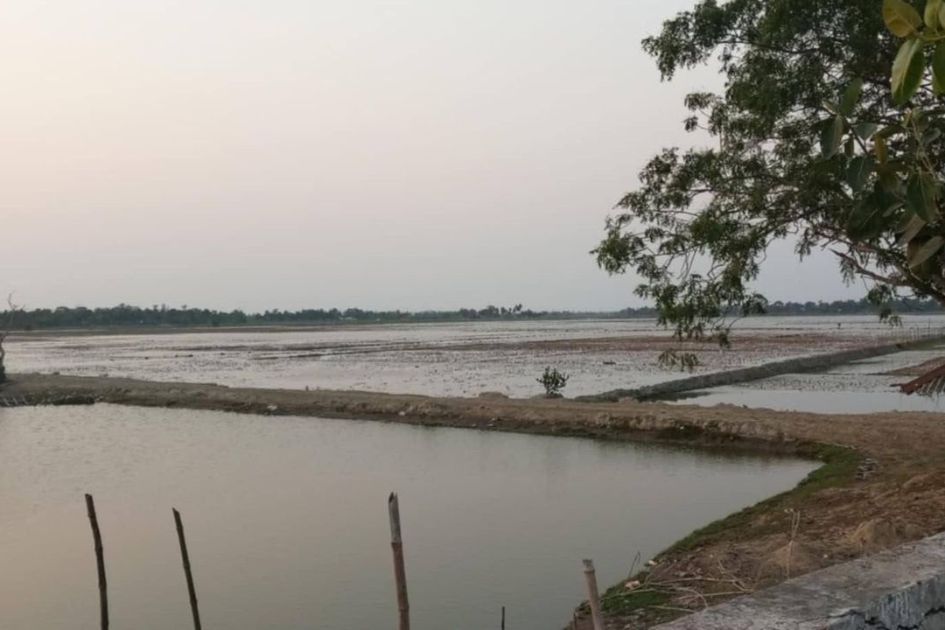



Thousands of acres in Satkhira have been inundated by saline water, destroying crops and freshwater sources, as authorities investigate suspected sabotage and experts warn of worsening climate vulnerability.
Thousands of acres of cropland in coastal Bangladesh have been inundated with saline water in what locals describe as a deliberate act of sabotage, raising serious concerns over environmental damage, food security and rural livelihoods.
The incident occurred in Assasuni upazila of Satkhira district, where sluice gates at the Kalki regulator were reportedly opened at night around two weeks ago. This allowed saline water from the Kopotaksha River to flow into surrounding low-lying areas, flooding nearly 10,000 bighas or over 3,300 acres of agricultural land across at least eight villages.
Crops and freshwater systems severely affected
Field observations indicate that villages including Gajuakati, Rautara, Goal Danga, Pirojpur, Khalia and Fatikkhali, along with parts of Boro Dal union, have been badly impacted. Large areas of standing Boro paddy, some yet to be harvested, are now submerged under saline water, raising fears of widespread crop failure.
“Our croplands and fish ponds have been filled with saltwater,” said Shib Prasad Mondal, a retired college teacher from Gajuakati. “We were expecting a good harvest this season, but now everything is at risk.”
Farmers say the intrusion has also triggered an acute shortage of freshwater for drinking, cooking and livestock. Grazing land and natural vegetation have been damaged, placing additional pressure on already vulnerable households.
Livelihoods and food security under threat
Local estimates suggest that thousands of farming families are facing immediate income loss. Experts warn that increased soil salinity could also undermine future cultivation, including the upcoming Aus rice season.
Union Parishad member Rampada Sana said significant portions of farmland remained unharvested when the saline water entered, amplifying the scale of losses. “Farmers had finally seen some hope after years of poor yields, but this incident may push them back into crisis,” he noted.
Investigation underway and governance concerns
Authorities have launched an investigation into the incident. Local representatives and community groups have raised concerns about weak monitoring and possible unauthorized interference in sluice gate management.
Officials from the Bangladesh Water Development Board have been informed. Upazila Executive Officer Shyama Nanda Kundu confirmed that a field inspection has already been conducted.
“We have instructed the relevant authorities to take immediate action. Those responsible will be identified through investigation and held accountable,” he said.
Climate vulnerability and expert reaction
Bangladesh’s coastal belt remains one of the most climate-vulnerable regions in the world, facing rising salinity, river erosion and increasingly frequent extreme weather events.
Sohanur Rahman, Executive Coordinator of YouthNet Global, said the incident reflects a deeper governance and climate justice challenge. “When water infrastructure becomes vulnerable to misuse or weak oversight, it is always the poorest and most climate-exposed communities who pay the highest price. This is not only an environmental issue, it is a question of justice, accountability and survival for coastal farmers,” he said.
Experts warn that such incidents, whether due to mismanagement or deliberate actions, can accelerate environmental degradation, disrupt fragile ecosystems and deepen poverty in already at-risk communities.
The situation in Assasuni underscores the urgent need for stronger governance, effective monitoring of water infrastructure and climate-resilient management systems to protect coastal agriculture and livelihoods.




