

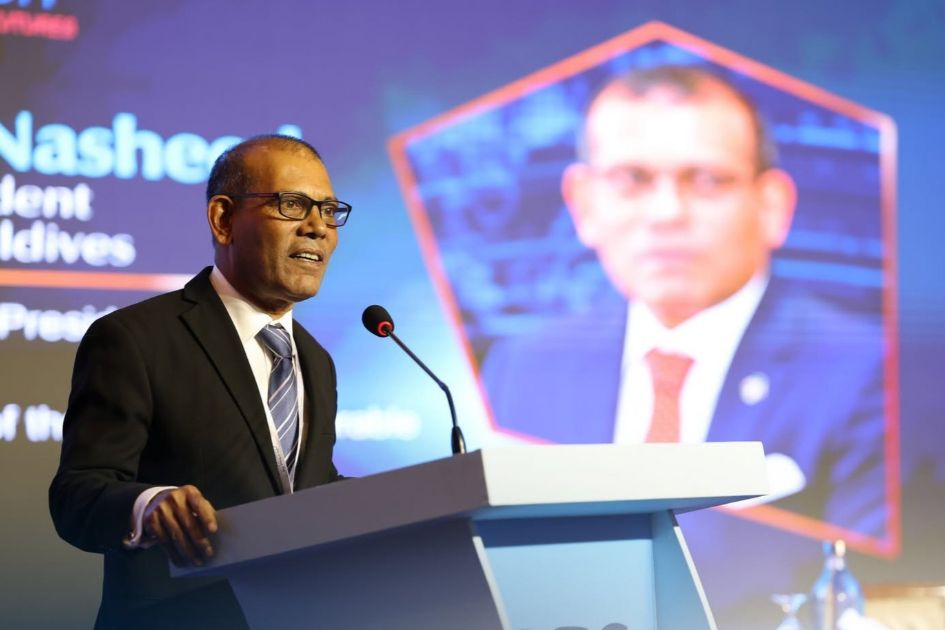



Former Maldives president Mohamed Nasheed urges fair climate payments and nature-based adaptation as rising debt limits vulnerable countries’ development options.
Twenty-five countries highly vulnerable to climate change are on the brink of bankruptcy under mounting debt, former Maldivian president Mohamed Nasheed said Monday, warning that the cost of adapting to a crisis they did little to cause is squeezing spending on basic services such as education and healthcare.
Nasheed made the remarks on the closing day of the three-day Bay of Bengal Conversation 2026 at the Sonargaon Hotel in the capital Dhaka. The conference was organised by the Centre for Governance Studies (CGS), a Bangladesh-based think tank.
He said the Maldives is spending around 30 percent of its national income each year to deal with the damaging effects of climate change, including the construction of barriers, efforts to prevent coastal erosion and rainwater storage infrastructure.
Yet the Maldives is not responsible for the problems it is being forced to address, Nasheed said. The cost of adaptation is pushing the country deeper into debt, with about 25 percent of its budget now going towards debt repayment, leaving less scope for spending on education, healthcare and other basic sectors.
Nasheed said climate change was not simply a matter of rising sea levels. Increasing ocean temperatures are destroying coral reefs, worsening coastal erosion and putting the islands at risk of disappearing.
The destruction of coral reefs is also disrupting the breeding of marine fish, directly affecting people’s livelihoods, he said.
Some countries became wealthy by using the world’s resources for their own interests, while others have been left to pay the price, Nasheed said.
People in Nepal had done nothing that could have caused devastating floods there, just as Maldivians had done nothing to cause sea levels to rise so sharply, he said.
“Therefore, somebody has to pay the price,” Nasheed said.
Climate-vulnerable countries are not seeking charity or grants, but a fair payment for the environmental services they provide to the world, he said.
“Protecting nature is not a cost, it is an investment,” Nasheed said.
Urging a greater focus on nature-based adaptation rather than concrete structures, he said restoring each metre of coral reef costs about $20 while planting mangroves costs $5. Building artificial barriers, by contrast, can cost thousands of dollars.
Technology and science should therefore be used to accelerate coral reef restoration efforts, he said.
Nasheed also warned that rising sea levels could eventually raise questions over countries’ geographical boundaries and economic zones.
He said maritime boundaries are determined on the basis of coastlines. If the Maldives’ coastline is submerged, questions will arise over what happens to its political boundaries and economic zones.
The Maldives has an economic zone extending about 200 nautical miles and rights to use resources up to 350 nautical miles, Nasheed said. Those rights could come under threat because of climate change.
He called on the international community to reconsider the United Nations Convention on the Law of the Sea (UNCLOS) in light of the threat.
Nasheed said many countries could see their territory threatened by climate change before the Maldives disappears.
This is therefore not a problem for any single country, he said, urging a new balance between development and the environment in the interests of survival.




