

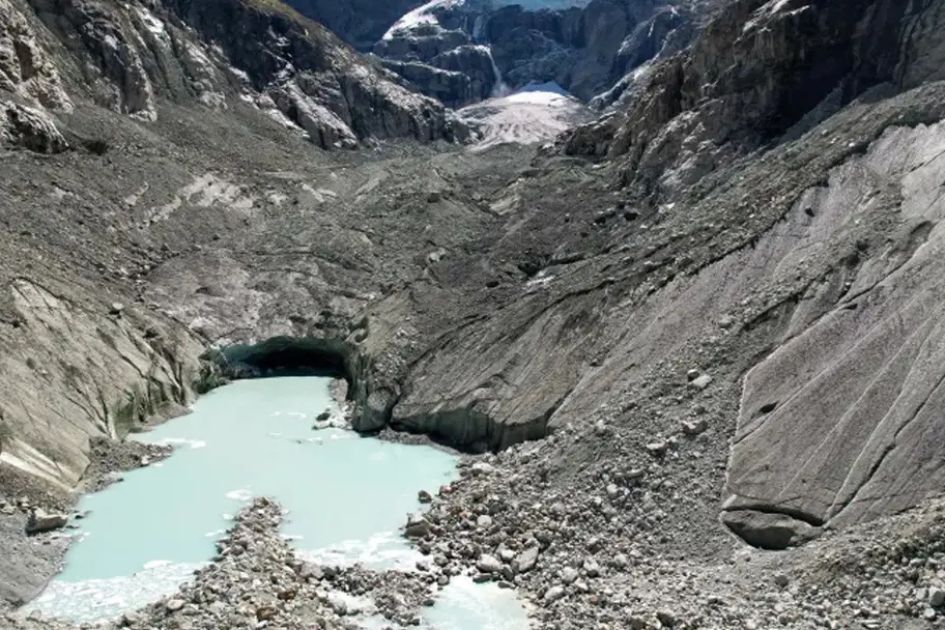



Record summer heat and inadequate winter snowfall are accelerating Alpine glacier retreat, threatening winter tourism, freshwater availability and hydropower as scientists warn that future losses depend on global emissions cuts.
Switzerland’s glaciers lost 5.5 percent of their ice volume in the hydrological year ending September 30, 2026, bringing total losses since 2021 to nearly 20 percent as record summer heat and inadequate winter snowfall accelerated melting, researchers said.
The findings were published by the Swiss Glacier Monitoring Network and the Swiss Commission for Cryosphere Observation, part of the Swiss Academy of Sciences.
The latest figures highlight the growing impact of global warming and human-induced climate change on the Alpine country’s glaciers, raising concerns about water supplies, hydropower production and winter tourism.
But why are Switzerland’s glaciers melting so rapidly, and how severe could the consequences be for the country?
What scientists found
In September, researchers from Glamos, the Swiss glacier monitoring network, visited 23 glaciers across Switzerland to measure ice loss at the end of summer and assess how much snow had accumulated.
Matthias Huss, head of Glamos and one of the report’s researchers, described the findings from the Tsess Ruj glacier in the western Swiss Alps to Reuters.
In July, the team had driven a measuring pole about four metres (13 feet) into the ice to establish a fixed reference point. When researchers returned in early September, only three metres (10 feet) of the pole remained visible above the ice.
This indicated that around three metres of ice had melted at an altitude of approximately 3,000 metres during August and September alone, excluding the heatwaves in June and July.
Huss said the measurements clearly demonstrated how unsuitable the prevailing weather conditions had become for Switzerland’s smaller mountains.
Why are glaciers melting so quickly?
According to the report, the average overall thickness of individual Swiss glaciers fell by between 2.5 and four metres in 2026. At some glacier termini, where ice extends from land into bodies of water, the reduction reached as much as 10 metres.
Huss told Al Jazeera that Switzerland had experienced its hottest summer on record. Below-average snowfall during winter had left glaciers without a sufficient protective snow layer when warmer weather arrived.
He identified global warming and human-induced climate change as the main drivers of the extensive ice loss.
Measurements from the team’s poles showed that melting was affecting glaciers across Switzerland, although the effects were particularly pronounced among smaller glaciers.
Small glaciers are shrinking rapidly, with some disappearing entirely, Huss said. Larger glaciers have also lost substantial amounts of ice but remain visibly vast.
Scientists warned that glaciers lost around 2.2 trillion litres of water between July and September alone. According to the report, this volume is more than four times the amount of drinking water used by all Swiss households over an entire year, potentially affecting the country’s future water supplies.
How will Switzerland be affected?
Switzerland’s identity and economy depend heavily on Alpine tourism and winter sports. The tourism sector accounts for approximately four percent of the country’s total employment.
Huss said the consequences extended beyond tourism, fundamentally changing the appearance of the mountains. Once covered in white snow and ice, mountain landscapes are gradually turning grey and black.
Glaciers also play a crucial role in supporting the economy through their contribution to water resources.
Huss said water was stored in hydropower reservoirs to generate clean electricity, while helping maintain flows in major European rivers. The continued presence of glaciers had made this possible, he said, but the benefits would not last indefinitely.
Harry Zekollari, a glaciologist and associate research professor in the Department of Water and Climate at Vrije Universiteit Brussel, expressed similar concerns.
Glaciers are important natural sources of water, particularly during hot and dry summer periods, he said.
Climate change initially causes glaciers to melt faster, increasing water supplies. But as the ice disappears, less remains available to melt, gradually reducing the amount of water released during summer.
Zekollari said European Alpine glaciers had already passed this peak in water availability, meaning river flows would continue to decline in the coming years.
He also warned that glacier loss could trigger natural disasters. Meltwater eventually flowing into the oceans could have wider consequences for coastal regions around the world.
Can the ice loss be prevented?
Climate scientists say it is still possible to preserve some of the remaining mountain ice, but doing so requires rapid action to limit the rise in global temperatures.
Zekollari said that if the world stopped carbon emissions now, approximately one-third of the ice in glaciers across the European Alps and Switzerland could be saved.
However, if global warming continues at its current pace, more than 90 percent of these glaciers’ ice could be lost permanently by 2100.
Glaciers in other parts of the world are somewhat more resilient, but the global outlook remains concerning.
Even if emissions are controlled, the world could lose 25 percent of its glaciers by the end of the century. Without effective emissions controls, losses could reach 50 percent.
The scientist warned that glacier retreat would continue over the longer term, even beyond 2100. The amount of ice that survives will depend on how successfully future temperature increases are limited.
Even a rise of 0.1 degrees Celsius in global temperatures could make a significant difference to how much glacier ice remains, he said.




