




Authorities say restoring tidal flows and strengthening forest protection will be central to saving Sonadia’s damaged mangroves after years of illegal shrimp farming.
Bangladesh’s navy will help evict illegal shrimp farms built by cutting mangrove forest on Sonadia island in Maheshkhali upazila of Cox’s Bazar district, after the prime minister approved a proposal from the Ministry of Environment, Forest and Climate Change.
The proposal, sent by the ministry to the Prime Minister’s Office, was approved on August 3.
Forest experts say tidal flows through countless small canals sustain mangrove ecosystems. When embankments block the mouths of those canals, the forest loses vitality and dries up. Encroachers then cut the forest, surround areas with embankments and use them for shrimp farming. Restoring the flow of tides is therefore essential to revive the mangrove forest, they say.
The navy is being brought into the effort under a project titled “Strengthening Capacity of MoEFCC, DoE and BFD for Natural Resource Management and Improved Climate Resilience.”
Fahmida Khanom, secretary of the Ministry of Environment, Forest and Climate Change, told that the prime minister had agreed to involve the navy in evicting illegal encroachers from Sonadia island.
“The navy is also ready to provide support,” she said. “All-out efforts will be made to free the island from encroachment and restore biodiversity.”
In 2006, the government declared Sonadia island an ecologically critical area, or ECA, because of its environmental importance. In an ECA, all activities that damage soil, water, air or other environmental components are prohibited.
In 2017, the Awami League government allocated 9,466.93 acres of Sonadia forestland to the Bangladesh Economic Zones Authority, known as BEZA, for 1,001 taka to establish an ecotourism park. As a result, the Forest Department lost legal authority to protect the mangrove forest.
After BEZA took possession of the land, no ecotourism activities were undertaken there. Once the Forest Department lost its legal authority, the scale and intensity of encroachment on Sonadia’s mangrove forest increased. The department estimates that at least 7,000 acres of mangrove forest have been cut down.
Considering the overall situation, the government decided in March 2025 to return 9,466 acres of Sonadia forestland to the Forest Department. So far, around 8,045 acres of forestland in three mouzas of Sonadia island have been returned to the department. BEZA still holds 12,270 acres of forestland in six mouzas on the island.
The project to evict illegal shrimp farms and restore biodiversity on Sonadia island was taken up during the interim government.
Fahmida Haque Khan, joint secretary at the environment ministry and project director of the “Strengthening Capacity of MoEFCC, DoE and BFD for Natural Resource Management and Improved Climate Resilience” project, told that the prime minister’s approval is required for any initiative involving the armed forces.
“We received that approval in August,” she said. “There is a meeting this month involving the Armed Forces Division, the navy and the environment ministry. A decision will be made there on the action plan for the eviction drive. The navy may need around 40 million taka for this operation. But under the project, we have an allocation of 20 million taka for eviction. We hope to reach a decision on this at the meeting.”
In 2025, the Maheshkhali upazila administration identified 45 kilometres of embankments in a survey and sought an allocation of 42 million taka from the government to remove them. The same year, the upazila administration evicted 11 illegal shrimp farms.
Mohammad Alamgir Kabir, general secretary of the Bangladesh Poribesh Andolon, an environmental rights group also known as BAPA, told that there had been token eviction drives in Sonadia before.
“It is good news that the government is planning an all-out eviction drive this time by involving the navy,” he said. “We have to see what steps the relevant ministry takes to restore biodiversity across the entire island after the eviction. At the same time, there must be strong monitoring to ensure that illegal shrimp farms cannot be set up again on the island.”
A 20-minute speedboat ride across the Bay of Bengal from ghat No. 6 on the Bakkhali River in Cox’s Bazar brings the eastern part of Sonadia island’s mangrove forest into view.
The Sonadia canal cuts through the mangroves. Rows of bain trees stand on both sides of the canal, while several small channels branch off into the forest. The mouths of those channels have been blocked with embankments.
From one such embankment, the destruction inside the forest is visible. It looks as if thousands of trees have been executed. Across the mangrove forest, thousands of tree stumps stand as witnesses to the devastation.
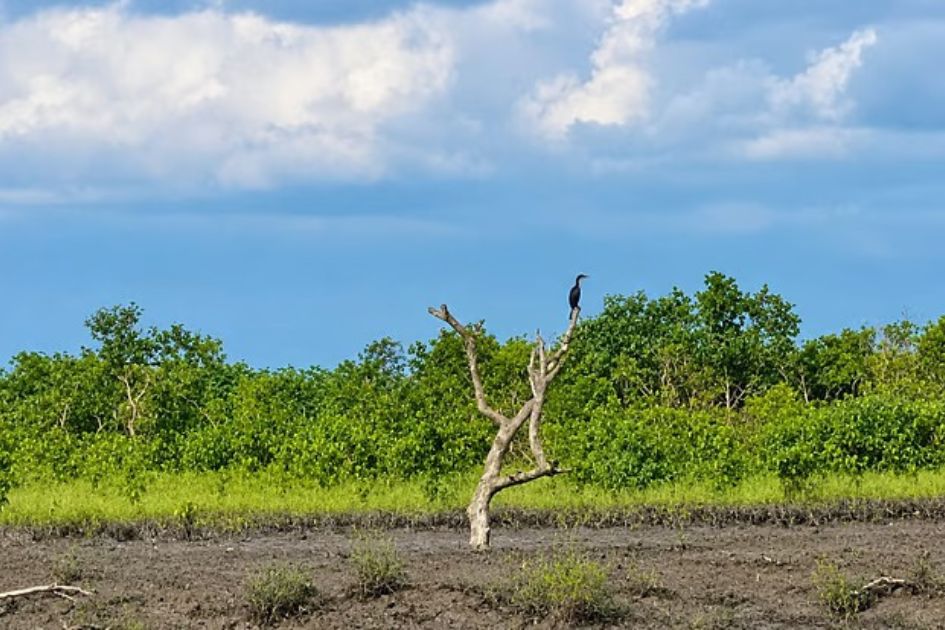
At noon on September 16, a cormorant sat on the stump of a felled tree, appearing bewildered after losing its familiar habitat. As far as the eye could see, forest trees had been cut down and the land converted into shrimp farms. Such scenes are scattered across the island.
Sonadia is a ward of Kutubjom union in Maheshkhali upazila. The Forest Department has a field-level office there.
Speaking at the office on September 16, beat officer Alauddin Al Azad told that forest staff come under attack when they try to stop encroachment.
“Our colleagues were injured in such an attack during Ramadan last year,” he said. “Only six of us work at this beat office. Hundreds of people come together to occupy the mangrove forest. We do not have the manpower to resist them.”
Aminul Hoque, acting president of BAPA’s Maheshkhali upazila unit, told that evicting encroachers alone would not be enough.
“To protect Sonadia island, the Forest Department must be strengthened by increasing manpower,” he said.
Source: The Prothom Alo




