





The ACC says a deeper inquiry is under way after preliminary findings of negligence in the World Bank-financed SUFAL programme. Its records identify an apparent 350-hectare plantation gap in Ramu; the World Bank says satellite checks cut the reported national restoration figure by 11,529 hectares but cannot address the Ramu sites because it has not seen the ACC report.
On paper, the plantation existed. Money had been allocated; hundreds of hectares had been earmarked for planting and government signboards marked project sites.
Across Bangladesh, the World Bank-backed programme ultimately reported that 92,431 hectares had been restored or reforested. But what investigators found in Joarianala Beat in Ramu, Cox’s Bazar, told a different story.
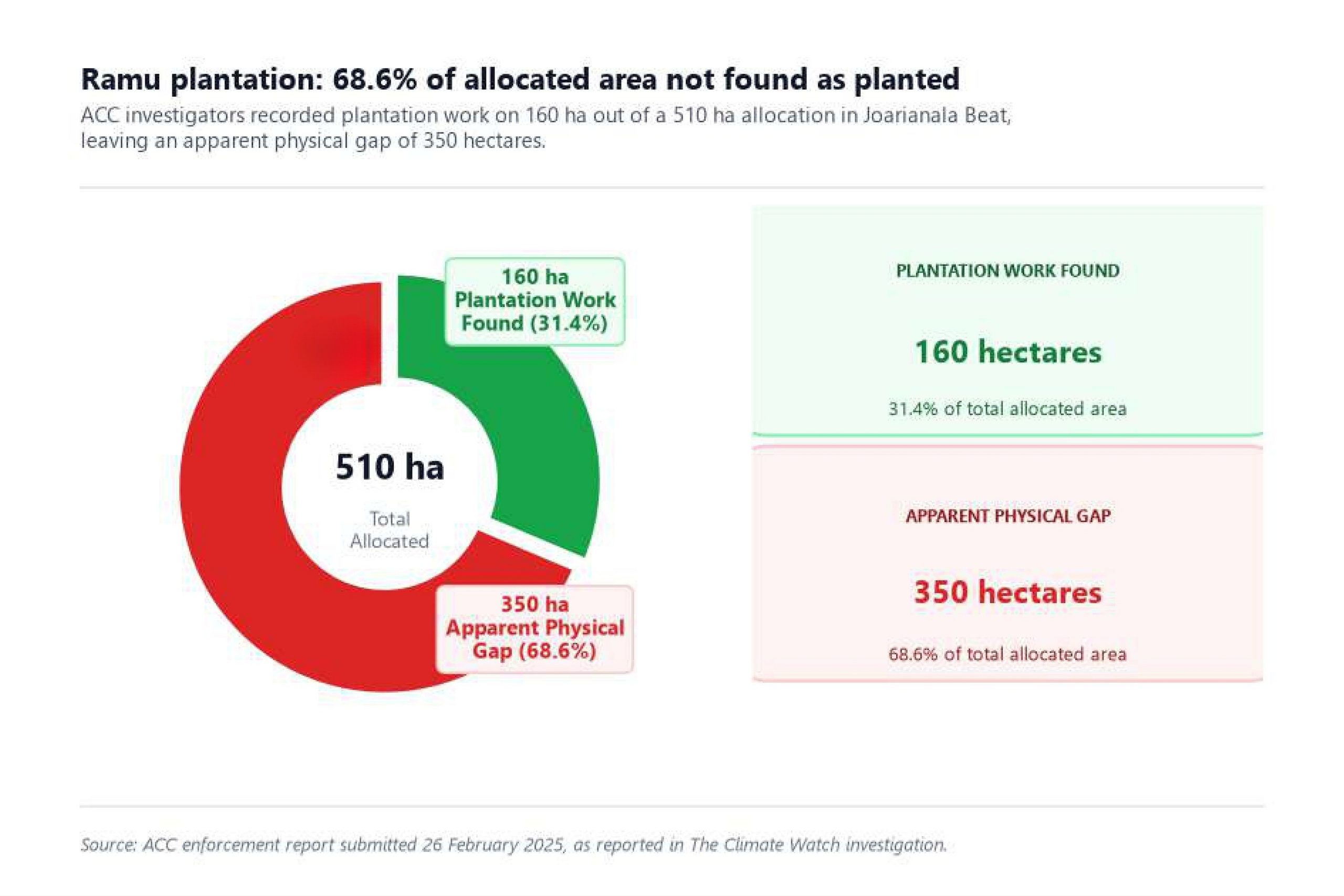
For the 2022-23 financial year, funds were allocated to establish new plantations across 510 hectares of forestland. Investigators from Bangladesh’s Anti-Corruption Commission reported finding plantation work on only 160 hectares.
That indicated an apparent plantation gap of 350 hectares, equivalent to 68.6 per cent of the allocated area. In other words, investigators reported finding plantations on fewer than one in every three hectares earmarked for the work.
At some designated sites, investigators said they found no plantation. Elsewhere, only scattered saplings appeared along boundaries. Government signboards reportedly stood on land where trees were absent, while many planted saplings had died because of inadequate maintenance.
The findings have raised a broader question over one of Bangladesh’s flagships internationally financed forest restoration programmes: Was the Ramu discrepancy an isolated implementation failure or evidence of wider weaknesses in plantation reporting, verification and maintenance?
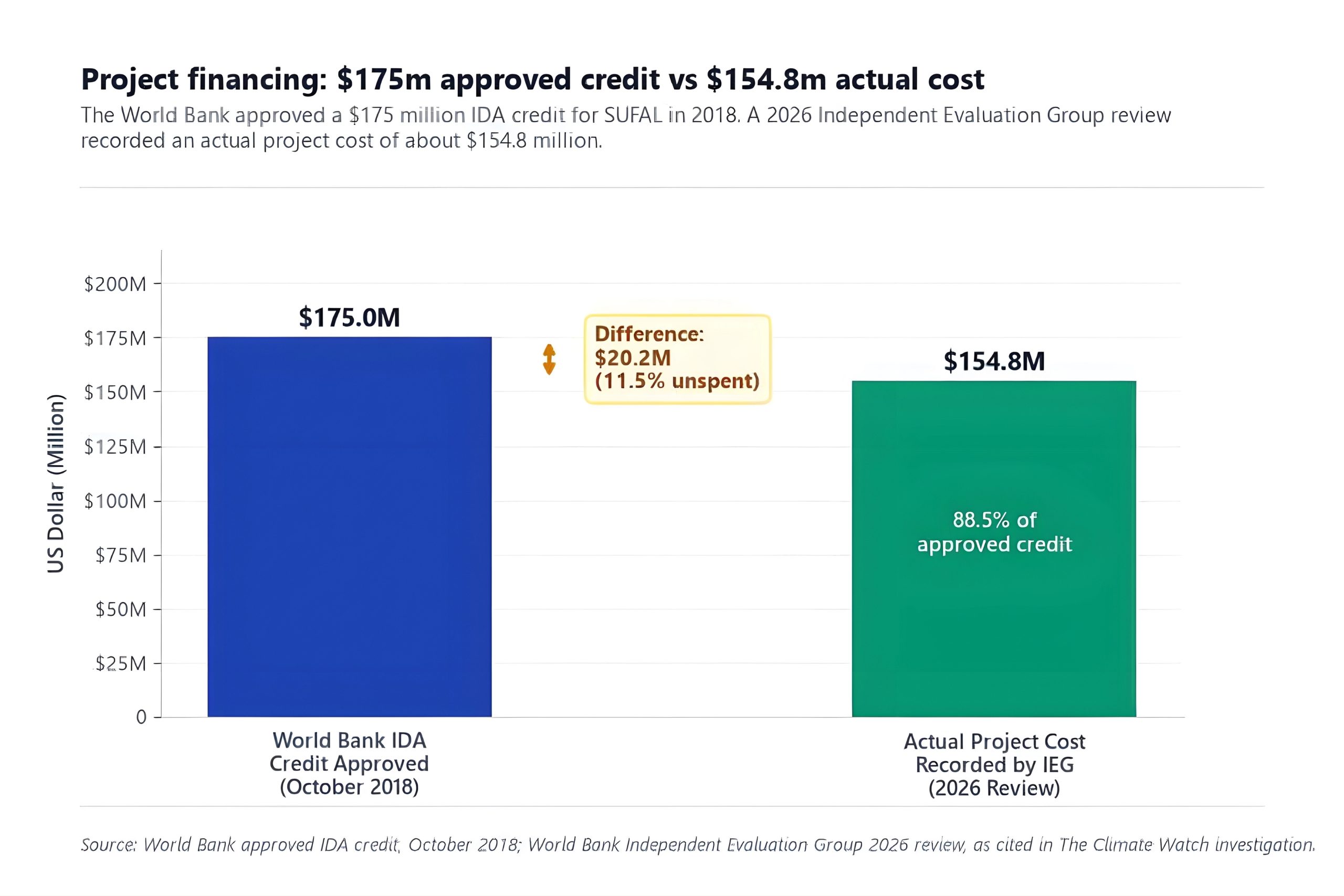
The Sustainable Forests and Livelihoods Project, known as SUFAL, was financed through a $175 million credit approved in 2018 by the World Bank’s International Development Association. The World Bank has not confirmed whether the Ramu schemes were included in the final project-wide restoration figure.
The ACC says it is now conducting a deeper investigation after finding preliminary evidence of negligence by senior project officials. Its records also identify suspected failures in plantation delivery and alleged corruption in staff postings.
Two ACC documents reviewed for this report trace the inquiry’s development. The first, an enforcement report following an operation at the Forest Department headquarters in Dhaka on 24 February 2025, recorded apparent irregularities in plantation work, financial accountability and staff transfers. A subsequent records-demand letter sought posting orders, transfer histories and personnel information from forest ranges and check stations across Chattogram, Cox’s Bazar, Bandarban, Rangamati, Khagrachari, Cumilla, Dhaka, Tangail and Mymensingh.
The latter document identifies the subjects of the inquiry as former environment, forest and climate change minister Md Shahab Uddin; his son, Zakir Hossain Jumon; then chief conservator of forests Md Amir Hossain Chowdhury; and others. It says the ACC was examining allegations of a posting trade, an organised syndicate, embezzlement of public funds and the accumulation of illegal wealth.
The allegations remain under investigation. The records reviewed for this report are not a charge sheet or a court verdict, and they do not establish the criminal liability of any individual.
Together, however, they raise a deeper governance question: whether weaknesses in field verification and control over personnel assignments allowed public and development funds intended to restore forests to be diverted or spent without the promised trees being established and maintained.
A plantation gap in Ramu
The most concrete discrepancy identified in the enforcement report concerns Joarianala Beat in Ramu upazila of Cox’s Bazar.
For the 2022-23 financial year, the report says funds were allocated to establish new plantations across 510 hectares of forestland. ACC investigators found plantation work on only 160 hectares.
That leaves an apparent gap of 350 hectares, or 68.6 per cent of the allocated area. Put another way, investigators found evidence of planting on less than one-third of the land covered by the allocation.

The report also refers to a further 362-hectare plantation programme in the 2023-24 financial year and says irregularities were alleged there as well, although it does not specify how many hectares were actually planted.
Taken together, the two annual programmes covered 872 hectares of planned nursery and plantation work. The ACC report says no plantation was found in substantial parts of the designated areas. In some places, investigators found only limited saplings marking boundaries. Elsewhere, government signboards reportedly stood on sites where there were no trees, while many planted saplings had died because of inadequate maintenance.
Those observations are important because plantation performance cannot be measured simply by showing that seedlings were purchased or placed in the ground. A viable forestry programme requires verifiable planting locations, appropriate species, maintenance, survival checks, and replacement of dead seedlings. A plantation that exists only in expenditure records, or fails soon after planting, does not provide the promised ecological or climate benefits.
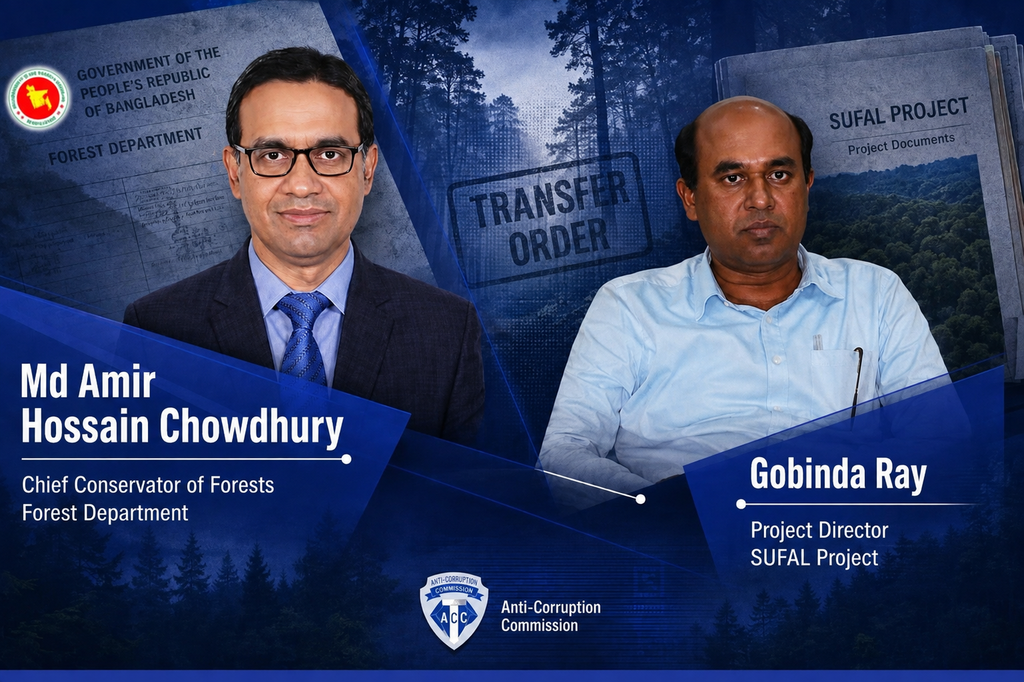
The enforcement report attributes the field-level failures to weak supervision and a lack of cooperation by the chief conservator’s office. It says Amir Hossain Chowdhury was questioned about the transparency of expenditure under projects overseen by his office but did not provide a satisfactory explanation to the enforcement team.
The ACC team, led by assistant director Md Ismail, also questioned the deputy chief conservator and SUFAL project director Gobinda Ray and collected records from the Forest Department. The enforcement report was submitted to the commission on 26 February 2025.
Following the personnel trail
The latter ACC letter shows that investigators did not limit their work to plantation accounts. They also began following the administrative trail behind transfers and postings.
The commission asked the Forest Department for copies of office orders issued during Amir Hossain Chowdhury’s tenure for postings at ranges and forest check stations. It also sought the department’s 2004 transfer policy, earlier transfer orders involving a group of named foresters, and lists of officers who had remained in particular divisional or field offices for more than two years, together with their contact details and permanent and current addresses.
The geographical reach of the demand was extensive. It covered forest divisions in the Chattogram region, including Chattogram North and South, Bandarban, Lama, the Chittagong Hill Tracts, land-management and wildlife units, and Khagrachari. It also sought records from ranges and forest check stations in Cumilla, Rangamati, Cox’s Bazar, Dhaka, Tangail, Mymensingh and other areas.

The focus on ranges and check stations is significant. These are operational posts where officials supervise forests, implement plantation programmes and regulate the movement of timber and other forest products. The breadth of the request suggests investigators were looking for patterns: repeated placement of particular officers, unusually long tenures, departures from policy or chains of orders that could support or disprove the allegation that assignments were exchanged for money or influence.
The enforcement report had already concluded that the Forest Department’s 2004 transfer policy was not consistently followed. It said investigators found information indicating illegal financial transactions linked to postings in forest ranges and stations and that the chief conservator appeared to have played a direct or indirect role.
That remains an allegation requiring proof through records, witness testimony and financial evidence. The ACC’s request for office orders and employment histories is therefore central to determining whether the suspected posting network existed, who benefited, and whether administrative decisions were tied to payments.
Former minister and son named in inquiry

The records-demand letter formally links the administrative inquiry to allegations against Shahab Uddin, who served in the former Awami League government, and his son, Zakir Hossain Jumon.
It says a three-member ACC team was formed to investigate allegations that Shahab Uddin, Jumon, Amir Hossain Chowdhury, and others used a posting syndicate and other corrupt practices to embezzle government money and acquire illegal assets. The document requested the Forest Department’s cooperation and set a deadline in August 2025 for the records.
The ACC publicly confirmed in August 2025 that it had opened an inquiry into allegations involving the former minister, his son, the chief conservator and others. The allegations included posting-related corruption, a syndicate, misuse of public money and unlawful wealth.
The inquiry has also intersected with a separate asset investigation. On 19 August 2025, a Dhaka court ordered the attachment of a five-katha plot and the freezing of eight bank accounts connected to Shahab Uddin and his son after an ACC application. That order was an interim preservation measure and did not determine guilt.
In late July 2026, ACC officials said the broader investigation into alleged abuse of power, embezzlement and recruitment and transfer-related corruption was continuing. The commission said some allegations under its wider inquiries had already resulted in cases, but its public statements did not clearly establish that a case had been filed over the specific Ramu plantation discrepancy described in the enforcement report.
ACC confirms deeper investigation
In a statement supplied to The Climate Watch in August 2026, ACC deputy director for public relations Akhtarul Islam said the commission had initially found evidence of negligence by the SUFAL project director and chief conservator of forests.
“The Anti-Corruption Commission initially found evidence of negligence by the project director and chief conservator of forests in the ‘SUFAL Project.’ The enforcement team submitted a report to the commission, and a deeper investigation is under way.”
Akhtarul Islam, ACC deputy director for public relations
The commission said its 2025 document verification found preliminary indications of suspected embezzlement connected to plantation work shown as completed. It has not publicly detailed the accounting basis, the amount under inquiry or the records supporting that allegation. The allegation remains to be tested in the deeper investigation.
The ACC said investigators had collected the relevant SUFAL records and would consider legal action after verifying them. The commission described SUFAL as a project worth Tk 1,500 crore; separately, the World Bank approved a $175 million International Development Association credit for the project in 2018.
“The Anti-Corruption Commission conducts operations against corruption and irregularities not only in the ‘SUFAL Project’ but across all projects of the Forest Department. The reports from these operations can lead to deeper investigations.”
Akhtarul Islam, ACC deputy director for public relations
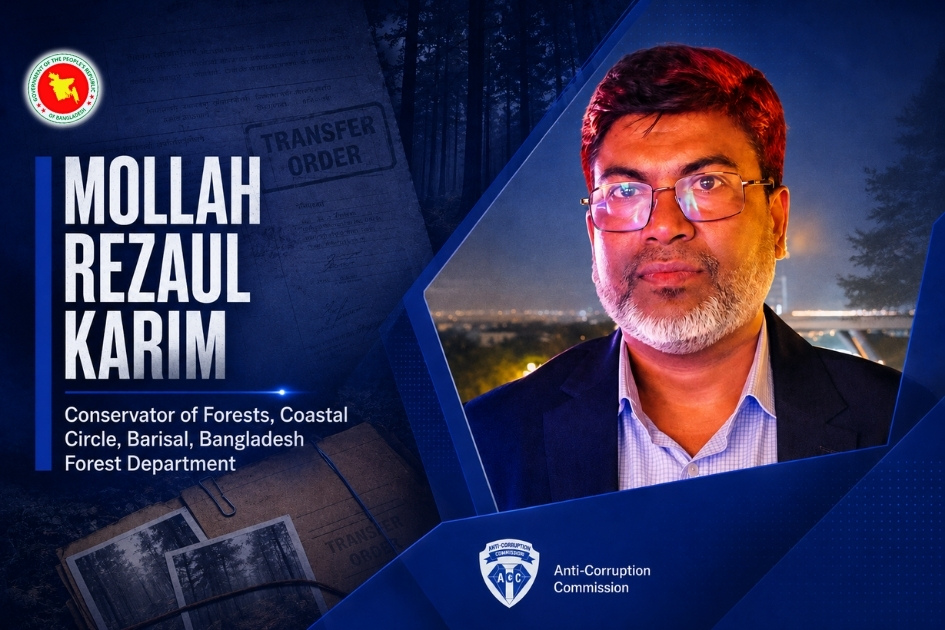
The commission said it had already filed a separate illegal-wealth case against Shahab Uddin. It is also investigating alleged unlawful assets of Barishal-region forest conservator Mollah Rezaul Karim, including an allegation that 77 employees were transferred in a single day in exchange for bribes. Those matters form part of the ACC’s wider Forest Department scrutiny; neither allegation, by itself, establishes responsibility for the Ramu plantation gap.
A flagship project with global financing
The Forest Department adopted the Sustainable Forests and Livelihoods Project, known as SUFAL, in 2018 to strengthen forest management and improve the lives of forest-dependent people. The plantation allegations concern work under that flagship programme, implemented with financing from the World Bank’s International Development Association.
The World Bank approved a $175 million credit in October 2018. The programme was designed to improve collaborative forest management and increase benefits for forest-dependent communities. Its original ambitions included restoration and planting across 78,930 hectares of public and private land, including about 22,000 hectares of coastal green belt. It was also expected to directly support about 40,000 forest-dependent households and involve a further 180,000 people in collaborative forest management.
The project closed on 30 June 2025 after two extensions. A 2026 review by the World Bank’s Independent Evaluation Group recorded an actual project cost of about $154.8 million and rated the overall outcome satisfactory. It said 92,431 hectares had been restored or reforested under site-specific collaborative management plans, exceeding the original overall target.
At first glance, that project-wide assessment appears difficult to reconcile with the ACC’s field findings in Ramu. The findings are not necessarily mutually exclusive: the ACC examined specific plantation sites and administrative allegations, while the World Bank review assessed the programme as a whole. But the World Bank’s own evaluation identified a weakness that makes local verification especially important.
The Independent Evaluation Group said planting began 22 months before the project’s digital site-specific planning platform became operational. It found persistent discrepancies between planted areas reported in the platform and conditions on the ground. Staffing constraints and the scale of the programme also resulted in inaccurate reporting of planted areas during a significant part of implementation.
The evaluation rated the quality of project monitoring and evaluation as only modest. It also noted significant delays in resolving audit observations, particularly those related to works, even though financial management and procurement were rated satisfactory.
These distinctions matter. A clean or unqualified financial audit opinion addresses whether financial statements fairly present receipts and expenditures under the applicable accounting framework. It does not, by itself, prove that every reported hectare was planted, survived, or delivered the ecological outcome claimed. Physical verification, geospatial records, survival audits and independent field checks are needed to establish that.
The ACC’s Ramu finding therefore presents a test case for the reliability of the project’s monitoring system: whether the 350-hectare gap resulted from false reporting, incomplete work, failed plantations, mapping or classification errors, poor maintenance or some combination of these factors.
World Bank says restoration total cut after satellite checks

In a response emailed to The Climate Watch on 12 August 2026, the World Bank said it was not aware of, and had not received, any communication or report from the ACC regarding SUFAL. The comments were attributed to Kirtan Chandra Sahoo, a World Bank senior environmental specialist.
The Bank said it identified discrepancies in third-party monitoring data for forest cover during implementation and undertook supplementary analysis using satellite imagery and remote sensing across more than 65 per cent of the project area. It then applied correction factors derived from differences between third-party monitoring and satellite-verified findings to the full dataset reported by the Forest Department.
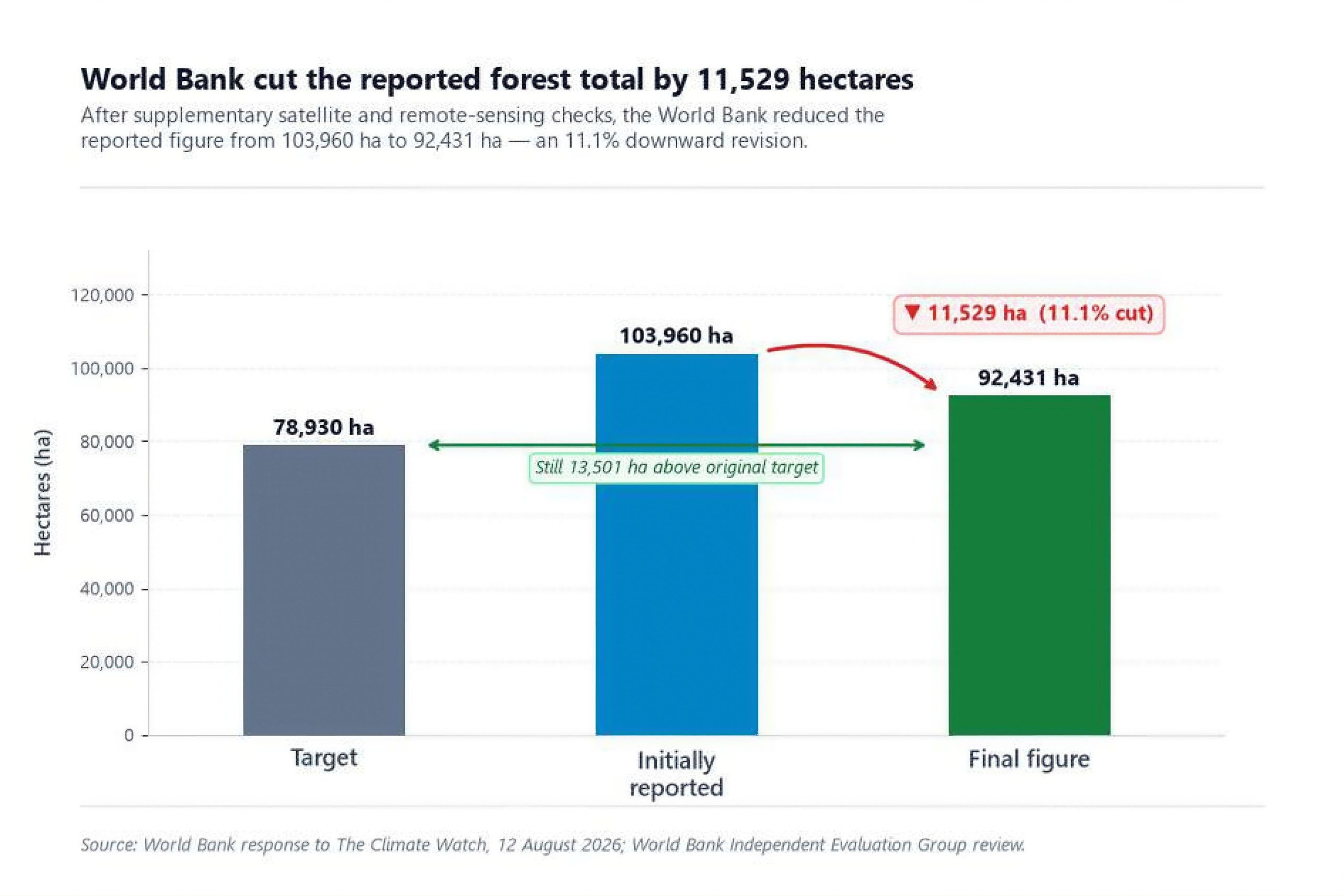
That process reduced the reforestation and afforestation figure from an initially reported 103,960 hectares to 92,431 hectares, a downward revision of 11,529 hectares, or about 11.1 per cent. The final figure was still 13,501 hectares above the original project target of 78,930 hectares.
The Bank said its site visits found plantation survival rates satisfactory. It said survival was also examined by an independent third-party monitor but was not reviewed through remote sensing because newly planted trees of different species were difficult to distinguish amid dense vegetation. It added that World Bank financial-management and procurement oversight did not identify any fiduciary irregularities.
“As we have not seen the ACC report, we cannot comment on the plantation figures cited for Joarianala Beat in Ramu.”
Kirtan Chandra Sahoo, World Bank senior environmental specialist
The response explains how the Bank revised the project-wide total but does not resolve the central site-level questions. It does not say whether the 510-hectare or 362-hectare Ramu schemes were included in the 92,431 hectares; provide the amount allocated, disbursed, or reimbursed for those schemes; identify who certified the work; explain how failed Ramu plantations were treated; or supply the requested site plans, geospatial files, supervision records, survival audits, and third-party monitoring reports.
The environmental cost of a paper plantation
If plantation money was spent without the promised forest being established, the loss would extend beyond public funds.
SUFAL was designed to restore degraded forests, strengthen coastal protection, increase carbon storage and support people whose livelihoods depend on forests. In Cox’s Bazar, where forests face pressure from settlement, infrastructure, extraction and climate hazards, the survival of plantations affects slope stability, watershed protection, biodiversity and local income.
A non-existent or failed plantation can still appear as an administrative output if monitoring stops at procurement, planting-day photographs, or expenditure certificates. But dead seedlings do not sequester the projected carbon, protect wildlife habitat, or reduce disaster risk. Nor do they provide the long-term forest products and livelihood benefits used to justify the investment.
The alleged sale of field postings could amplify that risk. If assignments at ranges and check stations are influenced by payments rather than competence and rotation rules, officials may try to recover the cost of obtaining a post, oversight may be compromised, and officers may become accountable to patrons instead of the public.
That is why the plantation and posting strands of the ACC inquiry should not be treated as separate administrative problems. The records suggest investigators are examining whether control over personnel created conditions in which weakly supervised project work and financial irregularities could occur.




