

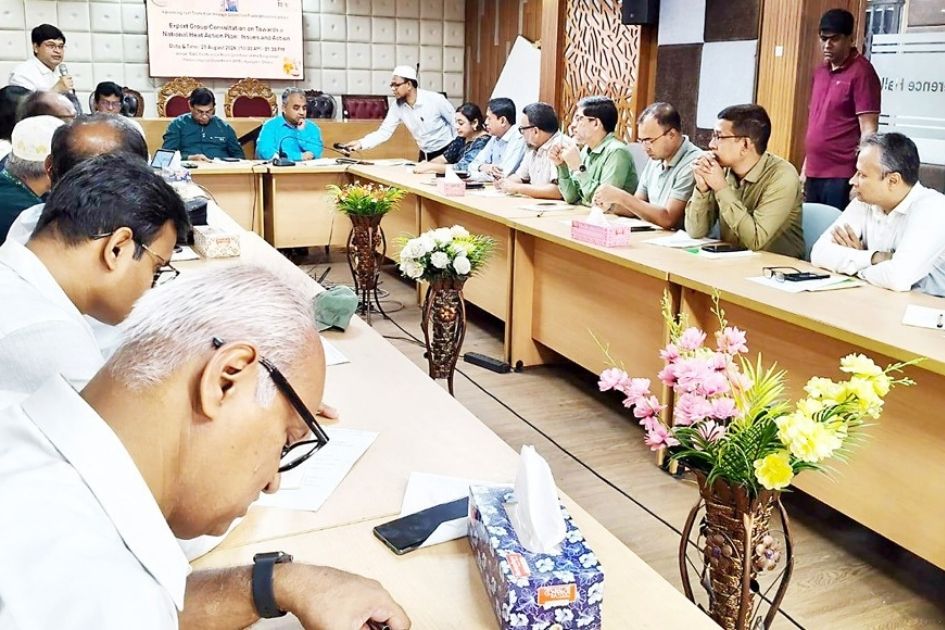



Speakers at a Dhaka discussion said stronger forecasting, early warnings and inter-agency coordination are needed to protect outdoor workers and climate-sensitive livelihoods from worsening extreme heat.
Experts have called for a comprehensive national heat action plan as rising temperatures and recurring heatwaves emerge as a growing threat to public health, livelihoods and economic productivity in Bangladesh.
The call came at a discussion jointly organised by the Just Transition Bangladesh Centre and the Bangladesh Meteorological Department at the BMD Conference Room in Dhaka on Saturday.
Speakers said extreme heat should no longer be treated solely as a weather-related issue, arguing that it has increasingly become a public health, labour, development and climate adaptation concern.
They stressed the need for a coordinated national mechanism to anticipate, prepare for and respond to extreme heat, particularly to protect people whose livelihoods and daily activities expose them to high temperatures.
The experts said a national heat action plan should bring together weather forecasting, early warnings, public health preparedness, occupational safety and climate adaptation measures.
They also emphasised stronger coordination among relevant government agencies and other stakeholders so that heat-related risks can be identified early and appropriate measures can be taken before extreme heat causes serious harm.
The Bangladesh Meteorological Department has an important role to play in strengthening heat forecasting and early warning systems, the speakers said, while stressing that warnings must reach communities in a timely and accessible manner.
They noted that outdoor workers and people dependent on climate-sensitive livelihoods can face particularly serious consequences during periods of extreme heat, including risks to health, income and productivity.
The discussion also highlighted the importance of integrating heat-risk management into Bangladesh’s broader climate adaptation and just transition policies.
Experts said Bangladesh needs to move from largely reactive responses to a planned and coordinated approach to extreme heat, with clear institutional responsibilities and measures tailored to the country’s most exposed communities.
They urged the government to develop and implement a national heat action plan as an urgent policy priority, warning that the risks associated with a warming climate will require sustained action rather than short-term emergency responses.




