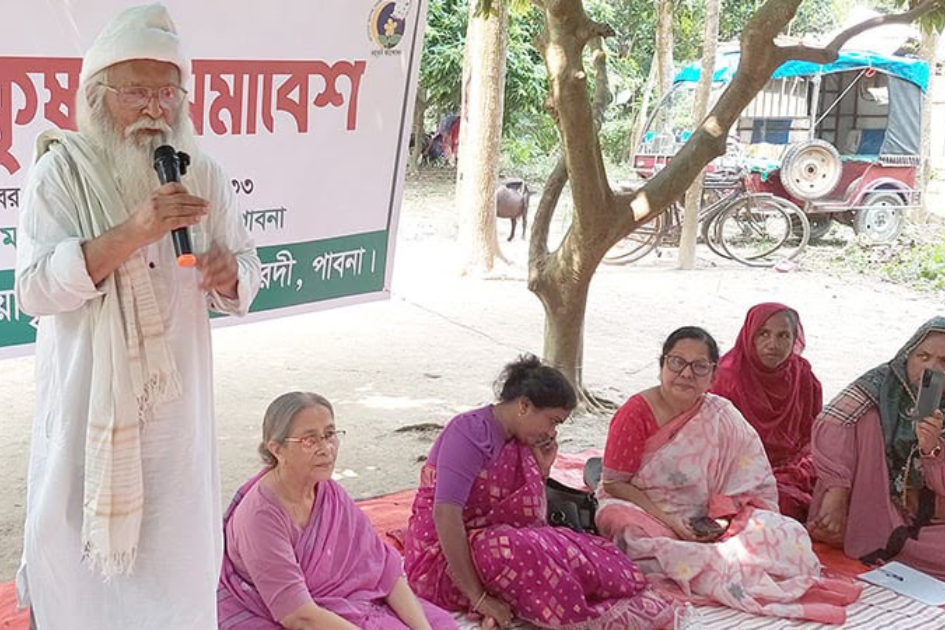



Farmers at a Pabna gathering shared experiences of chemical-free cultivation, indigenous seed conservation and efforts to reduce dependence on commercial agricultural inputs amid concerns over corporate influence.
Former adviser calls for ecological farming as Farhad Mazhar raises concerns over corporate influence on Bangladesh’s agriculture.
Former Fisheries and Livestock Adviser Farida Akhter on Sunday warned that the indiscriminate use of chemical fertilisers and pesticides threatens public health, calling for a shift towards ecological farming to protect people and the environment.
She made the remarks at a farmers’ gathering at Dakshin Harlpara village in Atgharia upazila of Pabna, jointly organised by UBINIG, a Bangladeshi policy research organisation, and Nayakrishi Andolon, a farmer-led ecological agriculture movement.
Several hundred farmers, including a large number of women, attended the gathering to discuss sustainable farming practices, indigenous crop conservation and the growing dependence on commercial agricultural inputs.
Health concerns
Farida expressed concern over what she described as an alarming rise in serious illnesses, including cancer, kidney failure and cardiovascular diseases, which she linked to the excessive use of agricultural chemicals.
She urged farmers to abandon chemical-intensive cultivation and adopt natural farming methods to safeguard human health, biodiversity and the environment.
Unsafe exposure to certain pesticides can cause serious health problems, although establishing links between agricultural chemicals and specific disease trends requires scientific evidence. The account of the gathering did not provide supporting data for the disease trends cited by Farida.
She also called for an end to artificial insemination in livestock breeding, claiming that existing practices threaten indigenous animal breeds. The account did not provide specific evidence supporting that claim.
Mazhar warns against corporate control
Addressing the gathering as chief guest, poet, writer and political thinker Farhad Mazhar criticised the growing influence of seed and agrochemical companies over Bangladesh’s agricultural system.
He alleged that corporate interests were shaping agricultural policies, weakening farmers’ independence and threatening traditional farming practices.
“Seed companies are destroying the agricultural system in the name of modernisation. Those seeking votes do not think about agriculture. They are beholden to companies,” he said.
Mazhar argued that growing dependence on commercial seeds, chemical fertilisers and pesticides was undermining indigenous agricultural knowledge and biodiversity.
“If we want to survive, we must build an agricultural system free from chemical fertilisers and pesticides. We must protect our indigenous varieties. There is no alternative,” he said.
Expressing concern over Bangladesh’s economic outlook, Mazhar alleged that corporate influence over government decision-making was compromising agricultural independence.
He argued that Bangladesh’s agricultural sector would struggle to progress without addressing political malpractice and what he described as corporate influence over government policies.
Mazhar also urged farmers to cultivate crops in harmony with nature, emphasising the ethical responsibility of protecting living organisms and ecosystems.
Farmers share experiences
Several farmers shared their experiences of cultivating crops without synthetic fertilisers and pesticides, highlighting the economic potential of ecological farming.
Abul Hossain, a local farmer practising ecological agriculture, said vegetables grown on his farm using organic fertilisers and natural methods fetched higher prices in local markets than conventionally grown produce.
“My vegetables sell at higher prices in local markets. This benefits me financially while allowing consumers to buy vegetables grown without chemical fertilisers or pesticides,” he said.
Jannatul Khatun, whose parents practise natural farming, expressed pride in her family’s commitment to producing food without synthetic agricultural chemicals.
“Both my parents are farmers. They grow crops without using chemical fertilisers or pesticides. As a farmer’s daughter, I feel proud of their work,” she said, adding that her family also benefited from consuming food grown through their own farming practices.
The gathering was chaired by Azmira Khatun, manager of UBINIG’s Ishwardi regional office.
Other speakers included UBINIG Director Seema Das Shimu, researcher Golam Mostafa Rony, Atgharia Upazila Livestock Officer Dr Md Nazmul Hossain and Chatmohar Assistant Upazila Education Officer Aslam Hossain.
Several farmers also addressed the gathering, calling for greater policy support for ecological agriculture, protection of indigenous seeds and reduced dependence on commercial agricultural inputs.
The discussions highlighted tensions between chemical-intensive agricultural production, the conservation of traditional crop varieties and farmers’ efforts to maintain greater control over their livelihoods.