




Bangladesh’s pesticide regulator has begun a phased withdrawal of paraquat, while glyphosate remains under review amid growing scrutiny of hazardous chemicals.
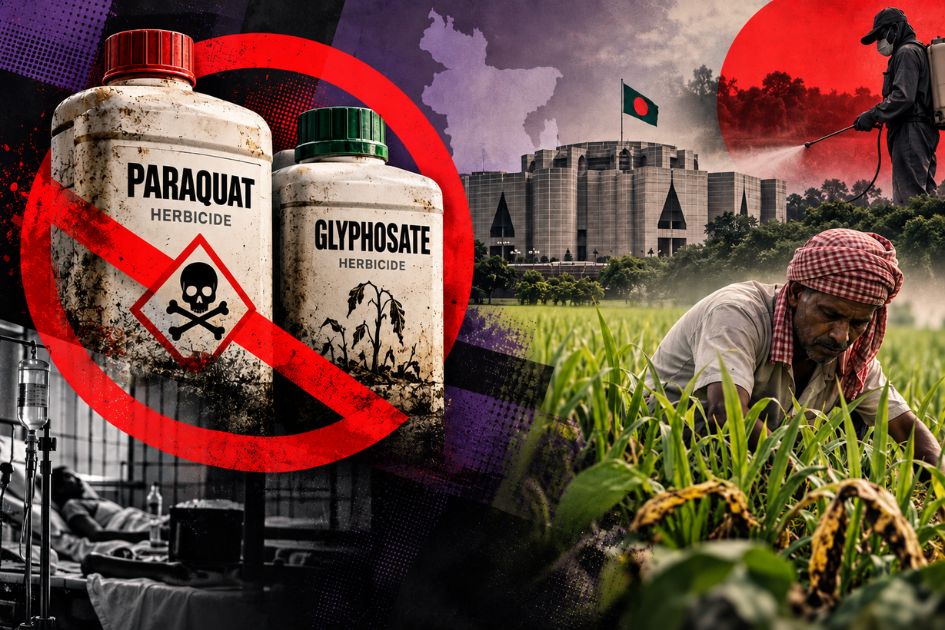
Bangladesh has moved to halt the use of the highly toxic herbicides paraquat and glyphosate, ordering existing stocks of the chemicals to be reduced to zero within six months while stopping imports, new registrations and licence renewals for the two groups of pesticides.
The decision was taken at the 91st meeting of the Pesticide Technical Advisory Committee, or PTAC, held on Thursday at the Agricultural Research Foundation of the Bangladesh Agricultural Research Council in Farmgate, Dhaka.
According to the meeting minutes, Bangladesh currently has 395 tonnes of paraquat-group pesticides in stock. Members unanimously agreed that the stock must be exhausted within six months of the issuance of the relevant notice.
For glyphosate, however, the minutes said an earlier decision taken at the committee’s 88th meeting would remain in force until the current status of glyphosate-group pesticides is reviewed and a further decision is made.
The meeting was chaired by Dr Md Abdus Salam, executive chairman of the Bangladesh Agricultural Research Council and chairman of PTAC.
Salam said the country’s National Biodiversity Action Plan had set a target of gradually reducing the use of 25 percent of hazardous pesticides by 2030. As part of that effort, he said, important decisions had now been taken on paraquat and glyphosate, described as among the most hazardous pesticides.
Under the decision, existing paraquat stocks must be brought down to zero within six months. Glyphosate stocks are also to be reduced to zero in line with the decision of the committee’s 88th meeting. Imports, new registrations and renewals of existing product licences for both groups will also be halted.
Dr Md Ahsanul Haque, a professor in the Department of Entomology at Gazipur Agricultural University who attended the meeting, said paraquat and glyphosate are both chemicals used to control weeds. He said concerns over paraquat’s risks to public health were considerably greater.
The latest PTAC meeting also adopted several measures aimed at withdrawing hazardous pesticides from the market, inspecting retail outlets, testing pesticides at ports and developing the necessary infrastructure. It also decided to conduct research to identify sources of heavy-metal contamination.
Paraquat has been banned in more than 70 countries, including countries in the European Union, China and Brazil, because of its serious risks to human health and the environment. Bangladesh had not previously taken steps to stop its agricultural use.
A study published in May this year on paraquat poisoning in Bangladesh also raised serious concerns.
The study, titled “Clinical and Laboratory Profile of Paraquat Poisoning: A Toxicological Crisis in Bangladesh”, was published in May in the American Society of Tropical Medicine and Hygiene journal. It identified 1,420 cases of paraquat poisoning at 10 tertiary hospitals in Bangladesh between 2013 and 2024.
In 2024 alone, the hospitals recorded 493 cases and 212 deaths. Among 257 patients for whom detailed information was available, 43.2 percent died. The hospitals involved in the research serve more than 65 percent of Bangladesh’s population.
Professor Md Abul Faiz, one of the study’s authors and president of the Toxicology Society of Bangladesh, said paraquat poisoning was becoming a major public health problem in Bangladesh.
He said paraquat had been subject to strict controls in various countries for many years. According to data from the Toxicology Society of Bangladesh, the chemical is banned in 77 countries. Recent international reports have likewise said it is prohibited in more than 70 countries, including the European Union, Britain and China.
In Bangladesh, however, paraquat had continued to be used in agriculture. Researchers analysing National Board of Revenue data in the study published in May 2026 found that imports of paraquat had stood at slightly more than 53 tonnes in 2013 but had risen to 4,695 tonnes in 2023.
Glyphosate was also discussed at the PTAC meeting, but the committee did not impose a new prohibition on the chemical. The meeting minutes said the previous decision would remain in place pending a review of the current status of glyphosate-group pesticides and a subsequent decision.
Glyphosate is one of the world’s most widely used herbicides. In 2015, the International Agency for Research on Cancer, part of the World Health Organization, classified glyphosate as “Group 2A”, meaning probably carcinogenic to humans. The agency cited limited evidence in humans, sufficient evidence from animal studies and strong evidence concerning genetic damage.
The European Food Safety Authority, however, said in its 2023 assessment that glyphosate did not meet the scientific criteria for classification as carcinogenic, mutagenic or toxic to reproduction.
The US Environmental Protection Agency is also conducting a new assessment of glyphosate’s health risks, with an updated assessment expected to be published at the end of 2026.
International attention on glyphosate has also focused on southern Lebanon. On June 10, Lebanon’s Foreign Ministry complained to the United Nations Security Council and the UN secretary-general that Israeli forces had sprayed glyphosate in several villages along the southern border on Feb 1, 2026.
The complaint, based on a report by Lebanon’s government research agency, said high concentrations of glyphosate had been detected in soil samples from Aita al-Shab, Ras al-Naqoura and Dhayra. The Lebanese Foreign Ministry said some samples contained concentrations of up to 22,750 micrograms per gram.
The 91st PTAC meeting also approved the registration of four pesticide products from a US-based agricultural technology company. The meeting minutes identified DuPont Bangladesh Ltd as the applicant.
The committee further decided to register 45 biological pesticides after reviewing field-level efficacy tests. The products include treatments for rice blast and leaf folder, corn borer and fall armyworm in maize, late blight in potatoes, downy mildew in cucumbers, collar rot and branch canker in tea plants and fruit flies affecting various fruits.
Several pheromone- and attractant-based biological pesticides were specifically approved for controlling fruit flies in bitter gourd, mango and guava orchards. The meeting minutes also listed the field efficacy rates for the products.
The latest decision follows PTAC’s 90th special meeting held in July. According to the minutes of that meeting, 19 pesticides had been banned in Bangladesh between 1960 and 2023, while the use of another 17 high-risk pesticides had continued.
Those pesticides were registered under 1,741 brand names and remained available on the market.
Several officials attending Thursday’s meeting said many influential companies operate in the pesticide market and do not want rapid decisions to be taken to stop harmful pesticides.
Pesticide use began in Bangladesh in the 1950s. The country imported three tonnes of pesticides in 1956, compared with more than 40,000 tonnes in both 2024 and 2025.
Officials said extensive government concessions on pesticide imports had resulted in the use of 327 molecules or variants in the country. Those pesticides are registered under 7,405 brand names and are used in agriculture.
After testing pesticides, the Bangladesh Food Safety Authority sent letters to the Ministry of Agriculture and Chattogram Port directing that imported products be subjected to mandatory testing. At the time, however, then-agriculture minister Abdur Razzaq recommended suspending the measure for six months following pressure from traders.
No further initiative was subsequently taken by the Ministry of Agriculture, PTAC or the agriculture department.
Nearly six years later, at PTAC’s 90th meeting, current Agriculture Minister Mohammed Amin ur Rashid said a committee of professionals and researchers had been formed to assess the extent of harm caused by paraquat, glyphosate and other toxic and harmful chemicals.
He said the committee would submit a report, which would then be presented on a broader scale. If the remaining pesticides were found to be highly harmful, he said, they too would be banned.
This post is republished from The Daily Samakal.




