

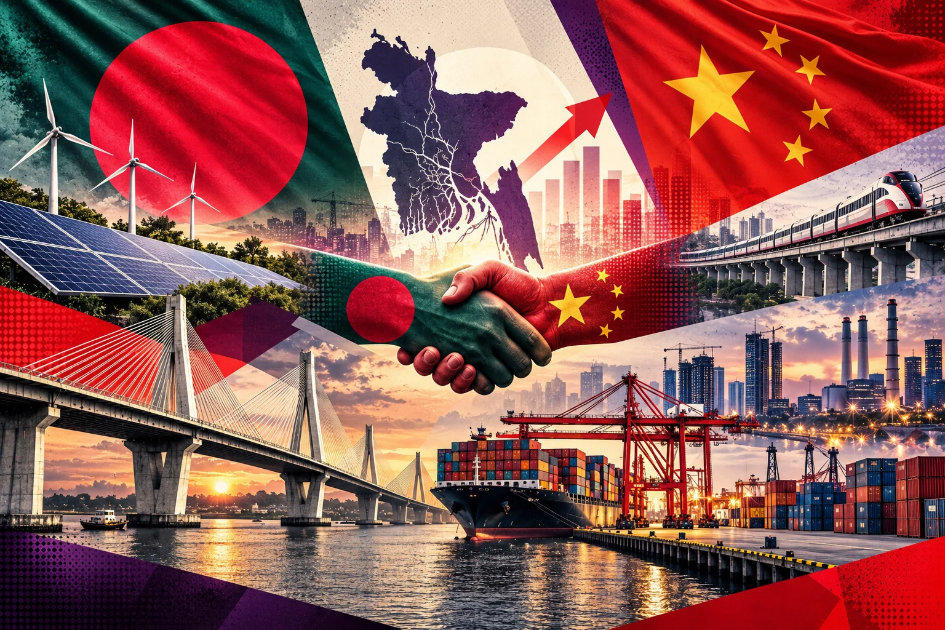



Economic reforms, a dedicated Chinese industrial zone and proposed multibillion-dollar projects signal Dhaka’s push to deepen trade ties, boost exports, create jobs and strengthen domestic manufacturing.
Relations between Bangladeshi and Chinese civilisations date back nearly 3,000 years. These ties are rooted primarily in the Brahmaputra River. Originating at Lake Manasarovar near Mount Kailash in the Himalayas, the Brahmaputra flows through Tibet and India’s Assam before entering Bangladesh through Kurigram. Near Dewanganj in Jamalpur, the river bends south-east and flows through Jamalpur and Mymensingh districts before joining the Meghna south of Bhairab Bazar and eventually flowing into the Bay of Bengal. The river’s flowing waters and the fertile alluvial soil it carries have enriched Bengal’s landscape. Over time, this has strengthened the deep-rooted connections between the people of the two countries.
After Bangladesh gained independence from Pakistan in 1971, China recognised it as an independent country on October 4, 1975. Since then, the two countries have strengthened their friendship through diplomatic relations, economic investment, military cooperation and collaboration in almost every sector. China accounts for nearly 60 per cent of Bangladesh’s imports. Chinese support for the country’s infrastructure development is also increasing.
Chinese investment
From February to October 5 this year, 110 Chinese companies registered to invest $291 billion, or nearly $300 billion, across various sectors in Bangladesh. These include IT-enabled services, renewable energy, electric vehicles, agro-based industries, pharmaceuticals and healthcare.
Prime Minister Tarique Rahman made his first foreign visits to Malaysia and China. During his visit to China from June 23 to 25 this year, 11 leading Chinese companies proposed investing a total of $9.21 billion in various sectors of Bangladesh in Beijing, the Chinese capital.
The proposals included $250 million from China Future Energy Group Holding Ltd for petroleum engineering and gas field development, including exploration and development of Bangladesh’s gas fields.
Shanghai SUS Environment Co Ltd expressed interest in investing $890 million in waste-to-energy projects.
China Civil Engineering Construction Corporation (CCECC), a state-owned Chinese construction company, proposed investing $650 million to develop the Mongla Port Economic Zone, build bonded warehouses and transform Mongla into a regional logistics hub. The project is expected to create 50,000 jobs.
Shenzhen Kaifa Technology Co Ltd expressed interest in investing $250 million in smart electricity meter manufacturing.
SF Express proposed investing $180 million to develop cold-chain logistics and bonded warehouse facilities in Mongla.
Huaxin Textile Industry Co Ltd announced plans to invest $190 million in expanding recycled cotton and yarn production in the Payra Port industrial area, manufacturing cylindrical lithium batteries and establishing a 200-megawatt solar power plant for its own use.
Zhongxin Environmental Protection Group proposed an investment of $1.65 billion.
CRRC Xi’an Co Ltd proposed investing $190 million to establish a railway component assembly plant.
Sichuan Road and Bridge Group Co Ltd proposed investing $4.5 billion.
China Kepai Education Group proposed investing $270 million to build a modern applied university and technical education industrial park with a capacity of 30,000 students.
Government strategies to increase investment
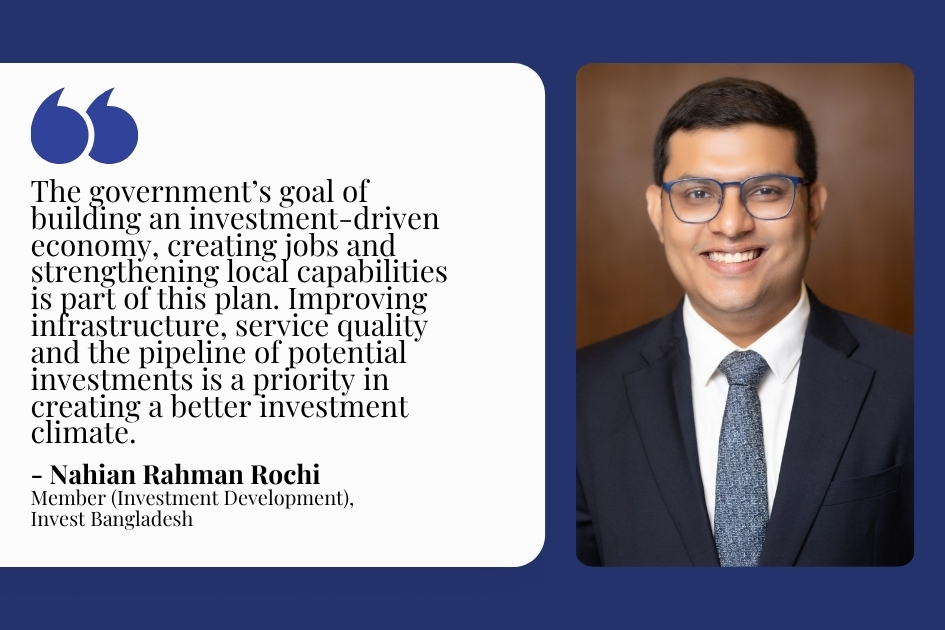
Seven of the 20 initiatives introduced by the government to increase domestic and foreign investment have been implemented, said Nahian Rahman Rochi, a member of Invest Bangladesh responsible for investment development.
He cited initiatives involving a Chinese economic zone, round-the-clock port operations, integrated investment services and new incentives for foreign investment.
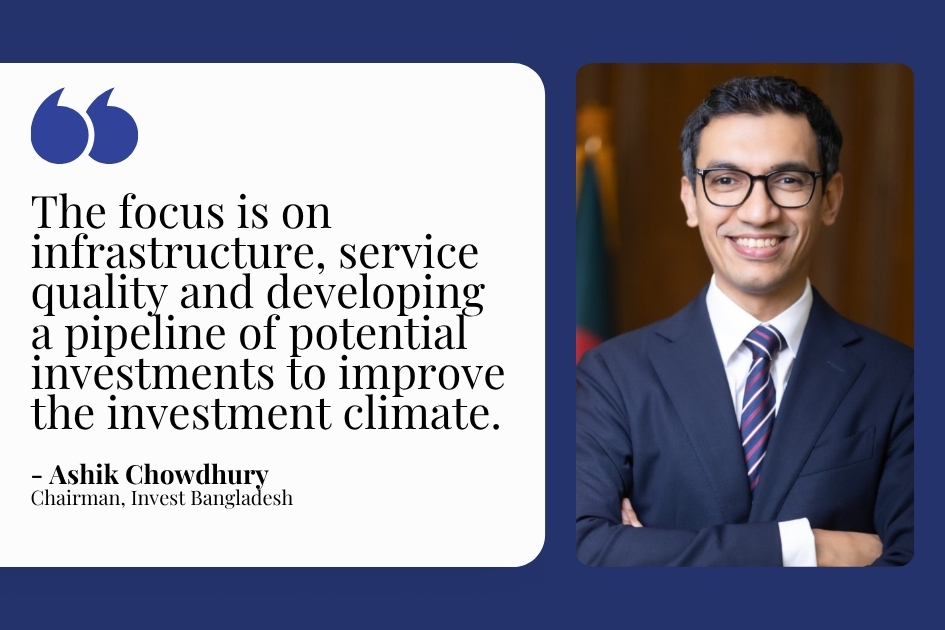
On March 16 this year, Invest Bangladesh announced the 20 initiatives. Its chairman, Ashik Chowdhury, said at the time: “Achieving the government’s goals of an investment-driven economy, job creation and strengthening local capabilities is part of this plan. The focus is on infrastructure, service quality and developing a pipeline of potential investments to improve the investment climate.”
Rochi said the 20 initiatives had been divided into three broad pillars: stronger infrastructure, investment facilitation and investment promotion.
Work on the Chinese economic zone has also progressed with the laying of its foundation stone. China Road and Bridge Corporation (CRBC) is implementing the project, which is targeted for completion by 2028. The industrial zone could create more than 100,000 direct jobs.
The project’s investment pipeline is worth approximately $1.3 billion, of which around $500 million is already active. Potential investments include $600 million from China, $300 million from the Middle East, $200 million from the United States and $100 million from South Korea, he said.
A meeting was held in Dhaka on October 1 between a visiting Chinese delegation and Mohammed Hasan Arif, vice-chairman and chief executive of the Export Promotion Bureau (EPB), Bangladesh’s export development agency, to expand bilateral trade, investment and economic cooperation between Bangladesh and China’s Yunnan province.
The meeting emphasised strengthening existing commercial relations, developing new markets and business connections and expanding opportunities for mutual trade.
Hasan Arif said Bangladesh was focusing on increasing Chinese investment in the country and exports to China. In particular, an outlet had been provided for Bangladeshi products in Kunming, China.
“Our products will be displayed there and, as they are sold, investors will also be encouraged,” he said.
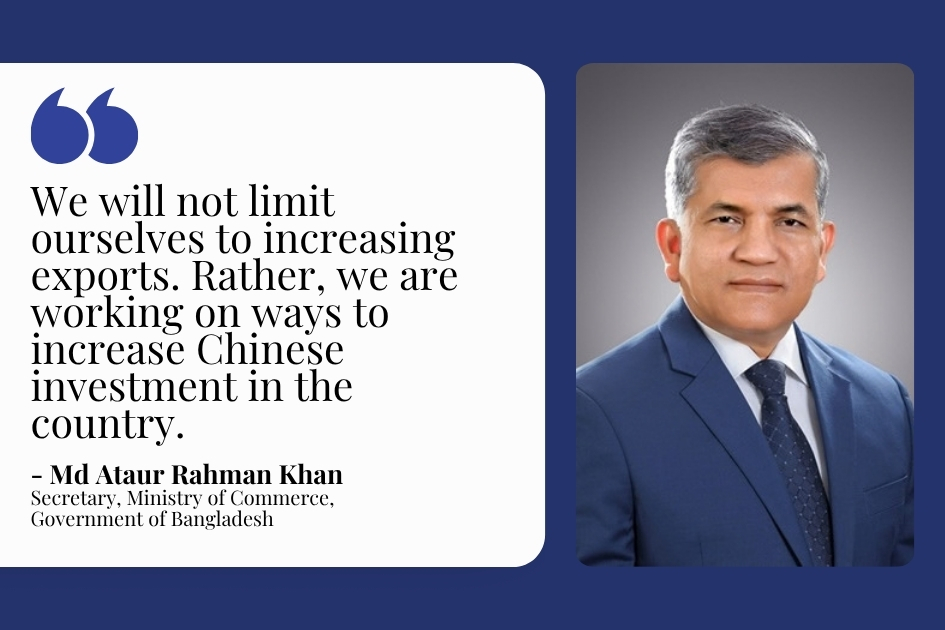
Commerce Secretary Md Ataur Rahman Khan said the Commerce Ministry’s commercial wing was working to attract Chinese investment.
“We will not limit ourselves to increasing exports. Rather, we are working on ways to increase Chinese investment in the country,” he said.
Md Firoz Uddin Ahmed, joint secretary of the ministry’s export wing and head of its joint venture committee, said research was underway to increase export trade, attract investment and reduce imports.
Welcoming Chinese investment is essential to increasing garment export earnings
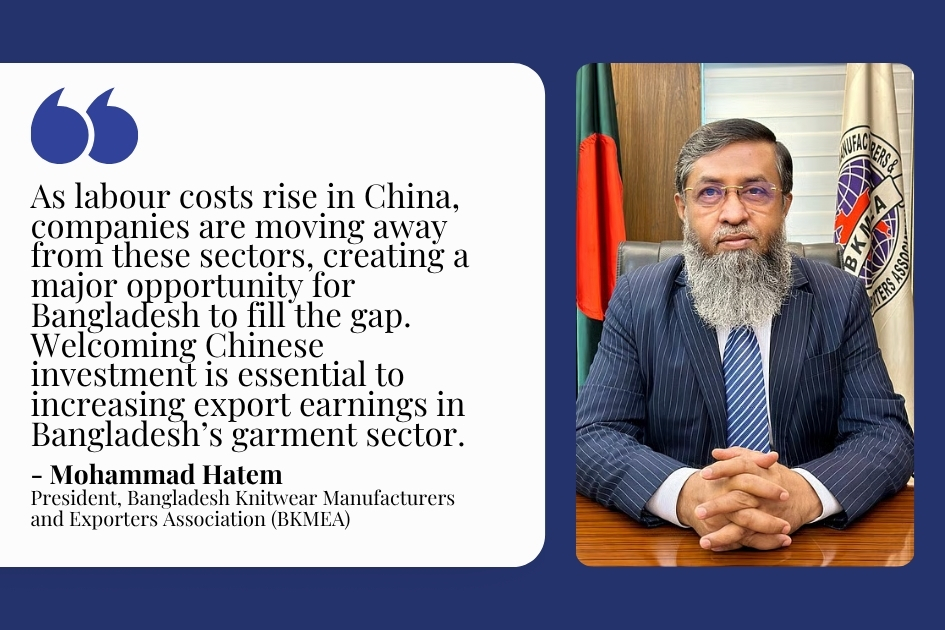
Mohammad Hatem, president of the Bangladesh Knitwear Manufacturers and Exporters Association (BKMEA), said discussions had been held on the potential for trade in clothing and leather goods between Bangladesh and China.
As rising labour costs in China were prompting companies to move away from these sectors, Bangladesh had a significant opportunity to fill the gap, he said. Chinese investors had already achieved considerable success operating garment factories in Bangladesh.
“Welcoming Chinese investment is extremely important for increasing export earnings in Bangladesh’s garment sector,” he said, adding that Chinese investment and technology could play an effective role in developing sectors where the country lagged behind technologically.
Retired Colonel Modasser, Bir Protik, described China as one of Bangladesh’s largest infrastructure development partners.
Under the Belt and Road Initiative, China is implementing several major projects in Bangladesh. Its involvement is visible in areas including the Padma Bridge approach roads, power plants and economic zones.
He said mutual goodwill needed to be strengthened to sustain and accelerate this potential.
Diplomatic and trade relations with China are a government priority
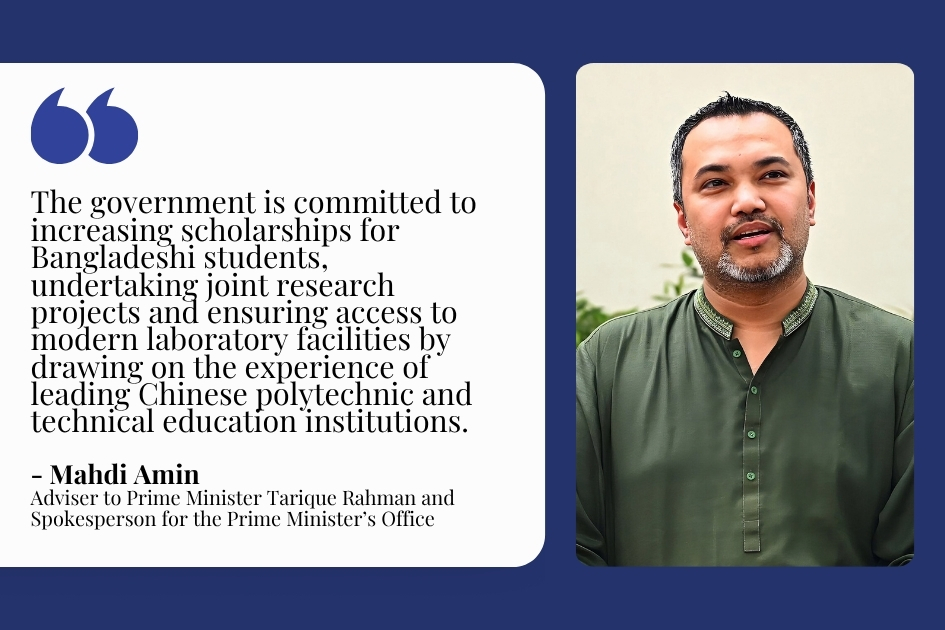
Mahdi Amin, an adviser to Prime Minister Tarique Rahman and spokesperson for the Prime Minister’s Office, recently said diplomatic and trade relations with China were among the government’s special priorities.
Calling for Chinese cooperation in education, he said the government was committed to increasing scholarships for Bangladeshi students, undertaking joint research projects and ensuring access to modern laboratory facilities by drawing on the experience of leading Chinese polytechnic and technical education institutions.
Chinese training could open new opportunities for cottage industries
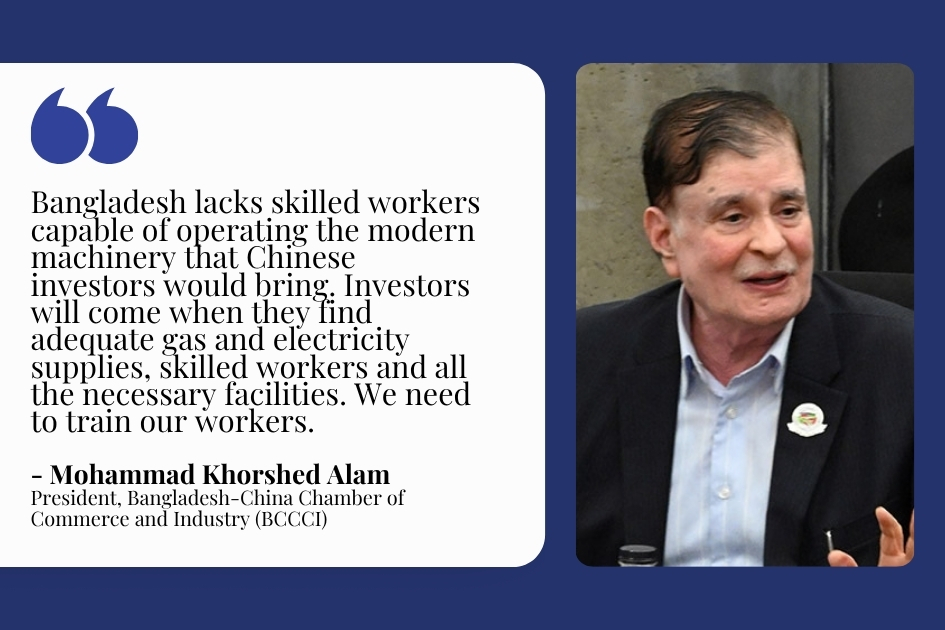
Mohammad Khorshed Alam, president of the Bangladesh-China Chamber of Commerce and Industry (BCCCI) and a veteran businessman, said Bangladesh lacked enough skilled workers capable of operating the modern machinery that Chinese investors would bring.
He said investors would come when they found adequate gas and electricity supplies, skilled workers and other necessary facilities. Bringing operators from China to install machinery would increase costs, making it essential to train local workers.
He said the BCCCI had asked the Chinese ambassador to arrange training for students at 20 polytechnic institutes in 20 cities across Bangladesh. However, he said, the relevant authorities had not allowed the proposed agreement to proceed, despite China’s willingness to sign it.
The government needed to demonstrate a commitment to training young workers, he said. Such training would help them secure good jobs and acquire the skills to manufacture car parts, vehicle filters and other small products from home, increasing household incomes.
“We are obsessed with the garment industry. But we need to strengthen our cottage industries,” he said, citing wallets, handicrafts and vanity bags as examples of products with significant earning potential. Training in design would be necessary to produce such goods.
He said the government had not responded to the proposal involving 20 polytechnic institutes. The Chinese ambassador had since left, and a new ambassador was expected to arrive, meaning the initiative would have to be discussed again.
He added that efforts were underway to arrange exhibitions in China for Bangladeshi products.
A Made in Bangladesh brand is needed
Khorshed Alam said Bangladesh needed a Made in Bangladesh brand.
“If we could establish a centre called Made in Bangladesh, where all kinds of locally manufactured products were displayed, we could easily showcase them to people from China and other countries,” he said.
He said foreign buyers would be better placed to judge which products would sell in their markets. The government should provide land near an airport or in another convenient location for such a centre, where products from different Bangladeshi manufacturers could be displayed and foreign buyers could place orders according to their preferences.
Such an initiative would create opportunities to increase exports, he said.
He added that Bangladeshi products were in high demand in China. Recalling his earlier travels through Hong Kong, he said he had seen two women carrying clothing. When he spoke to them, they said they travelled two or three times a week to buy jeans from Bangabazar in Dhaka and transport them in their hands, on their shoulders and in bags.
They would carry around 30kg in their luggage and another 20kg by hand, he said, explaining that they were conducting business in this way. Yet Bangladeshi traders were not taking advantage of similar opportunities.
He said he had signed a memorandum of understanding with a Chinese university to provide training to Bangladeshi students.
Bangladesh could also seek Chinese assistance to improve cotton cultivation, reduce production costs and make cotton farming easier, he said. He had also sent eight textile students to China for training at his own expense.
Such measures could reduce production costs in Bangladesh and eliminate the need to import fabric from China for the garment industry, he said.
Although Bangladesh had textile mills, garment manufacturers still imported fabric from China because it was cheaper. Training workers in cost-effective production methods could enable Bangladesh to manufacture fabric at competitive prices, reduce imports of garment raw materials and increase domestic value addition.
However, garment owners would also need to show greater consideration for gas consumption, he said.
He cited the example of a garment factory in Bangladesh that had been handed over to a Chinese company to operate for a year before a potential partnership investment. After operating it for some time, the company found that 1,800 people worked there.
The Chinese company had until February to continue operating the factory but had issued a notice that it would stop, he said. According to his account, a Chinese woman could sew 160 pieces of clothing a day, while a Bangladeshi worker could sew 60.
The company had proposed laying off 1,200 workers, but the owner had refused, he said.
“Our workers lack efficiency. There are many people in garment factories, but that is not the right approach. Creating employment is not the most important thing here. What matters is developing technical skills so that workers can earn higher salaries,” he said.
Shah Nusrat Jahan, director of the China, Japan and Korea desk at Invest Bangladesh, said separate desks had been established for China, Taiwan, South America, Europe and other regions to help investors identify the services available to them.
She said Chinese investors were particularly numerous and that the organisation’s website was now available in Bangla, English and Chinese. Some resources had been translated into Chinese, while others were still being translated.
An office had also been established in Guangzhou to attract investment. If it produced good results, the organisation would seek to open offices in other Chinese provinces, she said.
A Chinese economic zone had been established in Anwara, Chattogram, with a focus on Chinese investors, although companies from other countries would also be able to set up factories there.
China should invest in renewable energy
Power and energy shortages are preventing industries in Bangladesh from maintaining normal production. Energy shortages have led to layoffs at many industrial establishments, while numerous businesses have closed.
Solar power offers an alternative. Solar panels could help small and medium-sized industries and households address energy shortages, while also offering significant potential for agriculture.
Renewable energy could therefore be a key solution to the country’s electricity deficit.
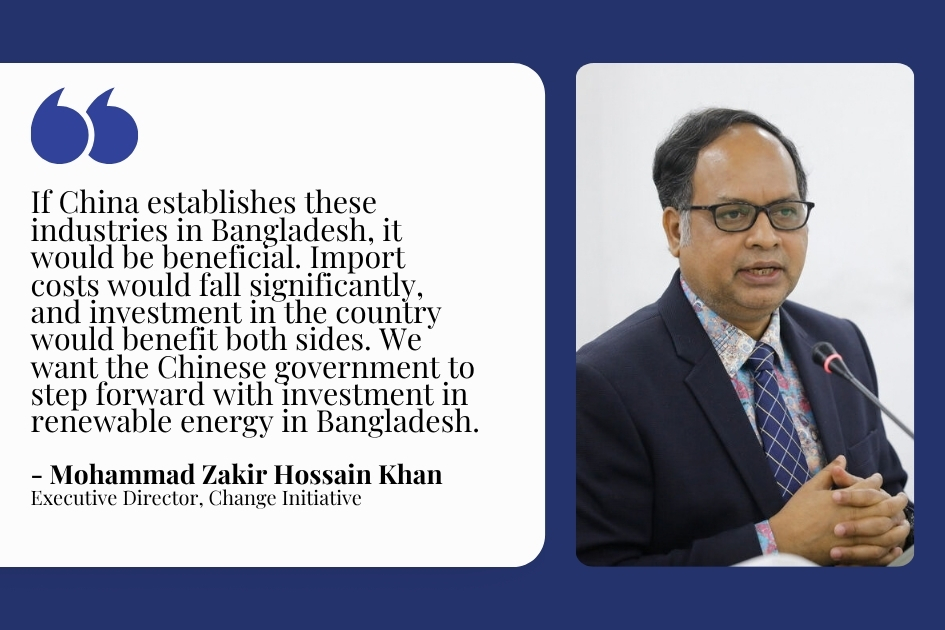
Mohammad Zakir Hossain Khan, executive director of Change Initiative, said China was the main source of imports for key components needed to expand renewable energy in Bangladesh, particularly solar panels and batteries. He said there was no alternative to China when it came to the easy availability of such products.
Local technicians were also familiar with the maintenance and repair of these products, having worked on them for years. Chinese companies establishing factories in Bangladesh would therefore benefit both countries by reducing import costs, he said.
He suggested that Chinese companies could establish factories jointly with rural electricity providers or distributors to serve communities where government electricity supply was not feasible, particularly in haor wetlands, hilly areas and places where grid expansion was not possible.
China could also install solar panels in industrial plots managed by the Bangladesh Small and Cottage Industries Corporation (BSCIC), where electricity shortages were a problem.
Investment in these areas could help ease Bangladesh’s financial constraints, he said. Chinese companies could also establish factories in partnership with local firms.
However, he stressed that quality assurance was essential for imported solar panels. Poor-quality products could cause serious financial, environmental and agricultural damage.
If imported solar panels failed to meet quality standards, farmers could lose access to irrigation and their crops could be damaged. Similarly, if solar panels installed at industrial facilities failed to work, production would be disrupted.
“We want the Chinese government to come forward with investment in renewable energy in Bangladesh,” he said, adding that the government should implement its five-year renewable energy development plan in phases.
Investment from China is needed to manufacture military weapons and equipment
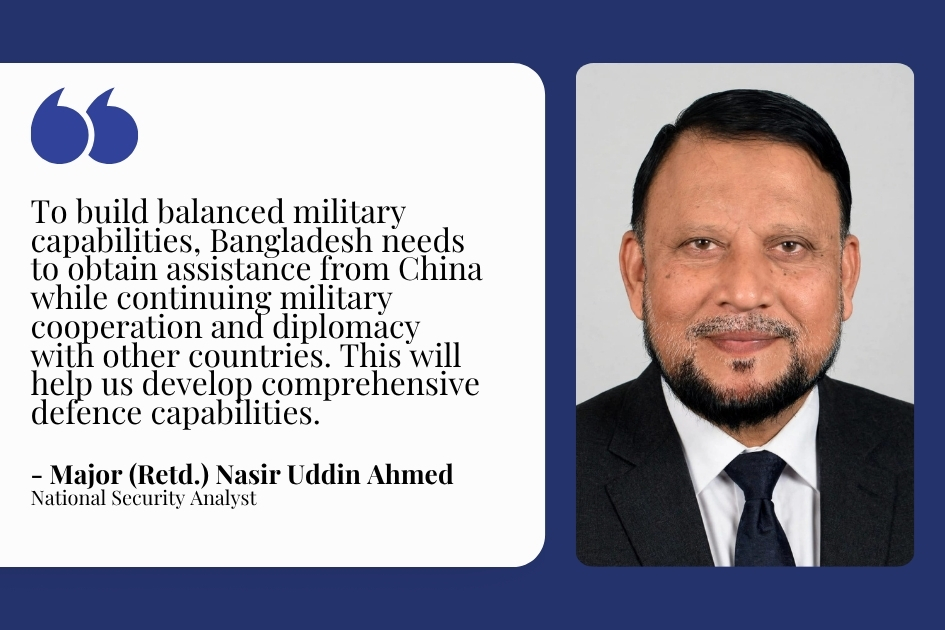
Major (retired) Nasir Uddin Ahmed, a national security analyst, said Bangladesh’s military ties with China had a long history.
He said Bangladesh had recently begun a process to purchase fighter aircraft from China. Even before that, China had provided assistance in various ways, including small arms, grenades, medium machine guns and submarines for the navy.
He said China’s main objective was to establish a military bloc in the subcontinent that could facilitate coordinated military action against potential adversaries when necessary.
India was China’s principal rival in the region, with which it had border disputes. China wanted neighbouring countries, particularly Pakistan and Bangladesh, to be militarily strong so that India could not redeploy troops from its borders with Pakistan and Bangladesh to the Chinese border during a major conflict, he said.
China had long sought to strengthen the military capabilities of Pakistan, Bangladesh and Myanmar, and those efforts continued, he said.
He added that China had opportunities to assist the military capabilities of all three countries, including their navies and air forces. How Bangladesh chose to accept such assistance would depend on its own judgement.
He said Bangladesh needed to maintain a balanced foreign military policy, taking into account its potential security challenges along its borders with India and Myanmar.
China could provide an opportunity in this regard, he said, but Bangladesh also needed to maintain technological cooperation with countries such as the United States and France. Bangladesh had obtained radar systems from France and received some technological assistance from the United States.
Such diversification was strategically important because relying on a single country could undermine Bangladesh’s sovereignty and military capabilities. If relations with that country deteriorated, Bangladesh could find itself in a vulnerable position, he said.
He added that Bangladesh also had opportunities to maintain military relations with Russia. The country had previously imported Mi-17 and other helicopters, as well as transport aircraft, from Russia.
To build balanced military capabilities, Bangladesh needed to obtain assistance from China while continuing military cooperation and diplomacy with other countries, he said.
Asked whether Bangladesh could attract Chinese investment in manufacturing military weapons and equipment, the analyst said there were clear opportunities.
He said China supplied not only weapons but also equipment regularly used by Bangladesh’s armed forces and equipment required for United Nations peacekeeping missions.
Bangladesh could save foreign currency and reduce its dependence on imports by manufacturing such equipment domestically, he said.
He added that, to his knowledge, some progress had already been made in this area. Efforts were also underway to manufacture drones in Bangladesh with Turkish assistance, which he described as a positive development.
He said the government should take initiatives to attract Chinese investment in manufacturing military weapons and equipment for the armed forces and law enforcement agencies.
China has been Bangladesh’s largest trading partner for 16 consecutive years
In a statement issued on October 1 to mark the 77th anniversary of the founding of the People’s Republic of China, the Chinese Embassy in Bangladesh highlighted various aspects of cooperation between the two countries in trade, investment, infrastructure and healthcare.
According to the statement, bilateral trade reached $12.8 billion in the first six months of 2026, an increase of 10.6 per cent from the same period last year.
It also said China had been Bangladesh’s largest trading partner for 16 consecutive years, from 2010 to 2025.
According to the embassy, total Chinese investment in Bangladesh stood at $3.6 billion as of June 2026. Chinese foreign direct investment in Bangladesh increased by nearly 50 per cent in 2025 compared with the previous year.
Operations at the China Economic and Industrial Zone in Chattogram officially began in July this year. The zone focuses on textiles and garments, machinery manufacturing, electronics and information technology, biotechnology and environmentally friendly energy.
The Chinese Embassy said the zone had attracted interest in potential investments worth around $500 million.
Regarding infrastructure, the embassy described the Padma Bridge as one of the most important examples of infrastructure cooperation between Bangladesh and China.
It also said Chinese companies’ coal, solar and wind power projects in Bangladesh had a combined generation capacity of more than 1,000 megawatts.
A series on economic diplomacy | Part 3




