

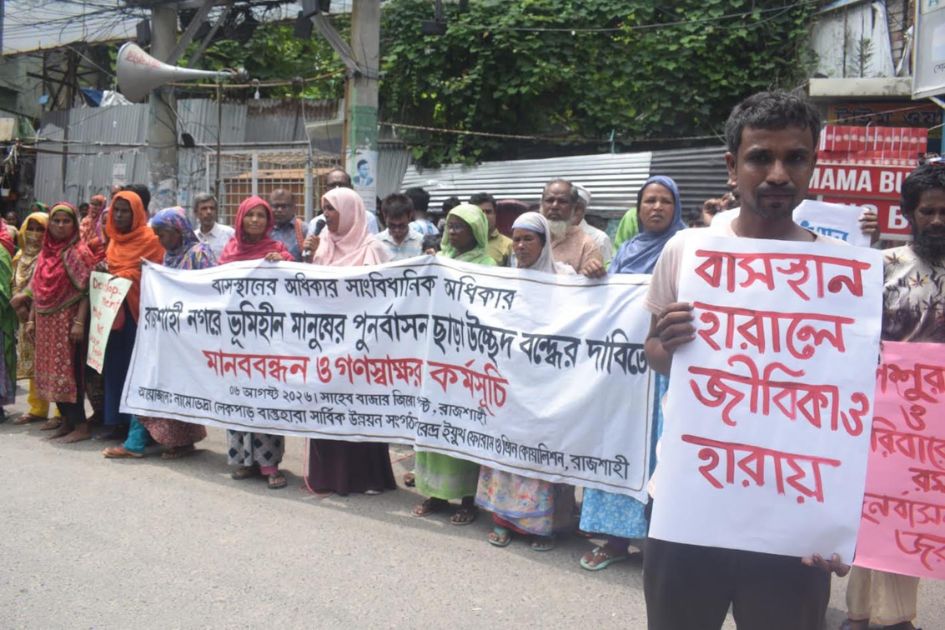



Protesters said thousands of low-income and climate-displaced families in Rajshahi remain vulnerable to displacement, urging authorities to prioritise rehabilitation, housing rights and community participation in urban development planning.
Residents of informal settlements, rights activists and civil society groups staged a human chain and signature campaign in the northwestern Bangladesh city of Rajshahi on Thursday, demanding an end to slum evictions without rehabilitation and calling for secure housing for low-income communities.
The programme was held at Saheb Bazar Zero Point in Rajshahi city and was jointly organised by the Namobhadra Lake Area Displaced People’s Development Organisation, Green Coalition and Barendra Youth Forum.
Participants included members of civil society, slum residents, human rights activists, labourers, teachers, students and representatives of various social organisations.
Speakers said thousands of families living for years in 104 slum settlements across Rajshahi, including the Namobhadra Lake area, were facing uncertainty over possible eviction and were living in inhumane conditions. They said most residents were rickshaw pullers, construction workers, domestic workers, small business owners, transport workers and day labourers whose work keeps the city’s economy functioning, yet they remain deprived of the basic right to secure housing.
The speakers said housing was not only a social necessity but also a fundamental right. They said Bangladesh’s Constitution, international human rights instruments and the Sustainable Development Goals place responsibility on the state to ensure safe, dignified and inclusive housing for citizens, adding that no eviction without rehabilitation could be considered humane or just.
Bachchu Mia, president of the Namobhadra Displaced People’s Development Organisation, said: “We are not occupiers. We are working people of this city. Rajshahi runs on our sweat. Yet every day we live in fear of losing the last shelter over our heads. We do not want eviction. We want the right to live with dignity.”
Namobhadra slum resident Jesmin Khatun said: “We ask the Bangladesh government and Tarique Rahman to provide us with homes before evicting us. If the Rohingya can have a place to stay in this country, then why can’t we, who are citizens of this country?”
Khalil Hossain, a resident of Jamalpur slum, said: “We came here after river erosion forced us from our homes. We collect dirty bottles, polythene and waste from this city. We keep the city clean, but we have no place to live.”
Nilufa Ismat Ara, member secretary of the Urban Poor Rights Implementation Committee and a resident of Jamalpur slum, said: “Losing a home does not only mean losing an address. It also means losing a child’s education, a family’s security, opportunities for livelihoods and dreams for the future. The government should see us as citizens, not criminals. We vote during elections too, and we want our rights.”
Mati Mia, a resident of Baharampur slum, said: “We have been working in this city for years. If I do not cook, your meals will not be prepared. If I do not clean houses, they will not be cleaned. Yet there is no recognition of our work or our existence. We want our children to build their future in a safe home instead of living in fear of eviction.”
Mahbub Siddiqui, president of Green Coalition Rajshahi, said: “A civilised city can never write its development story by evicting its most vulnerable people. At a time of climate change, poverty and urbanisation, ensuring safe housing is one of the key conditions for social justice and climate justice. Evictions without rehabilitation also violate international human rights principles.”
Barendra Youth Forum president Md Atikur Rahman said: “If Rajshahi is to become a truly inclusive, humane, sustainable and climate-resilient city, then development planning must also take into account these climate-displaced people. We do not want development that takes away the roofs over poor people’s heads. Development must ensure rehabilitation first. That is the responsibility of a just state.”
Anthropologist Shahidul Islam, member secretary of Green Coalition Rajshahi, said: “Research around the world shows that forced evictions deepen poverty, increase social inequality and have long-term negative impacts on children’s education, health and livelihoods. It is now time to ensure the participation of slum residents in urban development planning and establish rehabilitation as a legal obligation. Safe housing is not charity. It is a fundamental human right.”
He added: “Housing projects have been undertaken at different times for the urban poor and slum dwellers in Dhaka and Chattogram, but despite development projects worth billions of taka in Rajshahi, no housing project has been undertaken for the city’s urban poor and climate-displaced people.”
Professor Dr Golam Sarowar Sujon of the Department of History at the University of Rajshahi said: “No eviction should take place without rehabilitation. Housing, education and healthcare are fundamental rights, but slum residents receive none of these. They live in extreme hardship. The Liberation War of 1971, the mass uprising of the 1990s and the mass uprising of 2024 were all fought to secure these fundamental rights. People gave their lives in every movement, but those rights have been taken away and plundered. We no longer want to see this. These people’s housing must be ensured before any eviction takes place.”
Mahmud Jamal Kaderi, convener of the July-36 Council, presented a five-point charter of demands during the programme. The demands called for an end to any slum eviction in Rajshahi without guaranteed rehabilitation, the adoption of safe, dignified and environmentally friendly housing plans for all slum residents, the provision of basic services including water, sanitation, healthcare, education and social protection, the participation and consultation of affected communities before any eviction-related decisions are made and giving priority to housing rights for the urban poor in local and national development planning.
Speakers also urged the relevant authorities, elected representatives and policymakers to ensure that Rajshahi becomes a humane, inclusive, climate-resilient and sustainable city through equitable development that leaves no community behind. They said development should ensure housing rights rather than making people homeless.
Among those expressing solidarity at the programme were Tasnuva Amin, a student at the University of Rajshahi, and Gopal Deb Sharma, president of the Somporko Social Welfare Organisation.
The organisers said the signature campaign would continue alongside the human chain, and that the collected signatures would be submitted to the relevant government authorities to press for an end to evictions without rehabilitation and for effective measures to protect the housing rights of the urban poor.




