

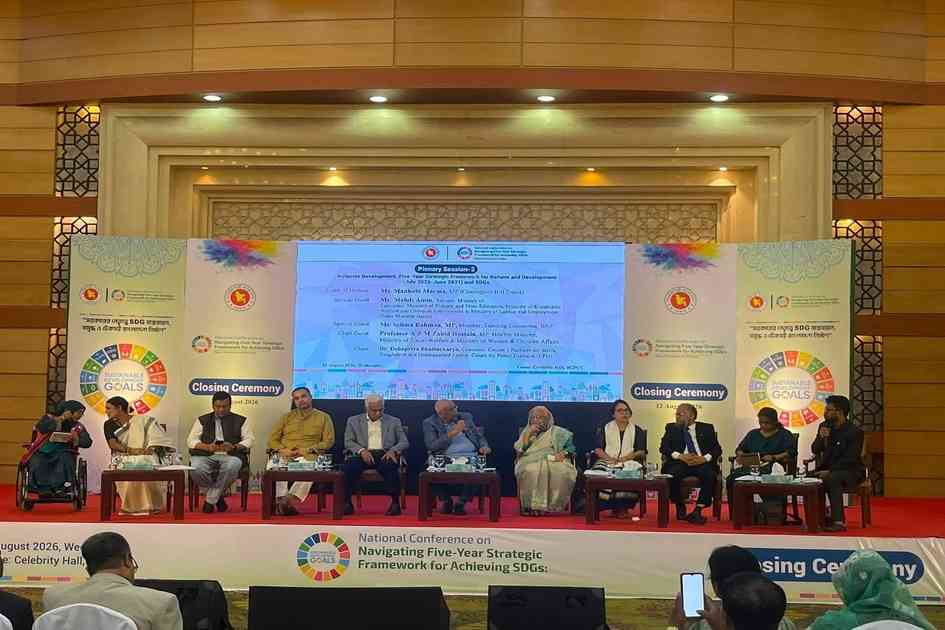



At a Dhaka SDG forum, officials, advocates and community representatives urged legal identity, accessible services, decent work and stronger protection for groups excluded from Bangladesh’s development process.
A lack of birth registration and National Identity cards is leaving large numbers of people from marginalised communities in Bangladesh unable to access education, healthcare, social protection and other essential public services, speakers said at a national conference on sustainable development.
The issue came into sharp focus during a plenary discussion on inclusive development and the five-year strategic framework for achieving the Sustainable Development Goals (SDGs), held at the Bangladesh-China Friendship Conference Centre in Dhaka.
Speakers called for coordinated government action to close the documentation gap, create decent employment opportunities, improve accessibility and ensure that marginalised communities are meaningfully included in Bangladesh’s development process.
Advocate Madhabi Marma MP, a lawmaker representing a reserved women’s seat for the Chittagong Hill Tracts, said geographic isolation prevents many communities in the hill districts from accessing education, healthcare and other essential services.
She also stressed the importance of protecting indigenous peoples’ land rights and ensuring that development policies reflect the specific needs of communities living in remote areas.
Professor Dr S M Abdul Awal, Principle Coordinator for SDG implementation in Bangladesh at the Prime Minister’s Office, pledged that the government would work to improve the lives and opportunities of the Manta community.
He said he would raise the issue with the Prime Minister, signalling greater policy attention to a community that remains largely outside formal systems of documentation and social protection.
Selima Rahman MP, BNP Standing Committee Member and reserved women’s seat lawmaker, was among the senior political representatives participating in the discussion.
Social Welfare Minister Professor Dr A Z M Zahid Hossain, who attended the session as chief guest, said the government wants to build a more humane Bangladesh where marginalised people and persons with special needs receive priority.
He said the government aims to achieve its five-year SDG targets within four years and plans to expand therapy services for persons with disabilities to the upazila level through mobile units.
Prime Minister’s Adviser and his office spokesperson Dr Mahdi Amin said district-level Employment Exchanges would be introduced to connect jobseekers with employers.
He also said the government plans to recruit 100,000 social and medical care workers nationwide, with women expected to account for around 80 percent of those jobs.
Ashrafun Nahar Misti, Taslima Akhter, Sohanur Rahman and Ramisa Chowdhury joined the session, highlighting barriers faced by persons with disabilities, informal workers, the Manta community and the hijra community. They called for accessible infrastructure, stronger documentation systems, skills development, economic empowerment, social protection and meaningful participation in development for all.
The session was moderated by Dr Debapriya Bhattacharya, Convener of the Citizen’s Platform for SDG Implementation.
The discussion underscored a central challenge for Bangladesh’s SDG agenda: development cannot be truly inclusive if people remain invisible in official systems or are unable to access basic rights and public services.
For Bangladesh to achieve its development targets, speakers said, marginalised communities must be recognised not simply as recipients of assistance but as rights holders and active participants in shaping policies that affect their lives.
The challenges facing the Manta community also demonstrate why climate justice, social protection, documentation, employment and inclusion must be addressed together.
Ensuring that every person can obtain legal identity, access essential services, develop skills, find decent work and participate meaningfully in society will be critical to achieving the central promise of the Sustainable Development Goals: leaving no one behind.




