

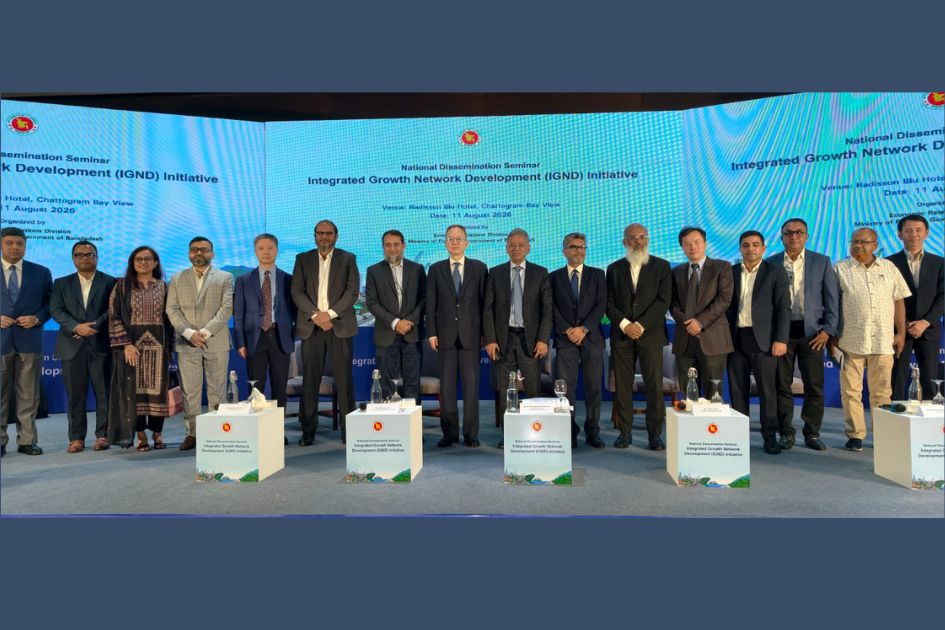



The IGND initiative places Chattogram at the centre of plans to strengthen logistics, energy, investment, skills and regional trade links for more balanced growth.
The Asian Development Bank plans to provide up to $5 billion in support over the next five years to accelerate Bangladesh’s economic growth through infrastructure, connectivity, logistics, energy and human resource development, a senior bank official said Tuesday.
Yingming Yang, ADB’s vice president for South, Central and West Asia, made the announcement at the national launch of the Integrated Growth Network Development initiative at the Radisson Blu hotel in Chattogram, Bangladesh’s main port city, on August 11.
He said ADB President Masato Kanda presented the IGND report to the prime minister during a visit to Bangladesh in May and expressed interest in providing up to $5 billion in assistance over the next five years.
“This commitment reflects ADB’s confidence in Bangladesh’s future potential and the transformative capacity of IGND,” Yang said.
He said Bangladesh now faced the challenge of increasing productivity, competitiveness and economic resilience. This would require a more efficient logistics system, increased private sector investment, stronger connectivity and more effective links between markets and economic activities across different regions of the country, he said.
Yang said the IGND initiative was directly aligned with these priorities. It provides a strategic framework to strengthen economic links among key growth centres, raw materials and product markets across the country, with the aim of increasing productivity, boosting investment and creating quality jobs.
He said the greatest benefits would come from planning and implementing investments in infrastructure, logistics, energy, urban development and human resources in an integrated way rather than separately.
The initiative also emphasises creating growth opportunities in different regions, including the north-west of the country, to ensure more balanced and inclusive development, he said.
Highlighting Chattogram’s importance, Yang said the city would play a key role in increasing exports, attracting investment and strengthening Bangladesh’s position in regional and global value chains as the country’s main gateway for international trade.
Finance and Planning Minister Amir Khasru Mahmud Chowdhury said Bangladesh must work in an integrated way to turn its economy into a trillion-dollar one by 2034. To achieve that goal, he said, development of the power and energy, port and logistics, industrial, skilled workforce, tourism and digital sectors must be brought under the same plan.
“Our goal is not just to make Chattogram the commercial capital. We want Chattogram to become a hub for the entire region. There is no need to remain confined to a small area. Our goal is to use Chattogram’s potential and develop it as a hub for the whole region,” he said.
The finance minister said priority had been given to modernising power transmission and distribution systems, expanding renewable energy and battery storage, increasing gas exploration and supply and developing new LNG and LPG infrastructure to make use of Chattogram’s potential.
“This is why we have decided to create a free zone on 600 acres of land. A Chinese zone is being developed thereand there is also a Korean zone. Now I am telling the Japanese to set up a zone as well. We are also encouraging the Koreans to bring their other promising sectors here. We are going to Korea with several proposals on this matter,” he said.
“When these become zones, educational institutions, hospitality facilities, hospitals and other necessary developments will take place here. These will happen naturally. No one will have to say it separately,” he added.




