

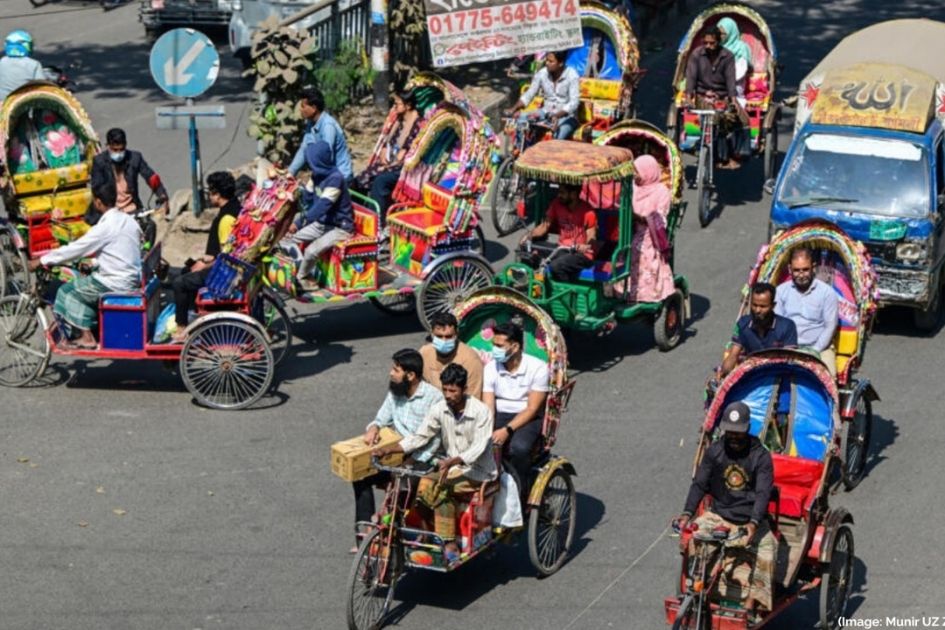



Dhaka’s e-rickshaw debate pits demands for safer, cleaner transport against concerns over livelihoods, regulation costs and the practical limits of a rapid transition.
Bangladesh Government’s proposed solar-charging rule for battery-powered three-wheelers exposes a hard trade-off between livelihoods, road safety and cleaner mobility. Battery-run and traditional rickshaws flooded Dhaka’s main roads and major thoroughfares after the political change and the fall of the Sheikh Hasina government during the July uprising in 2024.
The traffic light turns green. They surge forward.
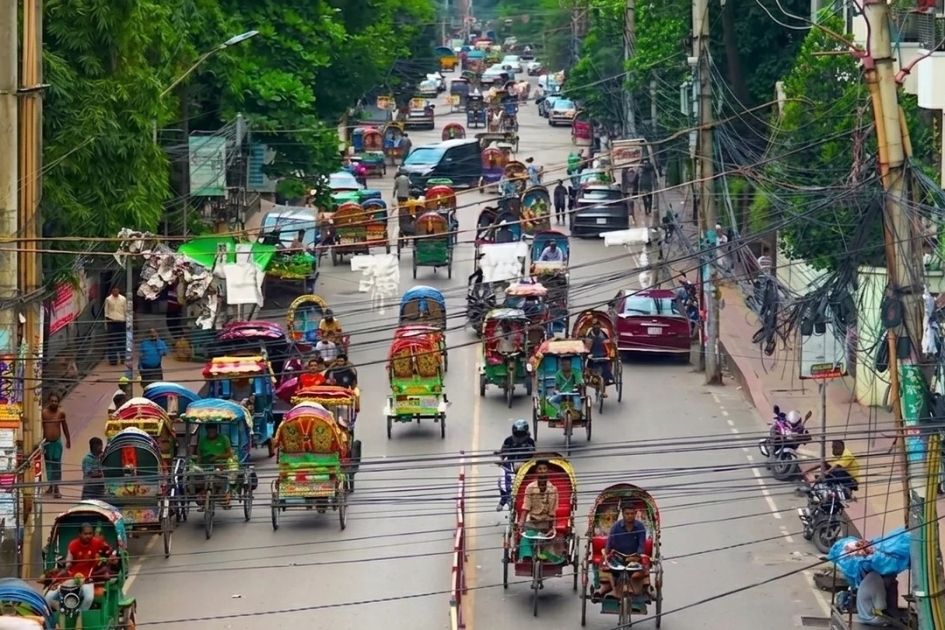
Battery-run auto-rickshaws spill across lanes, squeeze through gaps and emerge from side streets onto Dhaka’s busiest roads, adding another layer of pressure to a city already struggling with crippling congestion.
Now the government is moving to bring the rapidly expanding sector under formal regulation, including a proposal to make solar-powered charging a condition for registering or renewing battery-run rickshaws and auto-rickshaws.
The policy shift has opened a wider debate over road safety, electricity use, environmental sustainability and livelihoods. Within a single week, two very different groups took to the streets over the issue.
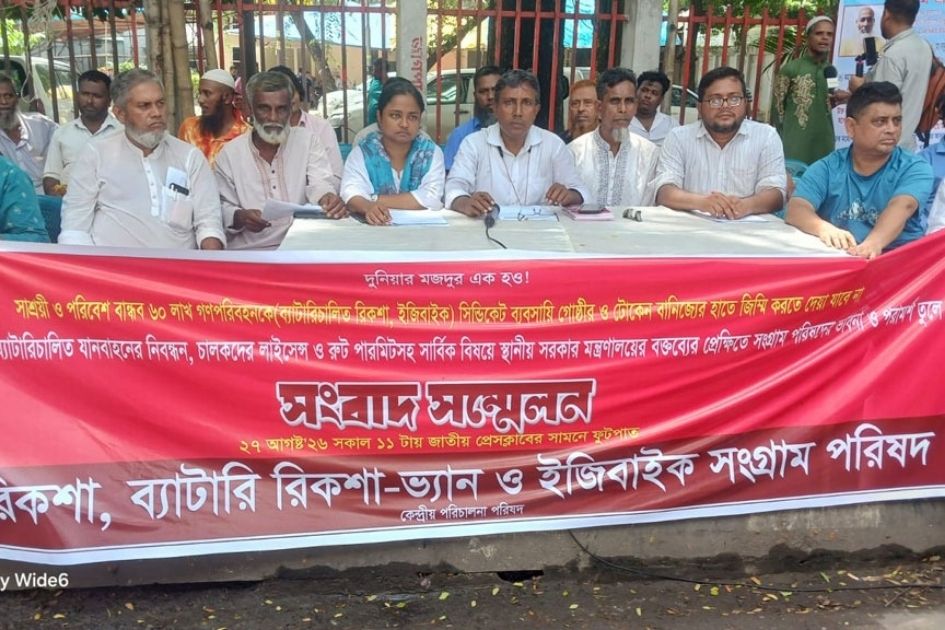
On Thursday, transport workers rallied in front of the National Press Club and held a press briefing against the proposed solar-charging requirement. On Friday afternoon, residents of Gulshan, Banani, Baridhara and Niketan gathered at Gulshan 2 to demand tougher enforcement against what they described as unauthorised and unsafe battery-powered three-wheelers.
The two demonstrations capture the central dilemma facing policymakers in Dhaka. Battery-powered rickshaws and easybikes have become an important part of urban transport, offering relatively cheap last-mile rides while providing income to large numbers of workers. But their rapid and largely informal expansion has also fuelled concerns over congestion, road safety, vehicle standards, electricity use and the handling of lead-acid batteries.
Workers’ representatives say at least 4 million people could face severe hardship if battery-powered rickshaws and other such vehicles are abruptly removed from the streets.
The workers are not rejecting regulation. They are challenging the pace, cost and design of the government’s proposed transition.
Workers demand regulation, but not an abrupt crackdown
At Thursday’s rally, the Rickshaw, Battery-Powered Rickshaw-Van and Easybike Struggle Council presented a six-point set of demands covering regulation, manufacturing, infrastructure, cleaner technology and the future of existing vehicles.
The council called for battery-powered rickshaws, auto-rickshaws and other slow-moving vehicles to be brought under training, registration and route permits through a comprehensive and coordinated policy and regulatory framework. It also called for protection of the local automobile industry.
The workers demanded that local manufacturers be allowed to produce and market vehicles based on government-approved e-rickshaw designs, alongside advanced training for mechanics. They also said no particular business group or commercial syndicate should receive preferential treatment in production or marketing.
The council called for parking facilities and charging stations at important points on the road network and demanded government support or subsidies to help operators shift towards cleaner lithium batteries.
It has opposed the proposed requirement that vehicles must use solar power for charging as a condition for registration or renewal, arguing that the cost could be beyond the means of low-income drivers and small vehicle owners.
The workers further demanded at least two years for existing vehicles to be modified or upgraded to meet any new government-approved design and technical standards.
They also called for dedicated lanes or service roads for slow-moving vehicles, including battery-powered rickshaws and auto-rickshaws, so that they can be separated from faster traffic rather than simply removed from the road network.
Khalekuzzaman Lipon, convenor of the council, said policymakers were focusing on congestion, accidents and electricity demand while overlooking the economic reasons behind the rapid growth of battery-powered three-wheelers.
“High unemployment is pushing people into rickshaw driving, while passengers depend on these vehicles because they are affordable and often one of the few practical options available,” he said.
The workers argue that the government could introduce safer and regulated alternatives to replace unauthorised vehicles rather than simply removing them from the streets.
Such a transition, they say, would reduce hardship among transport workers while allowing the government to increase revenue through vehicle registration and improve road safety.
Their demand for dedicated lanes reflects that approach. Rather than eliminating slow-moving vehicles from the urban transport network, they argue that separating them from faster traffic could reduce conflicts while preserving their role in local and last-mile mobility.
Their demand for at least two years to upgrade existing vehicles also reflects the financial reality facing drivers and small vehicle owners. For people who depend on daily operation for income, replacing or substantially modifying a vehicle can represent a major financial burden.
What the government is proposing
Under the framework outlined by State Minister for Local Government, Rural Development and Cooperatives Mir Shahe Alam, registration of battery-powered e-rickshaws would be handled by city corporations and municipalities rather than the Bangladesh Road Transport Authority, or BRTA.
The government has proposed making solar-powered charging a condition for registration or renewal. Under the proposed framework, vehicles charged from non-solar sources would not qualify for registration or renewal, while continued use of conventional electricity for charging could result in penalties.
Vehicles would also require fitness certificates from designated technical institutions, including the relevant automobile branch of the Bangladesh University of Engineering and Technology, or BUET, and government polytechnic institutes at district level. The certificates would be submitted to local authorities with a countersignature from traffic police.
The government has also said Dhaka would be divided into eight zones, with e-rickshaws assigned to specific zones. Different colours would be used to distinguish vehicles by zone, while geofencing would be used to prevent vehicles from one zone operating in another.
Separately, Road Transport Minister Sheikh Robiul Alam has said the government is moving towards restricting battery-run auto-rickshaws from major roads and highways as part of an effort to keep slower vehicles away from faster traffic.
“We are moving towards a policy decision that auto-rickshaws will not be allowed to operate on roads in important areas under any circumstances,” he said.
The regulatory framework marks a major attempt to formalise a sector that has expanded faster than the institutions designed to regulate it.
For passengers, battery-powered three-wheelers provide relatively cheap and accessible last-mile transport. For drivers, mechanics and small operators, they have become an important source of income.
Their rapid growth, however, has raised persistent concerns over congestion, road safety, electricity use, vehicle design and unregulated manufacturing.
A key practical question remains what exactly will qualify as solar charging. Whether the requirement involves dedicated solar-powered charging stations, individual vehicle-mounted systems or another arrangement will have a major bearing on the cost and feasibility of the policy, particularly in densely built parts of Dhaka where land for new infrastructure is limited.
Safety concerns are real, but the data are broad
Drivers themselves acknowledge that the sector lacks adequate discipline.
“Anyone who has never driven a vehicle before can start operating an auto-rickshaw,” one driver said. “There should be discipline. Drivers should be properly qualified.”
Commuters have also complained about sudden turns, lane changes and slow-moving vehicles operating alongside faster traffic.
“These vehicles should not be allowed on main roads,” one commuter said after recalling damage to his motorcycle in a collision.
Road safety remains a major concern.
The Road Safety Foundation recorded 1,376 deaths among drivers and passengers of different categories of three-wheelers in 2025, accounting for nearly 19 percent of all road deaths recorded by the organisation that year.
The figure includes battery-powered rickshaws, easybikes, CNG-run auto-rickshaws and human haulers and therefore cannot be attributed to battery-powered vehicles alone.
More detailed crash data by vehicle type would help regulators identify the specific risks associated with battery-powered three-wheelers rather than treating all three-wheelers as a single category.
No standards, no control
Prof. Dr. Md. Hadiuzzaman, a transport and road-safety expert and former director of BUET’s Accident Research Institute, said one of the sector’s biggest weaknesses is the absence of uniform design and technical standards.
“We are making auto-rickshaws according to our own preferences,” he said.
“There is no model specification and no standard. This cannot continue.”
He said workshops should come under technical oversight and manufacturers should require approval before producing battery-powered vehicles.
The proposed use of a BUET-developed prototype could provide a basis for standardising vehicle design and manufacturing.
Such standards could address braking systems, structural safety and electrical components. But standards alone will not be enough. Effective regulation will also require inspection capacity and enforcement at workshops and on the roads.
For small manufacturers and mechanics, the cost and timing of compliance could determine whether the proposed system is workable.
The battery and lead poisoning question
The environmental risks associated with battery-powered transport cannot be separated from the way batteries are manufactured, used, collected and recycled.
UNICEF has estimated that more than 35 million children in Bangladesh have elevated blood lead levels, while unsafe lead-acid battery manufacturing, handling and informal recycling have been identified as important sources of exposure.
The risk is therefore not electric mobility itself but the wider battery supply chain. Poorly regulated battery manufacturing, handling and informal recycling can expose workers and communities to toxic lead.
The environmental performance of electric three-wheelers also depends on how electricity is generated, how charging infrastructure is designed and how batteries are collected and recycled at the end of their useful life.
A cleaner transport policy therefore needs to address battery management as well as the source of electricity used for charging.
Calls for a just transition
Sohanur Rahman, Executive Coordinator of YouthNet Global, supports solar charging as a long-term clean-mobility goal but warned that an immediate nationwide mandate may be difficult to implement without adequate infrastructure, financing and enforcement capacity.
“Solarising three-wheelers should be our next step in clean mobility,” Rahman said. “But mandating solar charging for Bangladesh’s millions of electric rickshaws is currently unrealistic as a nationwide standalone system because of severe urban space constraints, high equipment costs and weak enforcement capacity.”
He said the transition must take into account the financial realities of drivers, vehicle owners, mechanics and small charging operators.
“Lead-acid batteries are certainly a concern, but a green transition cannot become a burden on the people whose livelihoods depend on these vehicles,” Rahman said.
“This has to be a just transition, with affordable access to cleaner technology, financing, training and social protection for workers.”
Rahman called for a phased approach linking clean-charging targets with available infrastructure, financing and enforcement capacity, alongside technical training and systems for the safe management and recycling of used batteries.
“The growing conflict shows why social dialogue is crucial,” he said. “The government, workers, manufacturers, transport experts and civil society need to sit together and agree on a practical and just pathway for the transition.”
The economics of that transition remain central. The eventual cost will depend on the price of charging infrastructure, battery replacement or conversion, vehicle modification, registration and compliance, as well as the availability of financing for drivers and small operators.
Residents demand immediate action
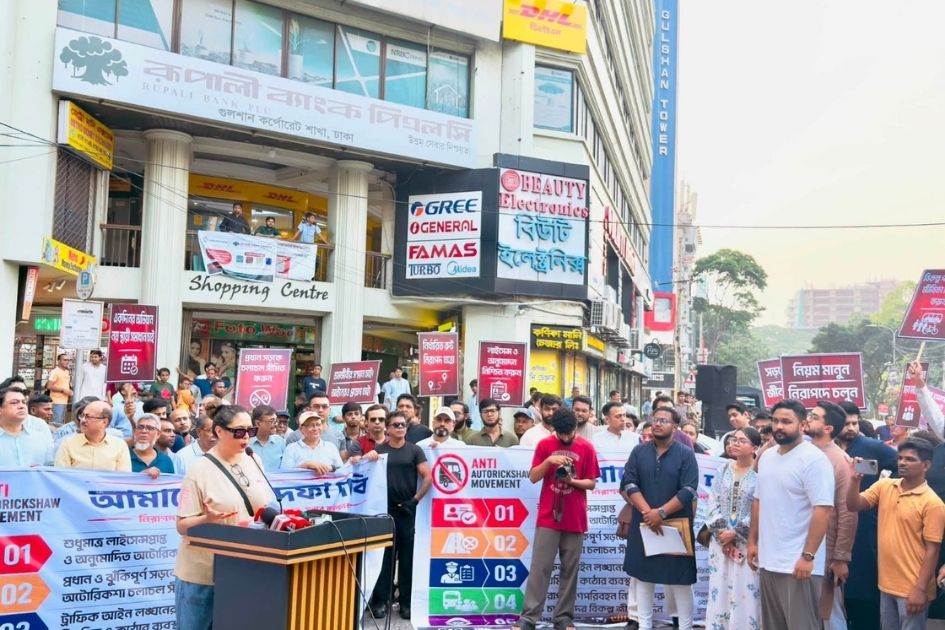
On Friday afternoon, residents of Gulshan, Banani, Baridhara and Niketan held a mass gathering at Gulshan 2 to protest what they described as the unchecked presence, disorder and lack of security associated with unauthorised battery-powered three-wheelers.
Shah Rafayet Chowdhury of the Anti Auto Rickshaw Movement said the protest was driven by frustration over what residents see as a failure to enforce existing rules.
“Dhaka is my home. I am frustrated about how unregulated and unlicensed vehicles like auto-rickshaws are freely moving on our streets, with no remorse or consequences. They are not only putting our lives at risk, but are creating a narrative that they rule this city, which is a slap to all our faces who continue to abide by the laws of responsible citizens living in this city,” he said.
Speakers expressed concern over traffic congestion, environmental pollution and road safety and warned that they would intensify their street movement if authorities failed to take immediate enforcement measures.
Participants cited figures suggesting that congestion has reduced urban traffic speeds to below 5 kilometres per hour and pointed to estimates of roughly $3 billion in annual economic losses associated with traffic congestion.
The figures were cited by participants at the gathering and should be considered alongside the methodology and source of any underlying congestion estimates, particularly because measuring the economic cost of congestion across Dhaka involves multiple variables.
Residents also raised concerns about lead-acid battery waste and possible contamination from poorly managed batteries.
They questioned what they described as administrative inaction despite widespread traffic violations, arguing that law-abiding residents and taxpayers should not have to bear the consequences of unchecked violations.
Some speakers proposed that drivers affected by restrictions should be helped into alternative employment, including opportunities in the ready-made garment industry or formal professional driving.
Organisers said they would intensify their street campaign if authorities failed to act.
Residents’ five demands
The residents’ demands, as outlined by speakers at the Gulshan 2 gathering, focused on removing unauthorised three-wheelers from their neighbourhoods while addressing the consequences for drivers.
They called for the removal of unauthorised battery-powered three-wheelers from Gulshan, Banani, Baridhara and Niketan and demanded immediate enforcement against traffic violations involving such vehicles.
They also called for measures to ensure safer and more disciplined road use, including stronger traffic management and greater protection for residents and other road users.
Another demand focused on environmental and public-health concerns, particularly the risks associated with the improper handling and disposal of lead-acid batteries.
At the same time, speakers called for alternative livelihoods for affected drivers, including opportunities in the ready-made garment sector or formal professional driving, arguing that enforcement should not simply leave workers without an income.
The organisers said they would remain on the streets and intensify their movement until their demands were addressed.
Two sides, one difficult transition
The workers’ and residents’ demands are not entirely incompatible. Both sides say they want safer and better-regulated roads. Their sharpest disagreement is over timing, enforcement and who should bear the cost of change.
Workers are asking for formal recognition, infrastructure, technical standards, financial support and time to comply with new rules.
Residents are demanding immediate action against vehicles they consider unauthorised and unsafe.
The policy challenge is therefore not simply whether battery-powered three-wheelers should exist. It is how to separate unsafe vehicles and practices from a transport system that millions of passengers and workers now depend on.
Formal registration, driver training, technical standards, manufacturing controls, organised charging and route management could bring greater accountability without necessarily eliminating the vehicles from the transport system.
But those measures will only work if they are affordable for small operators and backed by sufficient inspection and enforcement capacity.
The dispute also points to a deeper question about who should finance Bangladesh’s transition to cleaner urban mobility. If drivers are expected to replace batteries, modify vehicles, pay registration costs and adapt to new charging arrangements, the government will need to consider whether financing or other support mechanisms are necessary to make compliance possible.
The road ahead
The question facing Bangladesh is no longer simply whether battery-powered three-wheelers should be regulated. It is whether they can be made safer and cleaner without making low-income workers pay the entire price of the transition and without leaving Dhaka’s residents to bear the cost of continued disorder on the roads.
A blanket ban could threaten livelihoods and reduce access to low-cost transport. Continued weak oversight, however, could deepen concerns over congestion, road safety, unregulated charging, unsafe battery handling and poorly designed vehicles.
A workable policy will require more than registration and route restrictions. It will need enforceable technical standards, safer manufacturing, trained drivers, organised charging and parking infrastructure, affordable access to cleaner technology, safe battery collection and recycling and a realistic transition period.
The shift towards solar charging should be phased according to available land, infrastructure, financing and enforcement capacity rather than imposed through a one-size-fits-all approach.
The government, workers, manufacturers, vehicle owners, charging operators, transport experts, local authorities, road-safety organisations and civil society all have a stake in how that transition is designed.
For now, both camps are keeping up pressure on the streets. The outcome will depend on whether policymakers can build a system that gives residents safer and more orderly roads while giving workers a realistic path into a regulated, cleaner and safer transport sector.




