

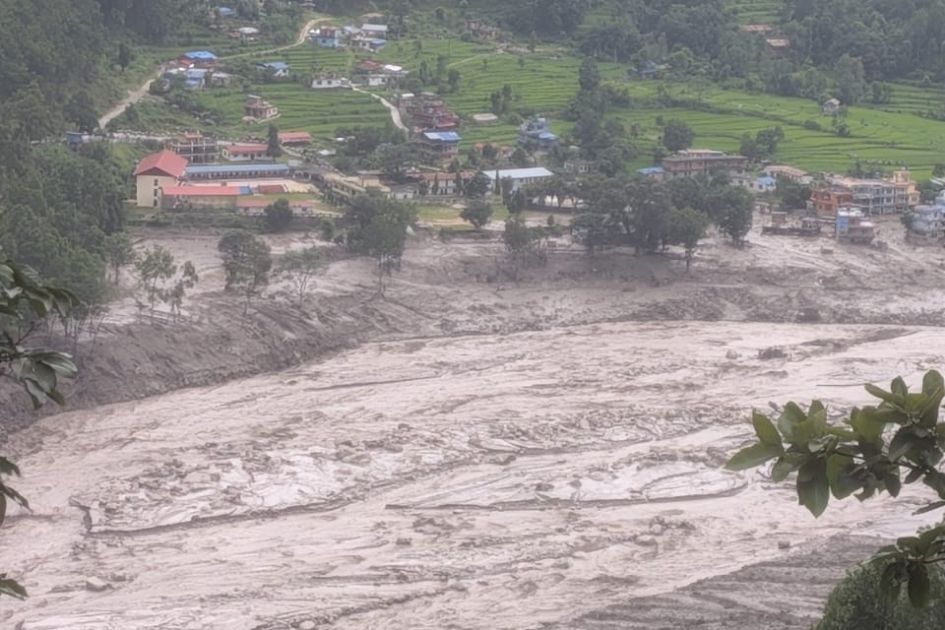



Nepal’s Bhotekoshi disaster renews scrutiny of slow climate finance as Himalayan communities face escalating glacial, flood and cascading cryosphere hazards.
A seven-year delay in approving a Green Climate Fund project intended to reduce the risks of Glacial Lake Outburst Floods in Nepal highlights failures in the international climate finance system, Friends of Earth Asia Pacific said Friday, following the devastating Bhotekoshi flash flood of Aug 26.
The organisation said the project had reportedly been in the Green Climate Fund’s pipeline since 2018 but was not approved until July 2025, despite rapidly escalating risks to Himalayan communities.
“It is absolutely shocking that the Green Climate Fund took seven years to approve a project aimed at protecting communities, infrastructure and ecosystems from increasing Glacial Lake Outburst Flood risks caused by human-induced climate change,” said Meena Raman, Climate Justice spokesperson for Friends of the Earth Asia Pacific.
“The project was in the GCF pipeline in 2018 but only got approved in July 2025. Had it been approved much earlier, early warning systems and other measures could at least have been in place to minimise the devastating impacts. This must not happen again. Time is of the essence when climate finance is intended to save lives.”
The organisation said the disaster showed that climate finance could not continue to move at a pace disconnected from the speed of the climate crisis. It called on the Green Climate Fund and developed-country governments that govern and fund international climate finance institutions to urgently accelerate financing for climate adaptation, disaster preparedness and resilience in vulnerable countries.
The Green Climate Fund, the world’s largest dedicated multilateral climate fund, was established under the UN Framework Convention on Climate Change to support developing countries in reducing emissions and adapting to climate change.
Friends of Earth Asia Pacific said Nepal’s experience raised fundamental questions about whether the fund was delivering climate finance at the speed and scale required by communities on the frontlines of the climate crisis.
“Climate change is accelerating, but climate finance is moving far too slowly,” Raman said. “For communities living below unstable glaciers and glacial lakes, seven years is not an administrative delay. It can be the difference between having an early-warning system and facing a disaster without adequate protection.”
The organisation said the Green Climate Fund should urgently review processes that have allowed critical adaptation projects to remain in the pipeline for years and establish mechanisms to prioritise projects addressing immediate and escalating climate risks.
It also called on the Fund for Responding to Loss and Damage to urgently provide financial assistance for rescue, recovery and reconstruction following the Bhotekoshi disaster.
“The Fund for Responding to Loss and Damage must also urgently respond with the financial assistance needed for rescue and recovery,” Raman said. “Developed-country board members of these funds must not delay action that can save lives. Immediate scaling up of resources for both adaptation and loss and damage is critical.”
Friends of Earth Asia Pacific expressed condolences to families who have lost loved ones, those still searching for missing relatives and survivors who have lost homes and livelihoods. It also acknowledged the Nepal Army, Nepal Police, local authorities, emergency responders and civil society members continuing rescue and relief operations.
The full scale of the catastrophe is still emerging, with hundreds reportedly missing and extensive destruction of settlements and critical infrastructure across Rasuwa, Nuwakot and downstream areas. Roads, bridges, hydropower facilities, communications systems, transmission lines, vehicles, businesses and border infrastructure have been damaged or swept away.
“We mourn those who have been lost and stand with the families still waiting for their loved ones. But this catastrophe must also become a national and international wake-up call,” said Puspa Dewy, Convenor of Friends of Earth Asia Pacific.
The organisation said the precise sequence of events behind the Aug 26 disaster must be established through an independent scientific investigation. Preliminary assessments have raised the possibility of an ice avalanche, rock fall or debris avalanche temporarily blocking the Lhende River and triggering a sudden surge of water and debris. A glacial lake outburst flood is also being investigated.
The reported absence of substantial rainfall immediately before the event highlights the increasingly complex and cascading hazards emerging from a rapidly changing Himalayan cryosphere, the organisation said.
The disaster followed the July 2025 Bhotekoshi/Lhende flood, which Nepal’s Department of Hydrology and Meteorology attributed to a glacial lake outburst near the Nepal-China border. The 2024 Thame disaster in the Everest region provided another warning, when a rock avalanche entering a glacial lake generated a displacement wave that breached the lake and released an estimated 156,000 cubic metres of water.
“The mountains have warned us. The rivers have warned us. The scientists have warned us. The people have warned us,” said Prakash Dahal of Friends of the Earth Nepal. “Nepal and the international community must now act before the next warning becomes another catastrophe.”
Friends of Earth Asia Pacific called on the Government of Nepal to establish a National Himalayan Cryosphere and GLOF Risk Monitoring and Early Warning Mission with permanent institutional status, dedicated financing and coordination among government agencies, scientific institutions, universities, security agencies and local governments.
The proposed system would include continuous satellite monitoring of glaciers and glacial lakes, high-resolution hazard mapping, automatic lake- and river-level monitoring, meteorological, seismic and hydrological observations, ground sensors and cameras, monitoring of moraine dams, ice cliffs and unstable slopes, comprehensive identification and ranking of potentially dangerous glacial lakes and 24-hour scientific monitoring during periods of heightened risk.
Nepal’s existing scientific assessments demonstrate the scale of the challenge. An ICIMOD-UNDP inventory identified 2,070 glacial lakes in Nepal across the Koshi, Gandaki and Karnali basins, including lakes assessed as potentially dangerous.
The organisation said GLOF and cryosphere hazard maps should become legally enforceable instruments of land-use planning. No major infrastructure should be approved in identified high-risk corridors without rigorous multi-hazard assessments, while existing settlements and infrastructure in extreme-risk areas should be assessed for strengthening, protection or phased relocation.
Friends of Earth Asia Pacific also called on governments, UN agencies, humanitarian organisations, development institutions, climate funds and civil society worldwide to provide immediate humanitarian assistance and long-term climate finance to Nepal.
The calls followed the Cryosphere Change, River Systems, and Youth Engagement in Nepal and the Asia-Pacific Region Conference, organised by Friends of Earth Asia Pacific and Friends of the Earth Nepal/Pro Public at Nagarkot on July 17, 2026.
The conference brought together scientists, government officials, researchers, environmentalists, lawyers, rights activists, mountaineers, journalists, youth and Friends of the Earth representatives from across Asia and the Pacific to examine climate impacts on the Himalayas, including the growing risks of GLOFs.
The conference’s Nagarkot Call for Action on Climate Justice warned of accelerating Himalayan ice loss and destabilisation.
Friends of Earth Asia Pacific said the Bhotekoshi disaster must mark a shift from reactive disaster response to proactive climate adaptation backed by accessible, predictable and timely international finance.
Because Himalayan hazards cross national boundaries, the organisation said Nepal should establish a permanent Nepal-China mechanism for real-time sharing of cryosphere, hydrological and meteorological information, including immediate notification of major avalanches, landslides, ice falls and glacial-lake changes, satellite imagery, emergency warnings, joint scientific investigations and regular disaster-response exercises.
It also said Nepal should make climate adaptation and resilience central to national development planning. Roads, bridges, hydropower projects, transmission lines, settlements, airports and tourism infrastructure must be designed for future climate and cryosphere conditions rather than historical risks.
Dedicated financing is also needed for GLOF preparedness, including monitoring, early-warning systems, protective infrastructure, relocation, ecosystem restoration, emergency communications and community preparedness.
“There can be no more excuses or delays from developed countries in meeting their obligations under the UNFCCC and the Paris Agreement,” Raman said.
“The communities most vulnerable to climate change cannot be expected to wait years for finance while glaciers destabilise and climate hazards intensify. Budgetary constraints cannot be an excuse when the most vulnerable are paying the price for a crisis driven overwhelmingly by historical emissions.”
Friends of Earth Asia Pacific called on developed countries, which it said bear the greatest historical responsibility for global greenhouse-gas emissions, to translate their commitments to climate justice into immediate, tangible and substantially scaled-up support for Nepal.




