

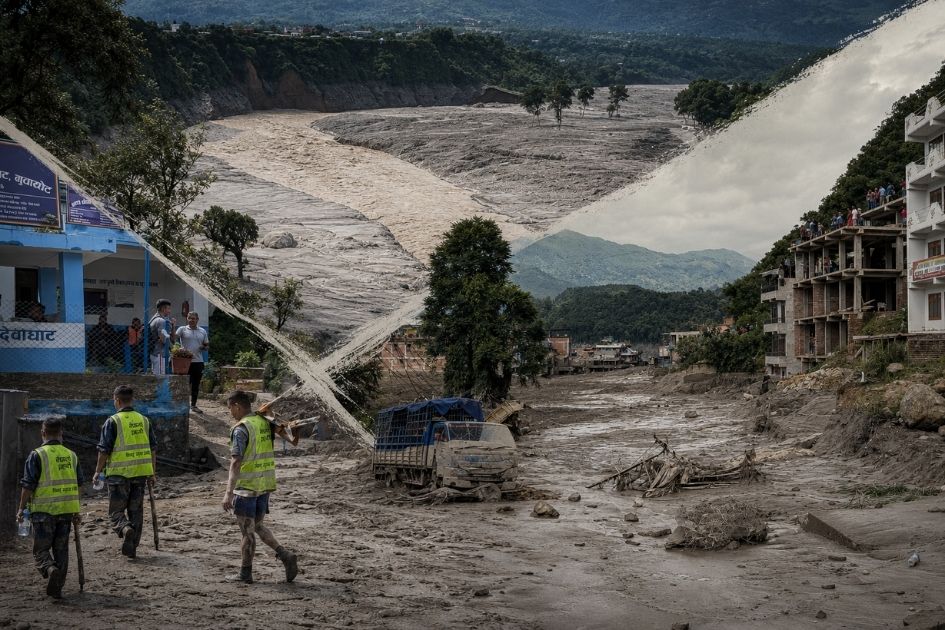



Scientists warn that warming temperatures, glacier instability and expanding meltwater lakes are increasing flood risks across Nepal’s Himalayan river basins.
The search and rescue operation continues for people missing after the flood in the Bhote Koshi River in Rasuwa. The bodies of those who lost their lives are still being recovered. The scale of destruction caused by the flood is difficult to put into words.
But how did a disaster of this magnitude occur? What role did the glacier play? And how serious is the possibility of a similar or even larger disaster in the coming days? These are now important questions.
According to available studies, the flood appears to have been triggered by a massive glacier avalanche on the northern side of the Langtang mountain range, about 20 kilometers northeast of the Miteri Bridge on the Nepal-China border. A mass of ice and snow fell from an elevation of around 5,000 meters to approximately 3,000 meters, triggering a major flood in the Lende Khola, preliminary studies suggest.
How Did the Disaster Become So Destructive?
According to Amrit Thapa, a Nepali scientist researching the Himalayan region and a PhD student at the University of Alaska Fairbanks, a landslide involving a hanging glacier may have played a major role in triggering the flood.
A hanging glacier is a glacier suspended on a steep mountain slope. After its lower sections break away and fall, the remaining upper section can also collapse as an avalanche. The energy generated by such a collapse can trigger a powerful flood.
However, Thapa says the exact source of such a large volume of water remains a subject of investigation.
“How that amount of water was generated is still a matter of research,” he said. “The studies so far indicate that there was a glacier collapse.”
Small pockets of water can form within glaciers, he explains. These pockets may have contributed to the unusually large volume of water released during the event.
Glaciers can develop cracks through which monsoon water penetrates deep into the ice. This can erode the interior and weaken the glacier. At the same time, ice becomes weaker during summer as temperatures rise and melting accelerates.
A glacier located on a steep slope is particularly vulnerable. As the ice weakens, sections can collapse and fall as an avalanche. Thapa believes a similar process may have occurred in Rasuwa.
How Much Is Climate Change Involved?
Rainfall, floods and landslides are natural processes. But scientists say the events increasingly being observed in the Himalayas cannot be understood simply as natural phenomena.
Basant Raj Adhikari, director of the Center for Disaster Studies at the Institute of Engineering, Tribhuvan University, and an expert who has conducted extensive research on Himalayan geology, climate change, landslide early warning and disaster management, says rising global temperatures are accelerating snow and ice melt in the Himalayas.
This is weakening glaciers and accelerating the formation of small lakes and ponds created by melting ice.
The impact of rising temperatures on glaciers is becoming increasingly visible. According to a study by the International Centre for Integrated Mountain Development (ICIMOD), the rate at which glaciers in the Hindu Kush Himalaya are losing ice has accelerated significantly since 2000.
Between 2000 and 2009, glaciers lost an average of 0.17 meters of water equivalent per year. Between 2010 and 2019, the rate increased to 0.28 meters per year, an increase of around 65 percent.
Glacier area has also declined significantly. Between 1990 and 2020, the total glacier area across the Hindu Kush Himalaya decreased by around 12 percent, while the estimated ice reserves declined by approximately 9 percent, according to the study.
Adhikari says the floods and landslides observed in recent years in places including Humla, Mustang and Sindhupalchok cannot be separated from the impacts of climate change.
Thapa also says recent events need to be understood in the context of climate change.
“We cannot simply describe these events as natural. The recent developments can be linked to climate change. They appear to be associated with rising temperatures and changes in the climate,” he says.
For glaciers, he says, snow is as important as food is to humans.
When fresh snow falls on time and remains through the winter, it is considered healthy for a glacier. But in recent decades, snowfall has increasingly become irregular, while snow that does fall often melts quickly. This is weakening glaciers and accelerating the formation of meltwater lakes.
The Risk Has Not Gone Away
Scientists say the scale of the recent flood is a major warning of the risks Nepal faces in its Himalayan region. Similar events could occur again and potentially become more severe.
The risks appear particularly high in the Trishuli and Bhote Koshi river basins. Scientists say ice melt and the formation of glacial lakes and small meltwater ponds are accelerating in these areas.
According to an ICIMOD study, 242 glacial lakes have been identified in the Trishuli basin and 269 in the Bhote Koshi-Poiqu basin, including the Tibetan region. These figures are based on a 2015 assessment.
If any of these lakes were to burst, or if a large section of a glacier were to collapse suddenly, it could trigger a destructive flood downstream in Nepal.
But the problem is not only the risk itself. The lack of information about that risk is also a major challenge.
According to Thapa, some research is being carried out in areas accessible from the Nepali side. However, there is insufficient information about the condition of glaciers and glacial lakes on the Tibetan side.
“Extensive research is needed to understand the situation. A small effort will not be enough; the government itself needs to invest,” Thapa says.
Regular information about the condition of glaciers and glacial lakes could help authorities assess potential risks, issue early warnings and, at the very least, reduce loss of human life.
Given Nepal’s mountainous geography, the country is already exposed to natural hazards. Global warming, however, is increasing the intensity of these risks. The impacts of rising temperatures are particularly visible at high elevations, where glaciers are melting faster and the formation of meltwater lakes is accelerating.
Temperature records show that the Himalayan region experienced a warming rate of around 0.42°C per decade between 2008 and 2018, more than twice the global average. Nepal’s Himalayan region has experienced an annual temperature increase of approximately 0.086°C.
A Pattern That Is Repeating
The Bhote Koshi flood cannot simply be treated as an isolated event. Rising temperatures, rapidly melting ice, expanding glacial lakes and weakening glaciers are creating a new risk landscape across the Himalayas.
Just last year, a flood in the Lende Khola area of Rasuwa killed more than 24 people and caused physical damage estimated at more than Rs 2 billion. In the same year, floods triggered by the melting of ice beneath the surface caused damage in Humla and Upper Mustang.
These events were smaller. But when developments across the Himalayas over the past several decades are examined together, scientists say a similar pattern can be seen.
The year before that, the bursting of a glacial lake in Solukhumbu caused destruction around Thame and along the Dudh Koshi River.
Two years earlier, a major flood in Melamchi killed around 24 people and was also linked to changes taking place in the high Himalayan region.
The pattern is not limited to Nepal.
On February 13, 2021, a major flood struck the Dhauliganga River in Chamoli district of India’s Uttarakhand. A rockfall from above struck a glacier, triggering a massive flood in the Dhauliganga.
Of the 171 people reported missing in the disaster, only 26 bodies were recovered. The flood caused approximately Rs 266.29 billion in damage to hydropower projects, roads and other infrastructure.
Basant Raj Adhikari says the events in Chamoli and Bhote Koshi reflect the same broader pattern.
“The event that caused the devastating flood in Bhote Koshi and the event in Chamoli, India, are part of the same pattern,” he says.
A similar event occurred in Nepal’s Seti River on May 6, 2012. A landslide near the source of the Seti River, which flows through the Annapurna range, triggered a devastating flood that killed 31 people and left 40 missing.
Even when looking only at events over the past 15 years, the number and frequency of incidents associated with glacial lakes, glacier collapses and changing conditions in the Himalayas appear to be increasing.
The question is no longer simply whether another disaster will occur.
The bigger question is whether Nepal will be able to understand and monitor the changing Himalayan landscape well enough to warn people before the next one strikes.




