




Dhaka University has launched an international Wellcome Trust-funded study to map urban heat risks, assess health impacts and support evidence-based climate-resilient urban development policies for Dhaka and South Asian cities.
Dhaka University, a leading public research university in Bangladesh, on Monday launched an international research project to identify health risks linked to urban heatwaves, develop mitigation measures and provide evidence-based policy recommendations for climate-resilient urban development in the country’s rapidly growing capital.
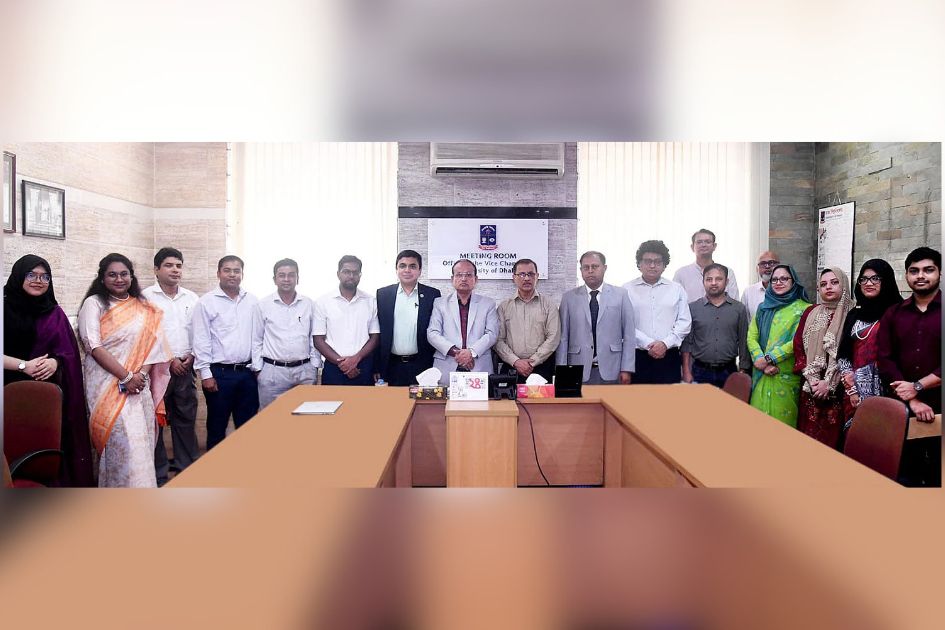
The project was inaugurated by Dhaka University Vice-Chancellor Professor A B M Obaidul Islam at a ceremony held in the university’s conference room.
Funded by the Wellcome Trust, the multidisciplinary initiative brings together researchers from Dhaka University, the Bangladesh University of Engineering and Technology (BUET), the Tulane University School of Public Health and Tropical Medicine in the United States and the Louisiana State University Health Sciences Center.
The project, titled “Exposing Hidden Heat: Mapping Heat-Driven Health Disparities and Advancing Policy Implications for Climate-Resilient Urban Development in Dhaka, Bangladesh,” seeks to better understand how rising urban temperatures affect public health and vulnerable communities while generating scientific evidence to guide future city planning and climate adaptation policies.
Researchers at the launch event highlighted the growing challenge of urban heatwaves and the need for stronger research-based interventions as cities across South Asia face increasing climate-related risks.
Dhaka University’s Department of Meteorology is implementing a key component of the project. Associate Professor Fatima Akter is leading the research team and serving as co-principal investigator overseeing meteorological and climate-related research activities.
The department will conduct advanced climate data analysis, develop temperature maps and carry out environmental monitoring to identify spatial and temporal variations in extreme heat across Dhaka.
Organisers said the study’s findings would support policymakers in designing inclusive and climate-resilient urban development strategies for Dhaka and other cities across South Asia.
Addressing the event, Vice-Chancellor Professor A B M Obaidul Islam said the research would contribute to efforts to tackle the challenges posed by global warming and extreme heatwaves.
He stressed that research should not remain confined to classrooms or laboratories and that its benefits must reach ordinary people. Education and research, he said, become meaningful when theoretical knowledge is successfully applied to real-world challenges and contributes to human welfare.
Among those attending the event were Dhaka University Pro-Vice-Chancellor (Academic) Professor Abdus Salam, Pro-Vice-Chancellor (Administration) Professor Mohammad Al-Mojadded Al-Feshani, Treasurer Professor M Jahangir Alam Chowdhury, Dean of the Faculty of Earth and Environmental Sciences Professor Md Humayun Kabir and Chairman of the Department of Meteorology Assistant Professor Robiul Awal.
Representatives from BUET, the two US universities and the Bangladesh Meteorological Department also participated in the programme.




