

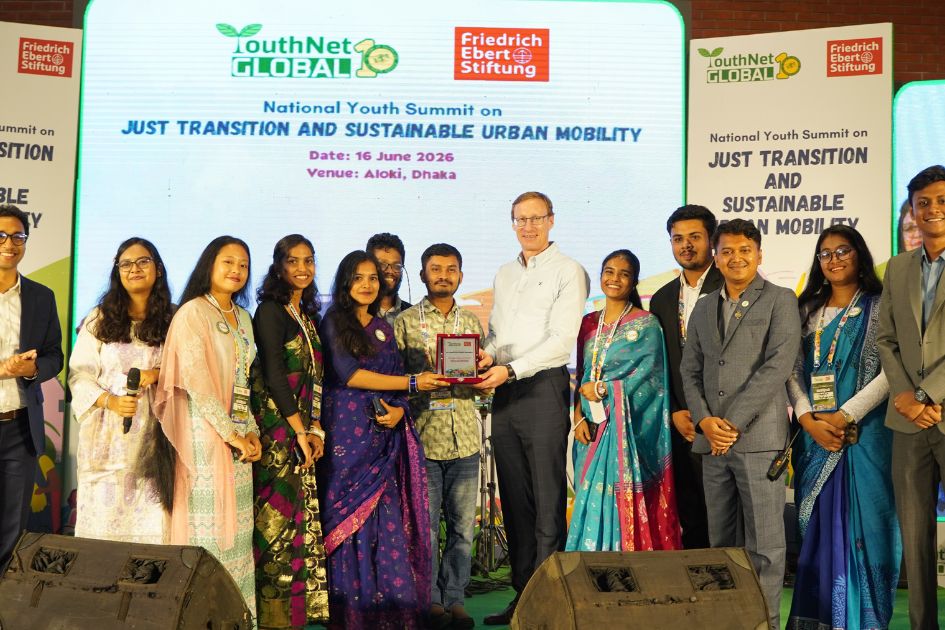



Young leaders at a Dhaka summit presented Green Move Cox, a renewable energy-based transport idea for Cox’s Bazar, linking clean mobility, climate justice and inclusive urban planning.
Around 150 young leaders, policymakers, climate experts, diplomats, academics, transport workers and representatives of vulnerable communities gathered in Dhaka this week to discuss how Bangladesh can move towards a low-carbon transport system while ensuring that no one is left behind.
The National Youth Summit on Just Transition and Sustainable Urban Mobility in Bangladesh was held on June 16 at the Aloki Convention Centre in the capital. The day-long event was organised by YouthNet Global in partnership with FES Bangladesh and brought together participants from across the country to explore pathways towards sustainable urban transportation and climate resilience.
Discussions focused on sustainable urban mobility, climate justice, public transport reform, air pollution, green infrastructure, workers’ rights and youth participation in climate governance. Speakers stressed that transport workers, low-income communities, women, persons with disabilities and other marginalised groups must be included in Bangladesh’s transition to a greener future.
Among the distinguished guests were Mohammad Navid Safiullah, Additional Secretary of the Climate Change Wing at the Ministry of Environment, Forest and Climate Change, European Union Ambassador to Bangladesh Michael Miller and Nayoka Martinez-Bäckström, Deputy Head of Development Cooperation at the Embassy of Sweden. They highlighted the importance of cleaner transportation systems, lower carbon emissions, improved air quality and stronger support for communities affected by climate change.

Representing Chattogram Division, a seven-member youth team presented a project titled “Green Move Cox”, which explored how Cox’s Bazar’s natural wind resources and abundant sunlight could be harnessed through wind turbines and solar technology to generate renewable energy. The project demonstrated how clean energy could power electric vehicles and support a more sustainable urban transportation system while reducing carbon emissions, cutting urban pollution and promoting environmentally friendly mobility solutions.
The summit also featured an exhibition where participants from all eight divisions showcased innovative ideas and local perspectives on sustainability. The Chattogram Division team displayed traditional products representing the culture and heritage of the Chattogram Hill Tracts and coastal region, including indigenous necklaces, bracelets, handmade ornaments, traditional accessories and local mangoes.
International guests and foreign delegates visited the stall and praised both the renewable energy project and the effort to highlight local culture alongside climate solutions.
Beyond discussions on technology and policy, the summit offered participants an opportunity to hear directly from communities often absent from national conversations. Delegates listened to the experiences of Tiger Widows, members of the Manta community and people from Bangladesh’s Haor region, gaining insights into the challenges, resilience and climate impacts faced by some of the country’s most vulnerable populations.
For several participants, the interactions provided a deeper understanding of vulnerability and social justice. Some noted that although they had worked with various organisations in Chattogram over the past three years, it was their first opportunity to engage closely with representatives of these communities.
The programme included interactive sessions, policy labs and innovation workshops where participants explored practical approaches to sustainable urban transportation and climate resilience. Discussions examined how cities could become more environmentally friendly through cleaner public transport, renewable energy integration, improved urban planning and inclusive policymaking.

Participants also explored the connections between transportation, public health, climate action and social equity.
The Chattogram Division team consisted of Khadija Akter from Chattogram, Mohammad Tanvir from Rangamati, Sing May from Bandarban, Sajjad Hossain from Cox’s Bazar and Tabassum Amin and Tonny Bhuiyan from Feni, along with another representative from the region. Team members worked together throughout the programme and said they were proud to represent their communities on a national platform.
The team received recognition and gifts from international guests during the summit, describing the gesture as both an honour and an encouragement to continue contributing to sustainable development and climate action.
Participants said the summit offered more than awards or recognition. They described it as a source of inspiration that reinforced their commitment to volunteerism, youth leadership and climate advocacy.
The event concluded with a strong message that young people are not only participants in conversations about the future but can also help shape it through innovation, collaboration and meaningful action.
Organisers and participants alike said the National Youth Summit on Just Transition and Sustainable Urban Mobility served as a platform for learning, connection and inspiration, demonstrating that building a greener and more sustainable Bangladesh requires not only technological innovation but also social inclusion, empathy and active youth participation from every corner of the country.




