

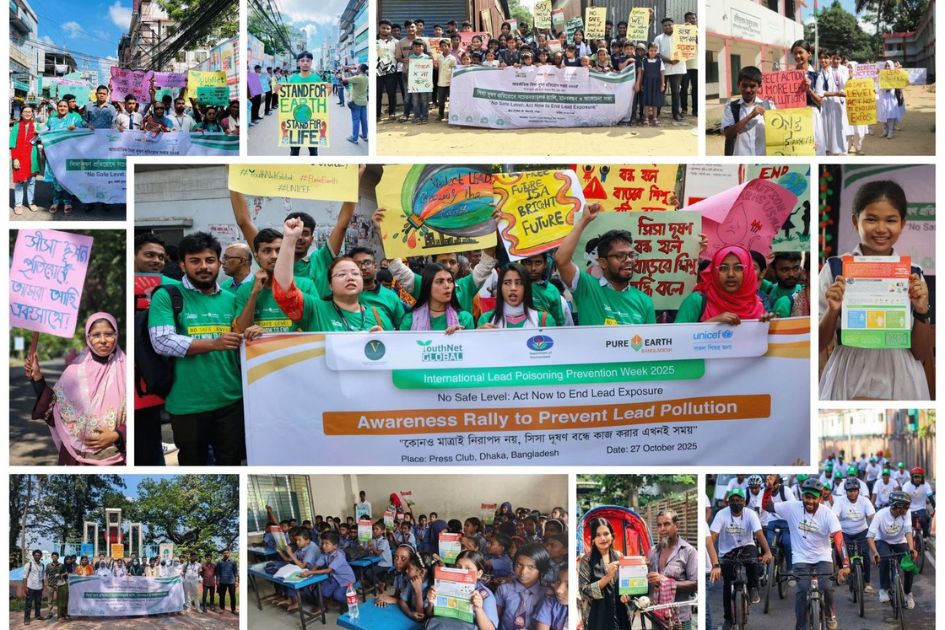



Bangladesh faces a worsening childhood lead poisoning crisis, with 36 million children at risk, yet the proposed FY2026-27 budget offers no dedicated screening, mapping or remediation plan.
In the densely populated neighbourhoods of Dhaka, children are growing up amid a silent but escalating public health emergency: widespread exposure to toxic lead that experts say is permanently damaging brain development and shaping lifelong cognitive outcomes.
Recent findings indicate that nearly 98 percent of children tested in parts of the capital have elevated blood lead levels, placing Bangladesh at the centre of one of the world’s most severe yet under-recognised childhood poisoning crises.
Despite the scale and consistency of scientific evidence, the proposed national budget for fiscal year 2026-27 contains no dedicated programme for childhood blood lead screening, no nationwide contamination mapping and no structured environmental remediation framework.
Public health specialists warn that this absence of targeted action risks locking millions of children into irreversible developmental disadvantage, with long-term consequences for education, productivity and national economic growth.
Lead is a highly toxic heavy metal with no safe level of exposure. Even minimal intake can permanently damage the developing brain, affecting memory, attention, behaviour and learning capacity. Because exposure is often silent and symptom-free in its early stages, harm is frequently detected only after irreversible neurological damage has already occurred.
The World Health Organization estimates that around 800 million children globally have elevated blood lead levels, with exposure contributing to nearly 900,000 deaths each year. At the population level, researchers say widespread exposure reduces cognitive potential across entire societies, weakening long-term economic resilience and workforce productivity.
The global pattern is now sharply visible in Bangladesh.
Estimates from UNICEF and Pure Earth suggest that around 35.5 million children in the country may be exposed to elevated blood lead levels, while a 2023 global assessment ranked Bangladesh eighth worldwide for IQ loss linked to lead exposure.
A joint study by icddr,b and Stanford University found that 98 percent of 500 children tested in Dhaka exceeded internationally accepted safety thresholds, with a median blood lead concentration of 67 micrograms per litre. Children living near industrial zones recorded significantly higher levels than those in less-exposed areas, underscoring the role of geography and proximity to contamination sources.
Exposure is particularly severe in southern Dhaka, where older industrial clusters remain concentrated, while northern parts of the city show comparatively lower levels.
Experts identify informal lead-acid battery recycling as the dominant source of contamination. Driven by the rapid expansion of battery-powered three-wheelers and small transport systems, used batteries are increasingly processed in unregulated facilities located within or near residential areas.
In many cases, batteries are dismantled and melted in open-air conditions without protective equipment, releasing toxic dust and fumes that settle in soil, water and homes. Children are then exposed through inhalation and hand-to-mouth contact.
Communities in Kamrangirchar, Lalbagh, Chawkbazar, Shyambazar, Sutrapur, Bangshal, Armanitola and parts of Keraniganj have been identified as major contamination hotspots. Additional exposure sources include industrial emissions, informal electronic waste processing and lead-based paints in older infrastructure.
While Bangladesh has introduced regulations governing lead-acid battery recycling and carried out enforcement drives against illegal smelting, implementation remains fragmented and limited in scale. Earlier targeted interventions, including efforts to reduce lead contamination in turmeric processing, demonstrated that exposure can be significantly reduced when action is sustained.
However, those efforts have not evolved into a comprehensive national system capable of addressing the scale and complexity of the crisis.
The proposed budget allocates Tk 69,409 crore to the health sector and Tk 2,240 crore to the Ministry of Environment, Forest and Climate Change. Yet there is no dedicated line item for lead exposure surveillance, hotspot mapping or national remediation.
Analysts say this reflects a major policy blind spot. Despite strong scientific evidence, Bangladesh currently lacks a structured national system to monitor exposure trends, identify emerging hotspots or evaluate intervention outcomes.
Without systematic surveillance, experts warn, the country is effectively operating without visibility over one of its most serious environmental health threats.
In Gazipur’s Kathgora area, however, a pilot remediation project supported by UNICEF and Pure Earth offers evidence that the crisis can be reversed. The initiative reduced blood lead levels among children through contaminated soil removal and environmental clean-up, demonstrating that targeted intervention can produce measurable health gains.
Experts say such programmes must now be scaled up into a sustained national framework backed by long-term investment and cross-sector coordination.
Speaking to The Climate Watch, Sohanur Rahman, Executive Coordinator at YouthNet Global, said the crisis reflects a failure to translate evidence into coordinated action.
“Lead poisoning has become one of the most serious yet under-recognised public health emergencies in Bangladesh. This budget should have marked a turning point. We need a national framework for screening, hotspot mapping, safe recycling systems, public awareness and environmental remediation,” he said.
He added that addressing the crisis requires coordinated action across health, environment, industry and local government institutions, without which fragmented interventions will continue to fall short.
Experts say Bangladesh’s situation mirrors a wider South Asian challenge driven by rapid urbanisation, informal recycling economies and weak environmental enforcement.
Without urgent and sustained intervention, they warn, millions of children risk lifelong cognitive impairment, with consequences that could undermine human capital development for decades to come.




