

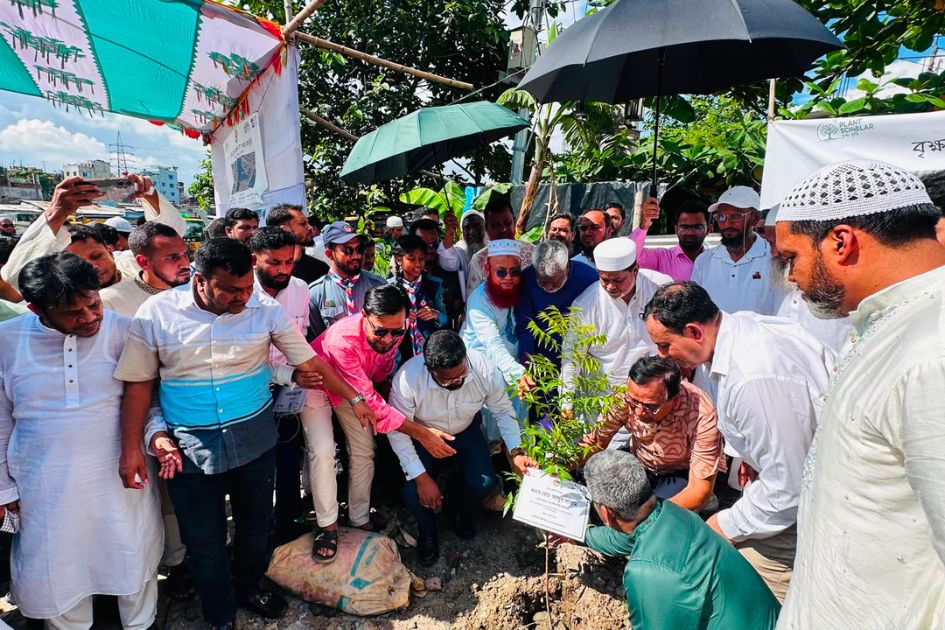



Dhaka’s Kamrangirchar tree drive prioritises survival, with students and young volunteers tasked with ongoing care, monitoring and digital tracking of planted trees.
A tree-planting programme in Dhaka, the capital of Bangladesh, on Sunday placed emphasis not only on planting trees but also on their long-term care and protection, with organisers saying the survival of the trees would be a key measure of success.
The “Plant Scholar”, or “Tree Scholarship”, initiative was held at around 12:30 pm along the Buriganga River and beside roads in Borogram Batteryghat area of Ward 56 of Dhaka South City Corporation (DSCC), the local government body responsible for southern Dhaka.
The programme was organised by DSCC with support from Sustainable Research and Consultancy Ltd (SRCL) and the Center for Atmospheric Pollution Studies (CAPS).
Local residents, students, Scouts members, young volunteers and environmental activists took part in the programme. Trees were planted in designated areas after a discussion session.
DSCC Administrator Md Abdus Salam, the chief guest, said planned tree planting was essential to building a liveable, clean and environmentally friendly Dhaka.
“But planting trees alone does not end the responsibility; ensuring their survival through regular watering, care and protection is the real success,” he said.
He said densely populated areas such as Kamrangirchar could benefit from planned greening of roadside areas, open spaces and riverbanks, which would reduce the effects of dust, air pollution and heatwaves while improving the area’s appearance.
Hamidur Rahman, a member of parliament from Dhaka-7, said tree planting was not a one-day programme but a responsibility towards future generations.
He said involving students and young people in caring for and monitoring trees could strengthen their sense of responsibility towards environmental protection.
The programme was chaired by Professor Dr Md Nurul Islam, vice-chancellor of Dhaka Central University.
He said tree planting was not merely a matter of beautification amid rapid urbanisation, rising temperatures and air pollution, but an important means of promoting public health, maintaining environmental balance and strengthening climate resilience.
The event was moderated by Professor Dr Ahmad Kamruzzaman Majumder, founder and chairman of CAPS. He stressed the importance of regularly monitoring the survival of planted trees and their environmental benefits through scientific methods.
Abu Zobayer, managing director of SRCL and an urban environmentalist, said the “Plant Scholar” initiative would not judge its success simply by the number of trees planted.
“Rather, importance is being given to how many trees survive and receive regular care,” he said.
He said selected students and young people would be assigned responsibility for caring for and monitoring the trees. Plans also include geo-tagging, GIS-based data storage and digital monitoring to record the trees’ locations, growth, care and survival.
The organisers said the main goal was to turn tree planting from a one-day formality into long-term urban greening through care, protection, monitoring and community participation.




