

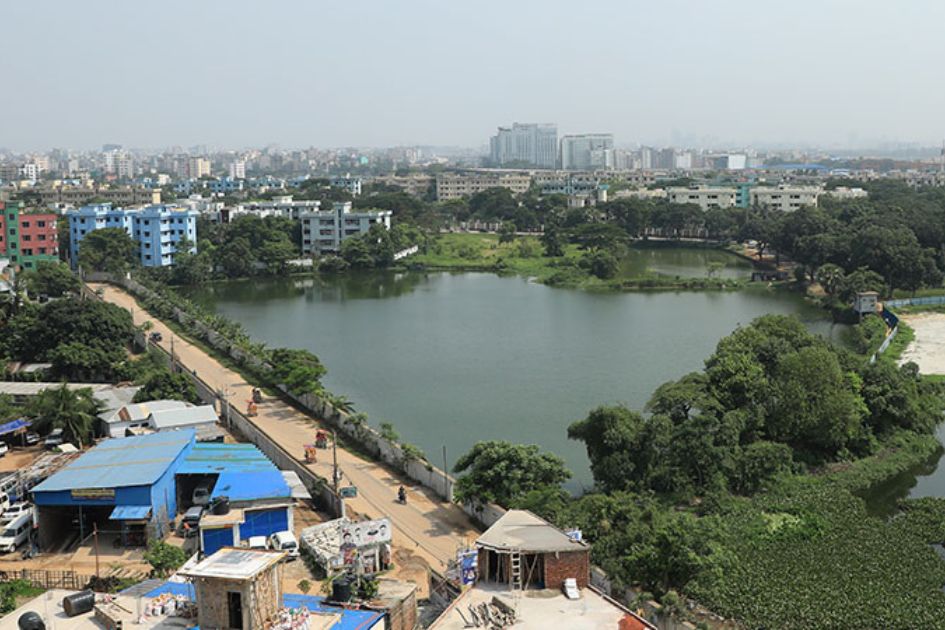

Nearly three years after the Detailed Area Plan proposed dozens of eco-parks and water parks, urban planners say the lack of implementation has left Dhaka increasingly vulnerable to flooding, heat and environmental degradation.
Nearly three years after Bangladesh adopted a new urban development plan for its capital, authorities have yet to make visible progress on a proposal to build 14 eco-parks and 55 water parks intended to reduce chronic waterlogging and restore Dhaka’s environmental balance, despite worsening floods after even light rainfall.
Urban planners say protecting wetlands and expanding green open spaces through planned conservation could significantly reduce waterlogging while helping regulate urban temperatures, recharge groundwater and preserve biodiversity.
The issue has returned to the spotlight after several days of heavy rainfall recently left much of Dhaka submerged, exposing the city’s growing vulnerability to flooding and renewing attention on recommendations contained in the Detailed Area Plan (DAP 2022-35).
The plan, prepared by the Rajdhani Unnayan Kartripakkha (RAJUK), Bangladesh’s capital development authority, covers the entire jurisdictions of the Dhaka North and Dhaka South city corporations, which administer the capital, as well as parts of the neighbouring Gazipur and Narayanganj city corporations.
An analysis of the DAP shows it recommends establishing 14 eco-parks and 55 water parks across the planning region. The largest proposed eco-park is centred on Bhawal National Park in Gazipur, an industrial district north of Dhaka. The plan states that the entire section of the national park within RAJUK’s jurisdiction should be preserved as an eco-park.
It also recommends conserving about 227 acres in the Dhirashram, Khalikair and Gazipur mouzas, along with 82.63 acres in Bhurulia mouza of Joydebpur in Gazipur, as eco-parks.
Dr Adil Mohammed Khan, executive director of the Institute for Planning & Development (IPD), a Bangladesh-based urban planning research organisation, said earlier planning documents had also emphasised the need to identify and protect water bodies, retention ponds and flood-flow zones, but authorities had consistently failed to act.
“Dhaka now gets submerged in just a little rain. It’s unbearable in the heat. Drinking water is scarce. Today’s multifaceted disaster is the result of repeatedly thumbing our noses at urban planning,” he said.
He said playgrounds, parks, water bodies, trees, wildlife and birds had become secondary under the country’s development philosophy.
“Fifty-five (water parks) were recommended, but it seems that after 20 years, only one or two might be implemented. And all the remaining areas will be encroached upon by residential or commercial buildings. That’s exactly how we’ve destroyed Dhaka,” he said.
The second-largest proposed eco-park would cover 1,206 acres of vacant land in the Gajaria and Baludhitpur mouzas of Nasirabad under the Dhaka South City Corporation. The area had been designated as a water retention pond under both the previous DAP and the Dhaka Metropolitan Development Plan (DMDP 1995-2015), Bangladesh’s long-term strategic urban planning framework for the capital. However, the government has yet to launch any significant initiative to preserve it.
Another proposed eco-park would cover approximately 508 acres in the Snanghata, Talna, Bhaturia and Chhota Palasia mouzas under the Dhaka North City Corporation. This area had also previously been designated as a water retention pond, but no visible progress has been made toward its conservation.
The DAP further recommends eco-parks covering about 284 acres in the Char Sanghar and Char Boktarbali mouzas of Keraniganj, a suburb southwest of Dhaka, and neighbouring Narayanganj, an industrial district adjoining the capital. Other proposed sites include 43 acres in Dogar mouza of Signboard, about 89 acres in the Jalkuri and Kubitpur mouzas of Narayanganj and 86.5 acres in the Jalkuri and Deulpara mouzas.
Additional eco-parks have been proposed on 61 acres in the Baider Bazar area of Menikhali, 52 acres in the Sadipur and Jampur mouzas of Rupganj-Kaliganj, 63.5 acres in Janjir mouza, 14 acres in Pitalganj mouza and approximately 3.5 acres in Katasur mouza along the banks of the Buriganga River within the Dhaka South City Corporation.
In 1995, RAJUK prepared the Dhaka Metropolitan Development Plan (DMDP 1995-2015), a 20-year strategic blueprint for the capital’s future development. The plan concluded that five permanent retention ponds would be essential to protect Dhaka from future waterlogging and identified the locations where they should be established.
Later, in 2010, RAJUK prepared the first Detailed Area Plan in line with the DMDP. That plan recommended preserving large tracts of land, ranging from more than 200 to 500 acres, in Kallyanpur, Goran Chatbari, Nasirabad, Beraid and Uttarkhan as permanent reservoirs or retention ponds.
The objective was to improve the capital’s livability through better flood management, drainage, groundwater recharge and restoration of the natural environment. Those locations continue to be designated as permanent reservoirs in both the current DAP and the Dhaka Water Supply and Sewerage Authority (Dhaka WASA) Drainage Master Plan. However, like many of Dhaka’s rivers, canals, lakes and public open spaces, these reservoirs have also been encroached upon.
After many of the reservoirs identified in earlier plans were lost to encroachment and land filling, the new DAP proposed creating 55 water parks alongside eco-parks to protect the capital’s remaining wetlands while reducing waterlogging.
Urban planners involved in preparing the DAP said the traditional concept of water retention ponds had been modernised by placing greater emphasis on preserving the natural movement of water instead of relying mainly on flood-control embankments. The eco-park and water park concepts were designed to allow water to enter and leave naturally while maintaining ecological functions.
The plan defines a reservoir as a natural, permanent or seasonal wetland where water remains for part of the year with a depth generally below six metres. Such reservoirs play an important role in maintaining local ecosystems, protecting biodiversity, recharging groundwater, supporting economic activities and preserving socio-cultural balance, it says.
The proposed water parks are generally smaller than the eco-parks, with most covering between 50 and 100 acres. Some range from two to four acres, while a few exceed 200 acres. The largest would occupy about 587 acres in the Goran-Chatbari area under the Dhaka North City Corporation, while the smallest would cover about 2.5 acres in the Kallyanpur House Building area.
The DAP proposes preserving existing major reservoirs within RAJUK’s jurisdiction and converting them into water parks.
According to the plan, the parks would be developed around 49 wetlands within RAJUK’s jurisdiction to preserve and restore existing reservoirs. They are also intended to retain rainwater, reduce waterlogging, recharge groundwater, regulate urban temperatures, conserve aquatic biodiversity, support fish farming and contribute to broader environmental restoration.
Md Ashraful Islam, former project director of the DAP and former chief town planner of RAJUK, said there was no alternative to developing such parks if Dhaka was to become more livable.
“There’s no alternative to constructing such eco-parks and water parks to restore Dhaka’s livability. RAJUK has already started the construction of one park in Motijheel and has made a policy decision to build another small park in Ghatarchar. But their implementation isn’t yet visible,” he said.
He said RAJUK could not build and maintain so many parks on its own.
“For this, relevant city corporations and other agencies must come forward in a coordinated manner. Otherwise, both the implementation of these parks and their long-term preservation will become difficult,” he said.
This post is republished from Daily Bonik Barta.




