


In Raghunathpur’s industrial belt, villagers and workers say unchecked emissions, unsafe jobs and disputed project approvals are putting health, agriculture and cultural identity at risk amid demands for accountability.
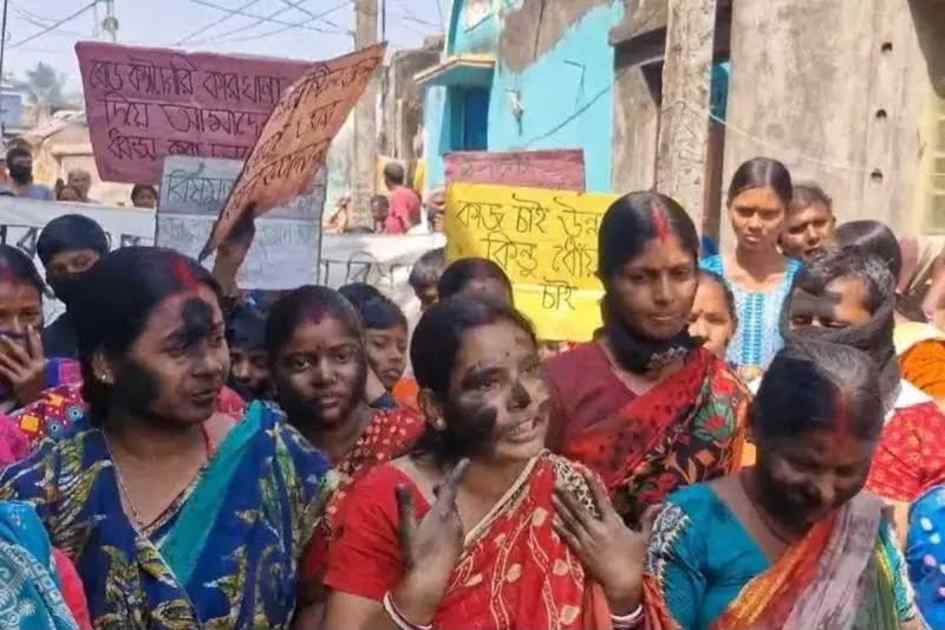
As millions across India celebrated Holi with colours, residents and workers in West Bengal’s Purulia district marked the festival with black paint and masks, protesting what they describe as years of industrial pollution affecting their health, livelihoods, workplaces, and environment.
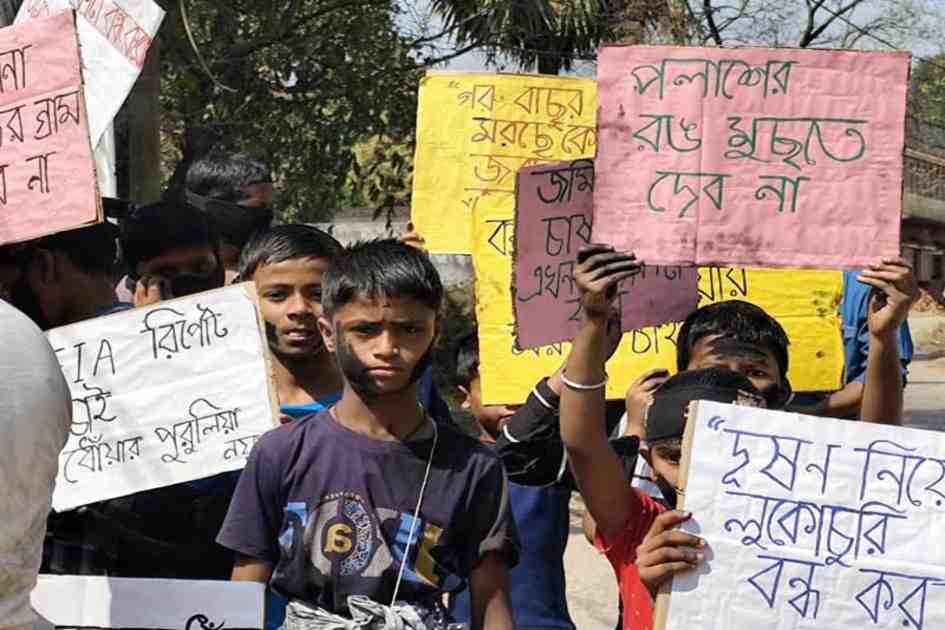
The community-led campaign, locally described as “Black Holi,” took place in the Jharukhammar industrial area of Raghunathpur, where villagers wore black masks, badges, and paint on their faces to highlight concerns over pollution from cement plants, stone-crushing units, sponge iron factories, and other heavy industries.
The protest was organised under the slogan “Save Purulia” and spread widely through social media, with residents sharing images of smoke-emitting factory chimneys and calling for stronger environmental accountability, cleaner industries, and protection of public health.
“We are not against industry. We want clean, green industries and permanent employment. We want jobs, but not by selling our children’s lungs,” residents said during the demonstration.
A Region Caught Between Industrial Growth and Environmental Pressure
Purulia, located in western West Bengal, is part of the culturally and ecologically significant Jangalmahal region. The district is known for its forests, agricultural landscapes, indigenous communities, and the globally recognised Chhau dance tradition, while also becoming an important industrial zone in recent decades.
Raghunathpur has emerged as a major industrial hub, with cement, mining-related, metal-processing, and other heavy industries operating across the region. Many of these industries fall under India’s “Red Category” classification, meaning they have a high potential for environmental pollution.
Residents of villages including Nutundi, Jharukhammar, and Durmut allege that emissions from industrial units have significantly affected local air quality and daily life. Community members report concerns about respiratory difficulties, asthma, skin problems, dust exposure, and declining agricultural productivity, which they attribute to prolonged exposure to industrial pollution.
Farmers say black dust deposits have affected crops, reduced yields, and contaminated local water bodies. Residents also say polluted ponds and water sources have affected livestock health, including reports of cattle deaths that communities associate with environmental contamination.
Beyond environmental impacts, workers employed in these industries are also raising concerns about occupational exposure to dust, smoke, and industrial emissions, highlighting the need for stronger workplace safety standards, regular health monitoring, and better protection for labourers.
Environmental groups and local communities have raised concerns that continued pollution could damage the biodiversity of the region, including the forests surrounding the historic Garh Panchkot tourism circuit, an area known for its hills, heritage sites, and natural beauty.
Residents have cited periods of unhealthy air quality, with pollution levels reportedly reaching dangerous conditions. They argue that worsening air pollution poses risks to vulnerable groups, including children, older people, and those with existing health concerns.
A Cultural and Ecological Identity Under Threat
The protest also highlighted the connection between environmental protection and cultural identity. Residents used the symbolism of Chhau, Purulia’s traditional masked dance recognised internationally for its artistic heritage, to express fears that pollution is threatening not only public health but also the region’s cultural and ecological character.
Through the imagery of black colours, masks, and traditional symbols, communities sought to show that environmental degradation affects both human lives and the landscapes that sustain local traditions.
Women residents also highlighted how pollution affects household responsibilities, access to safe water, and concerns about children’s health, adding a gender dimension to the environmental crisis.
Opposition to a Proposed New Sponge Iron Plant
The latest wave of protests was triggered by concerns over a proposed sponge iron project on approximately 134 acres of land in the region.
Residents allege that a company began fencing land in Hura village under Nutundi Gram Panchayat in Raghunathpur I block without completing the required public consultation process.
Under India’s environmental regulations, public hearings are mandatory for many categories of industrial projects to allow communities to express concerns and discuss possible environmental impacts before approval.
Local residents claim that the land was originally allocated to another industrial company in 2007 but was later returned to the state after the project failed to move forward. After remaining unused for nearly 18 years, the land has now become the focus of renewed public opposition.
“We will not allow poison to spread in our villages,” residents said during the demonstration.
The community has demanded an investigation into the alleged procedural violations and called for full compliance with environmental regulations before any new industrial activity begins.
Voices from the Ground: Communities and Workers Speak Out
For residents and workers of Raghunathpur’s industrial belt, the pollution crisis is not only about environmental data and regulations; it is about everyday survival, workplace safety, health, livelihoods, and the future of their families.
Saroj Mishra, a local resident, warned that the community would intensify its movement if authorities failed to address concerns over the proposed industrial project.
“If land fencing continues secretly without proper consultation, we will be compelled to launch a larger movement,” Mishra said.
Akshoy Dash, an affected worker from the region, highlighted the difficult reality faced by many workers who depend on industrial employment while being exposed to hazardous working conditions.
Workers say industrial employment remains an important source of income in the region, but they want stronger protections against occupational hazards, including exposure to dust, smoke, and industrial waste.
Many industrial workers face a difficult choice between employment opportunities and workplace safety, highlighting why just transition policies must protect both livelihoods and health.
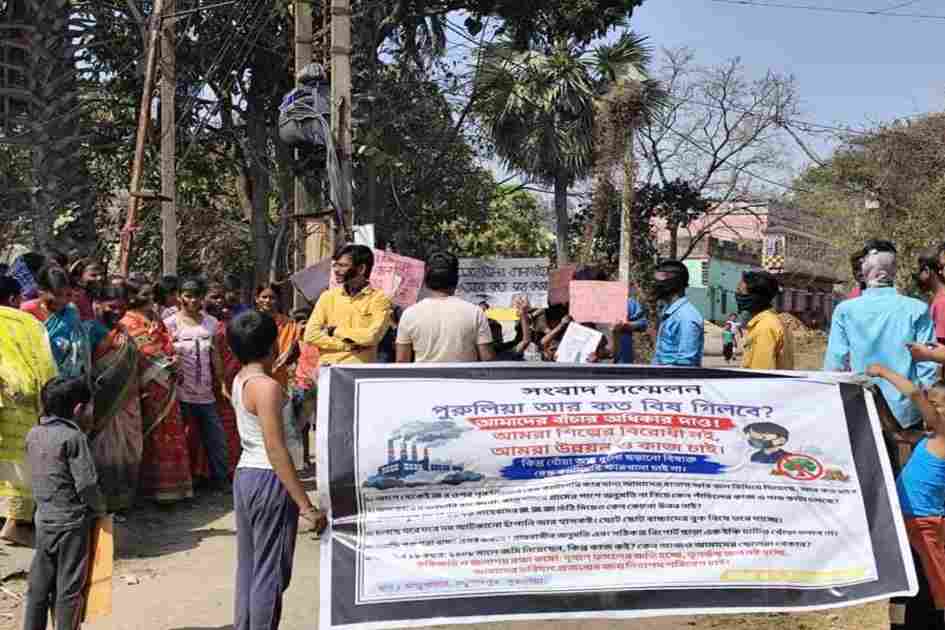
Residents and workers are calling for greater protection for industrial labourers, including regular health monitoring, safer working environments, access to medical support, and fair compensation and support mechanisms for families of workers who lose their lives or suffer serious health impacts allegedly linked to occupational exposure.
Archana Mandal, a nearby resident, spoke about how pollution has affected village life and household well-being. She highlighted concerns about contamination and its impact on local livelihoods, including reports from residents that cattle have died after exposure to polluted water and environmental contamination.
Rekha Mondal, another community member, said people are not opposing development but demanding an approach that protects both livelihoods and the environment.
Rajon Tudu, a young resident of the area, emphasised that young people need employment opportunities but also a healthy environment where they can build their future.
“We need jobs, but we also need a place where our families can live safely and our children can breathe clean air,” residents said during the movement.
Grassroots Resistance and the Challenge of a Just Transition
The concerns raised by communities in Purulia are part of a wider debate in India over how development and energy transitions can take place without undermining local livelihoods, ecosystems, and community rights.
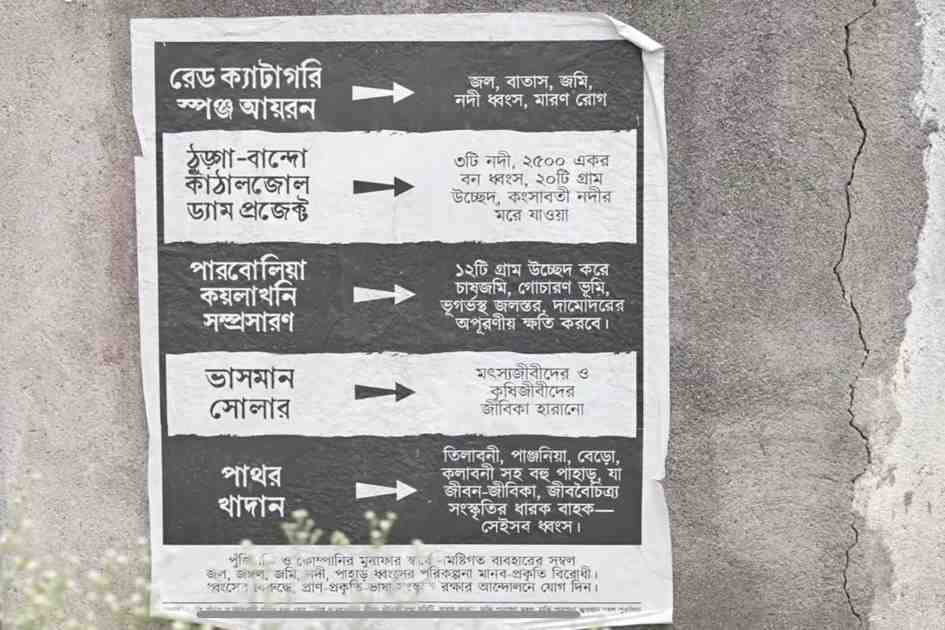
Alongside concerns over industrial pollution, community members have also raised broader concerns about development projects, including floating solar initiatives and other infrastructure proposals that they say could affect local ecosystems and livelihoods.
The Bengali-language protest posters displayed across villages highlight fears that poorly planned projects, including industrial facilities, dams, and energy infrastructure, could threaten agricultural land, forests, and water systems that support farmers, indigenous communities, and local economies.
The debate reflects a broader challenge facing India’s transition toward a cleaner energy future. While renewable energy expansion is essential to addressing the climate crisis, communities and experts warn that the transition must not create new social and ecological conflicts.
A just transition is not only about moving away from polluting industries. It is also about ensuring that renewable energy expansion respects local ecosystems, cultural practices, and the rights of communities dependent on natural resources.
Bharath Jairaj, Director of the Energy Program at WRI India, said India faces complex challenges as it expands renewable energy.
“India faces a complex situation where ambitious renewable energy targets can create pressure on land and water resources. Floating solar may reduce land conflicts, but it can also affect communities that depend on water bodies for their livelihoods,” Jairaj said.
He emphasised that inclusive planning and early consultation are essential.
“What is necessary is to conduct studies before launching projects and communicate their results with the communities. A proper assessment of impact on livelihood, aquatic life, and productivity is necessary to address their concerns,” he said.
Jairaj added that community participation is central to making the energy transition successful.
“We have to carry the entire society along to make the energy transition successful and meaningful,” he said.
Calls for Accountability and Stronger Environmental Governance
Residents and environmental campaigners are calling on industrial operators, regulatory authorities, and local administration to ensure that economic activities comply with environmental laws and do not transfer health, social, and ecological costs onto communities.
Their demands include independent investigation into alleged environmental violations and pollution impacts, mandatory environmental assessments and transparent public hearings before new industrial projects, strict monitoring of existing industries’ emissions, regular health assessments and stronger workplace safety protections for industrial workers, fair compensation and support mechanisms for families of workers affected by occupational deaths and illnesses allegedly linked to exposure, protection of agricultural land, forests, water bodies, and community health, and promotion of cleaner and sustainable industries that support local employment.
Sponge iron industries are classified as highly polluting industries under India’s environmental regulatory framework because of emissions of particulate matter and industrial waste. Residents argue that such industries should not be established near densely populated communities, agricultural land, or ecologically sensitive areas without proper safeguards.
Raghunathpur Sub Divisional Officer Vivek Pankaj said authorities had received complaints from residents and that the matter was being examined.
The companies mentioned in residents’ complaints should be given an opportunity to respond to the allegations before publication.
Local resident Saroj Mishra warned that if their concerns continue to be ignored, communities would intensify their movement and explore legal options, including approaching India’s National Green Tribunal.
A Wider Debate on Development and Environmental Justice
The struggle in Purulia reflects a wider challenge across India and around the world: how to balance industrial development, employment generation, workers’ rights, and environmental protection.
Rapid industrialisation has created economic opportunities but has also raised concerns over air pollution, environmental compliance, occupational health risks, and the rights of communities living near industrial corridors.
The debate in Purulia reflects a wider question facing industrial regions worldwide: how can societies create jobs while ensuring that workers and communities do not bear the hidden costs of economic growth?
Commenting on the issue, Dr. Mahalaya Chatterjee, a prominent Indian economist and Professor of Urban and Regional Economics at the Department of Economics, University of Calcutta, said governments have a responsibility to create employment opportunities while ensuring that jobs are decent, safe, and environmentally sustainable.
She emphasised that development must protect nature and human dignity, arguing that economic progress should be measured not only by the number of jobs created but also by the quality of those jobs, workplace safety, and the protection of ecosystems.
Sohanur Rahman, Executive Coordinator of YouthNet Global, said the concerns emerging from Purulia reflect a broader global challenge of ensuring that industrial development does not come at the cost of workers’ rights, community health, and ecological security.
“Workers are not just a workforce; they are people with the right to safe workplaces, dignity, and a healthy environment. A just transition must ensure decent jobs, labour protections, and justice for communities living on the frontlines of pollution,” Rahman said.
He added that environmental justice requires decision-making processes where affected communities have a meaningful voice.
“Climate action and industrial transformation must put people at the centre. Development should create opportunities without sacrificing clean air, safe livelihoods, biodiversity, and the rights of future generations,” he said.
The struggle in Purulia reflects a broader challenge facing communities across the Global South, where regions seeking economic growth often carry the environmental costs of industrialisation.
From industrial workers seeking safe employment to farmers protecting land and communities defending water resources, the message from Purulia reflects a growing global demand: development must be built with people, not imposed on them.
The Black Holi protest in Purulia represents a broader global question: can development create prosperity without sacrificing the health of people and the planet?
The voices from Purulia echo a growing global movement demanding that the future of industry and energy must be built on both economic opportunity and environmental justice.
For these communities, the answer lies in a just transition where decent jobs, clean air, workers’ rights, ecological protection, and community dignity move together.




