

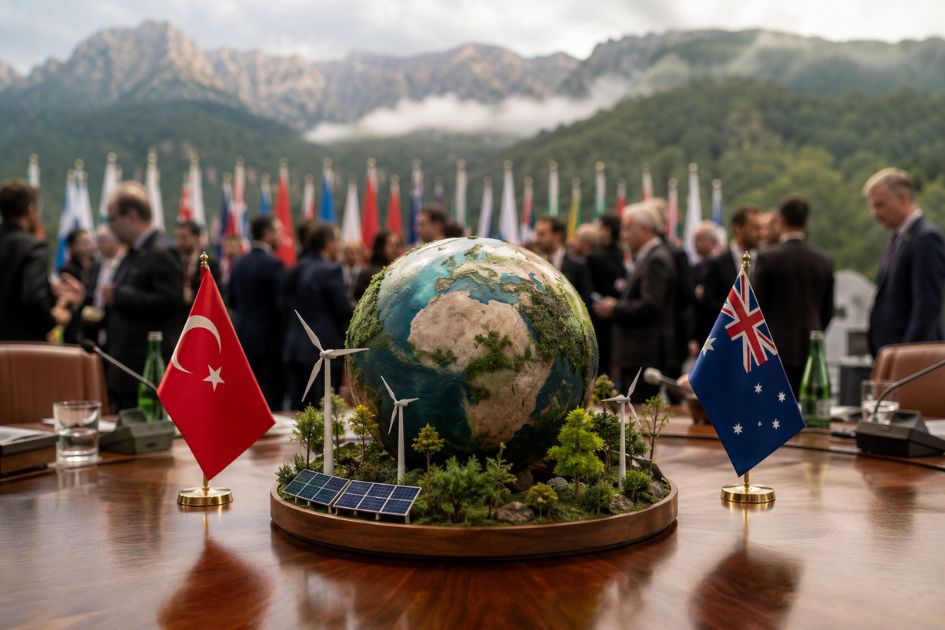

COP31 co-hosts Türkiye and Australia unveil a climate transition agenda as nations face mounting energy, finance and governance challenges, with implementation, justice and delivery emerging as key tests.
Türkiye and Australia, the incoming COP31 co-presidencies, have outlined an early agenda for what they describe as a “COP of the Future,” focusing on accelerating the global energy transition, expanding clean electrification and scaling accessible clean technologies amid rising geopolitical volatility and energy market instability.
The COP31 summit will be held in Antalya, Türkiye, from 9 to 20 November 2026, according to UNFCCC planning documents and host government confirmations.
In a joint letter circulated in May, the COP31 co-presidencies framed the summit as a platform to advance global energy transition pathways while ensuring clean technologies are deployed “at scale and with equitable access.” Key operational details remain undefined, however, prompting early questions over implementation pathways and institutional coherence.
The framing draws symbolic inspiration from Göbeklitepe, the 11,000-year-old archaeological site in southeastern Türkiye and one of the world’s earliest known monumental structures, described by UNESCO as a landmark of early collective civilisation. The co-presidencies cite it as a metaphor for “solidarity, balance and coexistence,” though observers note the contrast with increasingly fragmented global climate diplomacy.
Pre-COP Diplomacy: Roadmaps, Transition Gaps and Fragmented Governance
The Bonn climate talks (SB64), scheduled for 8-18 June in Germany, are expected to provide the first major test of political momentum ahead of COP31.
A key milestone will be the formal readout of the Santa Marta fossil fuel transition roadmap process, expected during London Climate Action Week (20-28 June). The initiative originated from COP30 discussions in Brazil and was further developed through a follow-up process in Colombia aimed at translating global fossil fuel commitments into voluntary national transition pathways.
So far, only France has publicly released a national fossil fuel phase-out roadmap. Several countries, including Mexico, South Korea, Cambodia, Portugal, the Netherlands, Denmark and the United Kingdom, are considered well-positioned to submit plans, while electoral cycles in Brazil and Colombia could slow formal domestic uptake and political alignment.
The Santa Marta process has drawn participation from more than 60 countries but remains non-binding and lacks enforcement mechanisms, raising questions about how voluntary roadmaps will translate into national action.
COP31 Architecture: Emerging Climate Governance System
Observers increasingly describe COP31 as operating within a fragmented and expanding governance landscape.
One layer consists of fossil fuel transition pathways, including Brazil-led roadmaps intended to guide voluntary national phase-outs and reforestation strategies, the Türkiye-Brazil-Australia Global Implementation Accelerator aimed at identifying scalable solutions and potential positive tipping points, and the Belém Mission to 1.5°C, which channels country-submitted proposals to accelerate national climate action.
A second layer includes coordination platforms such as the UNFCCC Action Agenda, which enables cities, businesses and subnational actors to report climate contributions, and the Just Transition Mechanism, designed to guide equitable transitions away from fossil fuels but still lacking dedicated finance and strong political backing.
A third layer consists of global tracking and finance systems, including the second Global Stocktake cycle beginning after COP31, which will assess collective progress; the Global Goal on Adaptation, still under negotiation around 59 indicators without a consolidated target; and the New Collective Quantified Goal on climate finance agreed in 2024, now entering a contested phase of financial delivery across developed and developing economies.
Taken together, analysts caution that this expanding system risks coordination gaps if parallel initiatives are not aligned with core UNFCCC decision-making structures.
Missing NDCs and Global Emissions Coverage
Despite rising ambition signals, significant gaps remain in national climate planning.
Fifty-six countries have yet to submit updated Nationally Determined Contributions (NDCs) for 2035, including Argentina, Egypt, Iran, the Philippines, Vietnam and Venezuela.
UN tracking indicates that existing submissions still cover approximately 85.7 percent of global emissions, meaning overall coverage remains broad, but ambition and timeliness remain uneven across major economies. Analysts say closing this submission gap will be an early credibility test for COP31.
Geopolitical Pressure and Climate Extremes Intensify
COP31 preparations are unfolding amid escalating geopolitical tensions and economic pressures that are increasingly shaping climate negotiations.
Energy market disruptions linked to ongoing conflicts have pushed oil prices to around $94 per barrel, while food and fertiliser inflation continues to strain import-dependent economies. At the same time, extreme heat conditions exceeding 40°C have been recorded across parts of Asia, Europe and the Middle East.
Scientists warn that emerging El Niño conditions could further intensify global climate extremes, increasing risks to food security, migration patterns and energy stability.
UN Secretary-General António Guterres has described the current moment as one of “heightened climate volatility,” urging faster fossil fuel phase-down and accelerated clean energy expansion.
Domestic Political Dynamics in COP31 Co-Presidency Countries
Domestic political conditions in both COP31 co-presidency countries are shaping expectations around the summit.
In Türkiye, President Recep Tayyip Erdoğan faces a politically sensitive pre-election period, with civil society groups and observers expressing concern over shrinking civic space and growing pressure on opposition figures and environmental activists.
In Australia, climate policy remains deeply contested, with the far-right One Nation party polling at around 31 percent, intensifying political pressure on Prime Minister Anthony Albanese’s government and narrowing space for long-term energy transition planning.
Environment Minister Chris Bowen has defended clean energy expansion as a pathway to “agency and resilience, not vulnerability and dependency,” though analysts caution that domestic constraints may shape Australia’s negotiating flexibility.
Campaign groups including 350.org and Oil Change International have urged Türkiye to convene a COP31 leaders’ summit focused on national transition plans, arguing that political coordination is now essential to accelerate implementation of existing commitments.
Climate Finance and Delivery Gaps
Despite global clean energy investment exceeding $2 trillion in 2026, significant financing gaps persist between developed and developing economies.
UN monitoring bodies report that several countries have yet to meet assessed climate finance contributions, raising concerns over predictability, trust and credibility within the multilateral system.
At the same time, analysts warn that insufficient progress on just transition finance risks deepening structural inequalities in the energy transition, particularly for climate-vulnerable communities already experiencing the most severe impacts.
Sohanur Rahman, Executive Coordinator of YouthNet Global, said COP31’s credibility will depend on whether climate governance embeds justice into its core delivery frameworks.
He added: “A just transition is not only about changing energy systems. It is about protecting workers, coastal communities and young people already facing the worst impacts of climate breakdown. Without justice, transition risks becoming exclusion rather than transformation.”
Outlook: Testing Global Climate Governance Capacity
With COP31 approaching, analysts increasingly argue that global climate governance is shifting from consensus-building to execution under conditions of political and economic constraint.
From fossil fuel transition roadmaps and adaptation targets to climate finance flows and delayed national NDC submissions, the coming months will determine whether COP31 can narrow the gap between commitments and real-world action.
More broadly, the COP31 process is emerging as a test of whether the multilateral climate system can translate negotiated ambition into credible national action under conditions of geopolitical tension, economic pressure and accelerating climate impacts.




