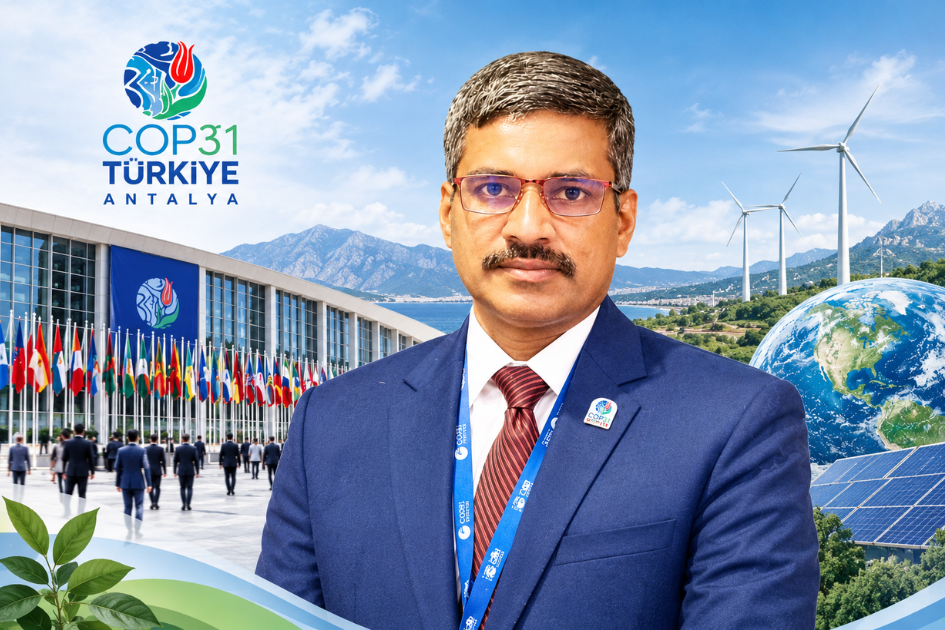



Bangladesh’s land constraints and reliance on loan-based climate finance pose challenges to its energy transition, prompting calls for grants, clean power and land-saving renewable technologies at COP31.
The 31st UN Climate Change Conference (COP31) formally opened on 9 November at the Antalya Expo Centre in Türkiye, under a joint presidency held by Türkiye and Australia. Billed as the “COP of implementation”, it is co-chaired by Türkiye’s Environment Minister Murat Kurum and Australia’s Climate Change and Energy Minister Chris Bowen. Opening-day discussions went past target-setting and kept coming back to delivery, and the scientific warning about holding warming to 1.5°C was taken seriously in the room. Three issues dominated the first day: the presidency’s proposed “35-by-35 Global Electrification Pledge” (electricity to make up 35 percent of total energy use by 2035), cutting methane from waste, and the money crisis facing climate-vulnerable countries. The least developed and most vulnerable countries were blunt about it. They will not keep sinking into debt to pay for one disaster after another, and grant-based climate finance is now the only arrangement they can rely on.
Tuesday, the conference’s second day, was Electricity Day in Antalya. Of COP31’s roughly 370 sessions, 140 dealt with energy and transport, and most of the attention went to power grids, battery storage, offshore wind, clean shipping fuels, electric vehicles and aviation fuels. In the Blue Zone, the Turkish presidency held its flagship Global Electrification Ministerial together with the International Energy Agency (IEA) and the International Renewable Energy Agency (IRENA). Bangladesh came to this stage carrying a problem that developed countries rarely have to think about. How do you build large-scale renewable power in a country that cannot spare a single inch of land?
The presidency sees one specific target as its main tool for the global energy problem. The 35-by-35 pledge asks countries to raise electricity’s share of their final energy use from about 23 percent today, a little over a fifth, to 35 percent by 2035. At a joint press conference on Tuesday morning with COP31 presidents Murat Kurum and Chris Bowen, UN climate chief Simon Stiell said that 30 percent of the world’s energy demand could be moved onto clean technology using what already exists. He added that around 180 international organisations have backed 1.7 trillion dollars of investment in power systems. He also offered a warning: “There is no quick, magic fix for climate change.”
The pledge is a voluntary political commitment, kept outside the formal negotiated text, and its biggest weakness is a missing word. Climate campaigners were quick to point out that nothing in it requires the extra electricity to come from low-carbon or “clean” sources. Climate Diplomacy Brief reports that this is the main reason the European Union has held back from signing. For Bangladesh, the absence of the word “clean” is a real worry and not a drafting slip. Our national grid still runs mostly on natural gas, coal and imported fossil fuels. Moving cooking, public transport and factories onto that grid would simply move the emissions to the power station. It would not cut them. So the question in front of us is where clean electricity is actually going to come from.
In Bangladesh this is daily life, not a textbook exercise. We are one of the most densely populated countries in the world, and most of our land is farmed intensively. Solar parks spread across hundreds of hectares of open ground, the kind built in the American Southwest or the Australian outback, are close to impossible here, because every one of them would take land straight out of food production. We are already losing cropland fast to saltwater intrusion, river erosion and unplanned urban growth.
This is where Bangladeshi engineers, environmental scientists and planners have started looking at other ways to generate power without using up land. Floating solar, or pond photovoltaics, puts panels on ponds and reservoirs, which cuts evaporation and leaves farmland untouched. Rooftop solar puts them on factories and homes. Agrivoltaics raises panels on tall posts above farmland, so shade-tolerant crops can grow underneath while carbon-free electricity is generated above. The government’s renewable energy roadmap aims for 20 percent of electricity from renewable sources by 2030 and a 15 percent cut in demand through efficiency. Analysts think Bangladesh’s solar capacity could reach 8.5 gigawatts by 2035. But writing a target down and building the infrastructure are different things. Solar needs large battery storage and a modern grid, and both depend almost entirely on international finance and technology from abroad.
Tuesday’s side events were taken up with the details of finance, and the centre of it all was the Electrify Now Finance Coalition, launched that afternoon. Made up of governments, multilateral development banks and private investors, the coalition wants to help countries put together portfolios of bankable clean energy projects, lower investment risk and make international capital easier to reach. The World Bank will join as co-chair from 2027. For Bangladesh, the real question is on what terms this money will come. A study presented in Dhaka on 3 November by the environmental research organisation Change Initiative found that almost nine-tenths of all climate finance for Bangladesh’s energy sector so far has arrived as high-interest loans. It puts the country’s renewable energy investment gap at no less than 1.35 billion dollars a year until 2030. For every dollar Bangladesh receives in grants, it receives 2.70 dollars in loans. If climate action keeps being paid for by piling on debt, the economy will buckle before the solar panels are even installed.
Speaking to The Business Standard in Antalya on Tuesday, Sheikh Faridul Islam, State Minister for Environment, Forest and Climate Change, said plainly that Bangladesh will demand direct, grant-based climate finance. It will also look for direct partnerships with the European Union and international financial institutions on technology and clean energy. “Climate justice is not charity, and it is not a handout,” he said. Meanwhile, the talks on a Just Transition Mechanism for a fair shift away from fossil fuels, informally known as the Belém–Antalya Mechanism, have largely stalled over political differences. At COP30 in Belém, the draft text for this mechanism, meant to protect workers and affected communities, was changed from “establish” to “develop”, and the requirement to phase out fossil fuels entirely was dropped. Carbon Brief reports sharp disagreement among countries over its scope and over whether it should have a fund of its own. Developing countries have warned that knowledge-sharing and workshops will not buy a single battery without dedicated money. Without that money, Bangladesh will also miss its national target of 116 billion dollars in climate finance by 2035.
Prime Minister Tarique Rahman arrived in Antalya on Tuesday evening for a bilateral meeting with Turkish President Recep Tayyip Erdoğan, ahead of Bangladesh’s national statement on 12 November. At this summit, Bangladesh’s delegation needs to put three specific demands on the table. First, it should back the global electrification pledge only if the pledge is tied to clean energy, and it should ask for direct grants for grids and battery storage. Second, it should make sure the Just Transition Mechanism is adopted in Antalya with a clear governance structure and funding, instead of letting it get stuck in bureaucratic wrangling. Third, it should seek to have floating solar, rooftop solar and agrivoltaics listed as priority technologies in international technology-transfer frameworks for land-scarce, densely populated countries. Funding for electric buses and modern rail in Dhaka, Chattogram and the country’s fast-growing cities should also be on Bangladesh’s list of international asks.
COP31’s second day may not produce any dramatic headlines. But if Antalya can secure funding for the Belém–Antalya Mechanism and tie the expansion of electricity to grants and clean power, it will do more for Bangladesh’s power grid than the showier speeches on the main stage. It will do more, too, for our farmers, whose fields may soon become the country’s next power stations.
Professor Dr. Ahmad Kamruzzaman Majumder is Dean of the Faculty of Science and Professor in the Department of Environmental Science at Stamford University Bangladesh, Joint Secretary of Bangladesh Poribesh Andolon (BAPA), and Chairman of the Centre for Atmospheric Pollution Studies (CAPS).