

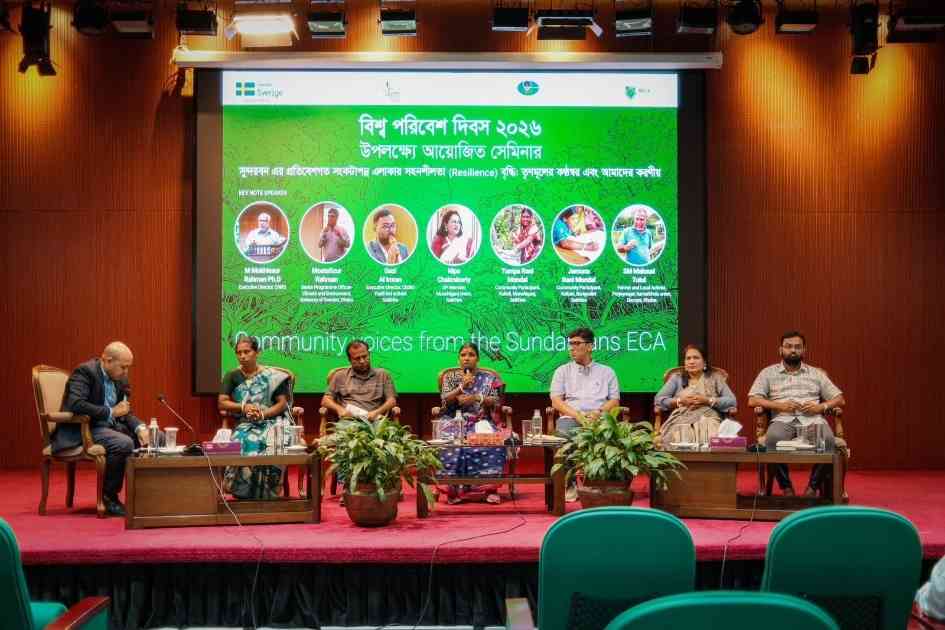

Grassroots testimonies highlighted how freshwater access, mangrove restoration, youth leadership and local governance are helping coastal communities adapt around the Sundarbans Ecologically Critical Area.
Community representatives from Bangladesh’s climate-vulnerable southwest coast joined government officials, development partners, academics, environmental experts, civil society, media, university students and local stakeholders at a national seminar focused on strengthening resilience in the Sundarbans Ecologically Critical Area.
The seminar, titled “Enhancing Resilience in the Sundarbans Ecologically Critical Area (ECA): Voices from the Grassroots” and the Forest & Tree Conservation Act, 2026, was organized by CNRS with Bangladesh’s Department of Environment and the Bangladesh Environmental Lawyers Association to mark World Environment Day 2026.
The event was held under the Biodiversity for Resilient Livelihoods (B4RL) Project, supported by the Embassy of Sweden in Dhaka. It provided a platform to share evidence, lessons learned and Nature-based Solutions that are being used to strengthen resilience across Bangladesh’s southwest coast.
A key focus of the seminar was the testimony of community representatives from climate-vulnerable coastal areas, who shared firsthand experiences of locally led climate adaptation and ecosystem restoration.
Tumpa Rani Mondal, a farmer and community representative from Munshiganj, said improved access to freshwater had transformed women’s lives by reducing the burden of water collection and improving household well-being.
Jamuna Rani Mondal, a Project Implementation Committee member of the B4RL Project, highlighted the importance of mangrove restoration through Assisted Natural Regeneration and plantation in strengthening biodiversity, protecting coastal ecosystems and improving community resilience.
Nipa Chakraborty, a Union Parishad member from Munshiganj, emphasized the role of local government leadership and community participation in conserving and sustainably managing natural resources.
Gazi Al Imran, executive director of CEDIO, underlined the importance of youth leadership and grassroots activism in protecting the Sundarbans Ecologically Critical Area.
SM Maksud, known as Tutul, a farmer and local climate activist from Dacope in Khulna, said canal re-excavation had restored freshwater availability, supported climate-resilient agriculture and improved livelihoods, showing the practical benefits of nature-based solutions for coastal communities.
The discussions underscored the importance of resilient ecosystems, empowered communities, strong institutions and youth leadership in building a climate-resilient future for Bangladesh.




