

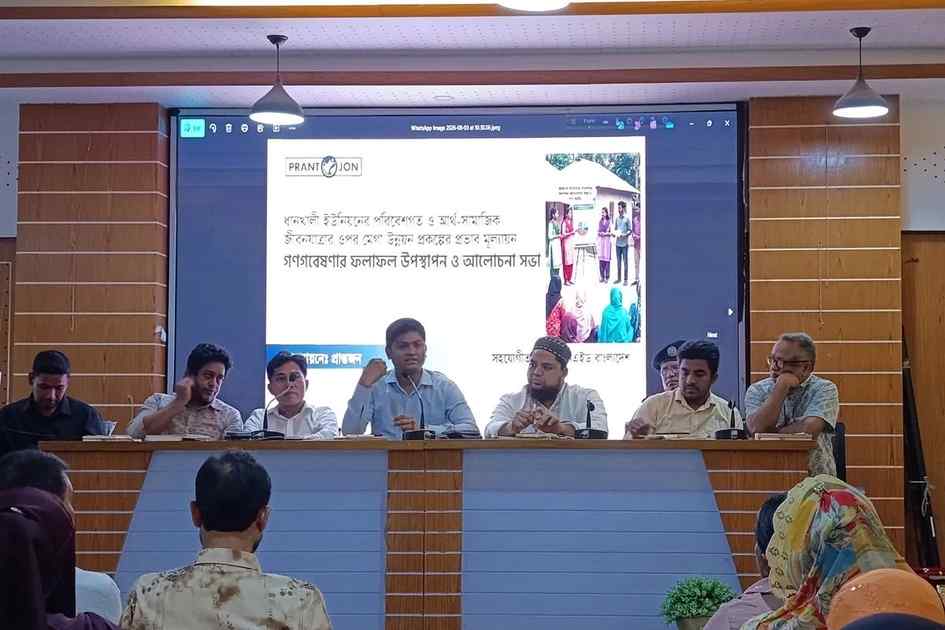



Community researchers documented declining farm work, rising insecurity and ecological stress in Dhan Khali, urging pollution controls, rehabilitation support and cleaner energy options.
The development of fossil fuel-based mega power projects in Kalapara of coastal Patuakhali has significantly affected local livelihoods, economic conditions and the environment, according to a two-year community-led research study.
The findings were presented at a discussion on “Assessing the Impacts of Mega Development Projects on Environmental and Socio-Economic Livelihoods” organised by local development organisation Prantajon with support from ActionAid Bangladesh at the Kalapara Upazila Parishad auditorium.
The event was attended by Kalapara Upazila Nirbahi Officer (UNO) Md Arifuzzaman, ActionAid Bangladesh Assistant Programme Officer Marzia Jahan, Prantajan Field Coordinator Saifullah Mahmud, Assistant Professor of the Department of Environmental Science at Patuakhali Science and Technology University Arifur Rahman, government officials, development practitioners, community representatives and local residents of Dhan Khali Union.
The discussion was chaired by Mezbah Uddin Mannan, Executive Member of Kalapara Environment and Public Safety Forum, while Saifullah Mahmud moderated the event.
Speakers included UNO Md Arifuzzaman, Assistant Professor Arifur Rahman, Kalapara Upazila Health Officer Dr Tenmong, Senior Upazila Fisheries Officer Apu Saha, ActionAid Bangladesh Assistant Programme Officer Marzia Jahan and Organising Secretary of Kalapara Environment and Public Safety Forum Md Nazrul Islam. Local residents who participated in the research, including Halima Aysha and Mehedi Hasan, also shared their experiences.
The study was conducted in Dhan Khali Union, where several fossil fuel-based power projects have been developed. Researchers examined how large-scale energy infrastructure has affected communities traditionally dependent on agriculture, fisheries and natural resources.
Farmers, fishers lose traditional livelihoods amid rapid energy expansion
As part of the participatory research process, 20 local residents were trained to collect community-level evidence with academic support from Patuakhali Science and Technology University. The study combined household surveys, community discussions and interviews with local residents to examine changes in livelihoods, environmental conditions, health and social wellbeing.
The research surveyed 457 households and found a major decline in farming-based livelihoods. Before the power projects were established, 161 respondents were engaged in agriculture as their primary occupation. The number has now fallen to 51, indicating that 110 farmers have lost their main livelihood source.
The study also highlighted challenges faced by fishing communities and other traditional workers as environmental changes have affected access to natural resources and local employment opportunities.
Economic insecurity rises as local occupations decline
The research found growing economic vulnerability among local households. The number of day labourers increased from 49 to 71, while unemployment rose from seven to 32 people.
Researchers noted that many people who were previously dependent on agriculture have been forced to shift away from traditional occupations due to changing livelihood conditions.
Residents’ perception of their financial wellbeing has also changed significantly. Before the projects, 67.84 percent of respondents described their economic condition as good or very good. Currently, only 10.07 percent share that view, while 71.33 percent consider their financial situation poor or very poor.
The number of people identified as homemakers increased from 98 to 152, with researchers suggesting that many women who previously contributed to agricultural activities have lost those livelihood opportunities.

Water, air and biodiversity concerns emerge in project area
The research identified several environmental challenges, including increasing soil salinity, declining agricultural productivity, shortage of safe drinking water, reduced air quality, biodiversity loss and degradation of local ecosystems.
The report noted that local rivers and canals once supported more than 30 species of fish, including hilsa, but many aquatic species have become increasingly scarce. Researchers said changes in the local environment have affected fishing communities and reduced access to natural resources.
The study also highlighted gender-related impacts, noting that women have faced increased challenges due to changing livelihood patterns, reduced economic opportunities and growing household pressures.
Hundreds of families displaced by land acquisition, study claims
Dhan Khali Union currently hosts the 1,320-megawatt Payra Power Plant operated by Bangladesh-China Power Company Limited and the 1,320-megawatt Patuakhali Power Plant operated by Rural Power Company Limited. Land has also been acquired for another proposed power project.
According to the research report, land acquisition for these projects has directly displaced at least 685 families, while around 1,500 farming and fishing households have indirectly lost employment opportunities.
The study was conducted over two years, with surveys carried out among 457 households in the first phase and 396 households in the second phase across eight wards of Dhan Khali Union. Researchers also conducted courtyard meetings and interviews with key informants.
Researchers call for renewable energy and a just transition
The research team recommended stronger measures to control coal waste and fly ash pollution, expand renewable energy access and introduce livelihood recovery programmes for affected communities.
The study called for greater investment in clean energy solutions, including solar home systems and biogas plants, while urging authorities to ensure rehabilitation support for displaced families and communities facing economic losses.
At the event, officials, researchers, development practitioners and community representatives called for stronger safeguards for communities affected by large-scale infrastructure projects. They urged authorities to address environmental risks and ensure development initiatives are socially and environmentally sustainable.
The findings contribute to wider global discussions on how climate-vulnerable countries can balance energy security, development needs and climate commitments. Researchers emphasised that future energy planning should prioritise environmental protection, community participation and a just transition towards cleaner energy systems.




