

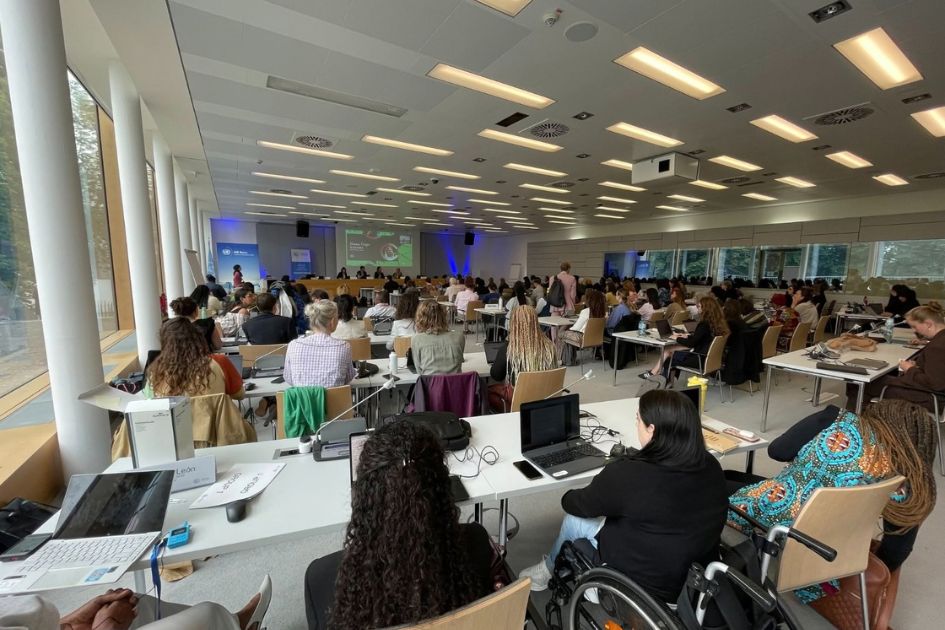



As SB64 advances gender-responsive climate action, experts argue that integrating masculinities, power structures, and gender-transformative data is essential to strengthen climate governance, accountability, and equitable transitions.
The current Bonn Climate Dialogue, SB64, represents a critical moment within a broader policy trajectory that includes the approval of the Gender Action Plan at COP30, the ongoing technical and normative discussions shaping its operationalization and the emerging roadmap toward COP31 in Antalya, where questions of implementation, indicators and accountability will become central to climate governance reform.
Climate policy has made important progress in recognizing gender as a critical dimension of climate justice. However, much of this progress still rests on an incomplete analytical foundation. Gender is still often operationalized primarily as a proxy for women and girls, while the gendered systems that structure emissions, governance, adaptation and decision-making remain insufficiently examined. If climate action is to be genuinely transformative, it must address a central but still under-integrated driver of climate outcomes: masculinities.
This is not a call to shift attention away from women, girls, Indigenous peoples or gender-diverse communities, who are disproportionately affected by climate impacts. It is a call to strengthen gender-responsive climate policy by making visible the full architecture of gendered power. Masculinities are understood here as plural, socially produced and context-specific configurations of norms, identities and expectations that shape behavior and institutions, while masculinist systems refer to the institutionalized forms of power that normalize extraction, control and unequal decision-making authority. Together, they structure who emits, who decides, who benefits and who bears climate risks.
Across fossil fuels, transport, construction, mining, industrial agriculture and heavy industry, men continue to dominate both employment and leadership. These sectors are among the highest contributors to greenhouse gas emissions. Men also disproportionately occupy decision-making positions in political and economic institutions that determine energy systems, infrastructure pathways and climate finance priorities. This produces a structural alignment between masculinized power and emissions-intensive development models.
These patterns are not biological. They are produced and sustained through social, political and economic systems that shape expectations of behavior, identity and value. Dominant masculinities associated with control, risk-taking, emotional suppression and provider-centered identity influence both institutional decision-making and individual practices that reinforce high-carbon systems. These norms are embedded in labor markets, education systems, corporate cultures and state institutions, shaping consumption patterns, mobility choices, occupational segregation and responses to climate risk.
At the same time, masculinities are not uniform. Boys, young men, adult men and older men experience climate risks, responsibilities and opportunities in different ways. In climate-exposed sectors, many men face heat stress, occupational hazards, pollution exposure and livelihood insecurity. Others experience identity strain when economic transitions disrupt provider roles and social expectations of control and stability. These differentiated realities are central to understanding how climate transitions unfold socially and politically.
Despite this complexity, most climate data systems remain narrowly focused on vulnerability. Existing gender- and age-disaggregated frameworks under the UNFCCC have improved visibility of differential impacts, but they remain limited in capturing power, agency, emissions-relevant behavior and governance influence. They describe who is most affected by climate change but not who drives emissions, who holds decision-making authority or how gender norms structure production and governance systems. Without this broader analytical architecture, climate policy risks addressing symptoms while leaving structural drivers intact.
Emerging evidence from climate science, sociology and political economy shows that gender norms influence emissions behavior, governance practices, leadership pathways and environmental decision-making. Masculinities shape whether high-carbon consumption is normalized, how risk is defined and managed and how institutions prioritize growth over ecological stability. These dynamics are not peripheral; they are constitutive of how climate systems function.
Responding to this requires a shift in how climate data and policy frameworks are designed. It requires moving beyond binary and static understandings of gender and toward intersectional approaches that account for age, class, geography, occupation and other axes of inequality, while explicitly integrating masculinities as a relational system of power embedded in both identities and institutions.
Methodologically, this means moving beyond vulnerability-only frameworks toward approaches that integrate power, responsibility, agency and transformation. It includes mixed-method research, participatory action research and social norm analysis that can capture how gendered expectations shape environmental behavior and institutional decision-making. It also requires integrating care as a central analytical category, recognizing care work as both ecologically low-carbon and socially foundational to resilient societies.
From a data and policy perspective, SB64 represents a critical opportunity to address a persistent gap in climate governance. Gender- and age-disaggregated data systems under the UNFCCC must evolve to include indicators that capture emissions-relevant behaviors, decision-making power and governance influence. This includes systematically tracking gendered patterns of consumption and mobility linked to emissions, occupational segregation across high-carbon and low-carbon sectors, representation and leadership in energy and industrial systems and norm-based indicators that measure shifts in care, responsibility and environmental stewardship.
Equally important is the development of gender-transformative indicators that distinguish between descriptive conditions, behavioral practices and structural power relations. These indicators should track change in norms, behaviors, participation, accountability and decision-making across social groups, including men and boys. Without this multi-level measurement of transformation, climate policy cannot credibly claim to be gender-responsive in a substantive sense.
Just transition frameworks must also integrate identity and social norm transformation as core components, not secondary considerations. Economic restructuring alone is insufficient if it leaves intact the gendered norms that define work, status and belonging. Transition strategies must expand the legitimacy of care, repair, maintenance and social infrastructure work, while supporting men and boys in navigating shifts in provider identity and social expectations. Social protection systems must be strengthened to reduce vulnerability during structural economic change and prevent exclusionary or destabilizing transition dynamics.
There is already emerging practice-based evidence that demonstrates how this shift can be operationalized.

One well-established and highly relevant example is the EcoMen initiative in Bangladesh, led by YouthNet Global in collaboration with MÄN and supported by partners within the MenEngage Alliance ecosystem. EcoMen engages boys and young men in climate-vulnerable contexts through structured, participatory reflection processes that critically examine masculinities in relation to climate justice, care and environmental responsibility.
Rather than treating young men only as beneficiaries or future leaders, EcoMen positions them as gendered actors embedded within systems of power and emissions. The initiative works through dialogue, community engagement and experiential learning to explore how norms of masculinity shape consumption, mobility, household dynamics and environmental attitudes, while linking personal identity transformation with collective action.
A key contribution of EcoMen is its integration of care-centered masculinities into climate action. It challenges the association between masculinity and dominance over nature, promoting instead relational forms of identity grounded in responsibility, empathy and stewardship. This enables alternative masculinities that are compatible with low-carbon and climate-resilient futures.
Importantly, practice-based evidence from EcoMen shows how shifts in gender norms among boys and young men can influence broader community dynamics, including environmental awareness, shared responsibility and acceptance of more equitable social roles. Evidence from YouthNet Global’s implementation across climate-vulnerable regions of Bangladesh further demonstrates how such approaches contribute to community resilience, including in contexts where climate stress intersects with social stigma, livelihood insecurity and environmental degradation.
Complementary methodologies developed by organizations such as MÄN in Sweden and the MenEngage Alliance further demonstrate how critical reflection on gender norms can support behavioral change, accountability and care-based leadership. These approaches form a broader methodological ecosystem that links personal transformation with structural change, rather than isolated behavioral interventions.
Despite these advances, institutional and political barriers continue to limit progress. A persistent challenge is the widespread perception that gender and climate work concerns only women and girls. This narrow framing obscures the role of masculinities, gendered norms and masculinist systems in shaping emissions pathways, governance structures and climate outcomes. It also limits the political space for transformative approaches that engage men and boys as gendered actors within systems of responsibility and accountability.
Another major constraint is the limited availability of age-, gender-, occupation- and sector-disaggregated climate data. Many climate institutions lack the methodological tools, resources and political support needed to integrate social norm analysis and gender-transformative approaches into planning, monitoring and reporting systems. This reinforces a broader governance gap in understanding how power operates through climate systems.
Addressing these challenges requires coordinated policy shifts across climate governance systems. Evidence on social norms and gender stereotypes related to masculinities, care and behavioral drivers must be systematically integrated into Nationally Determined Contributions, National Adaptation Plans and national climate reporting processes. Gender-transformative indicators must be embedded within climate monitoring systems to track change in attitudes, behaviors, participation, leadership, accountability and decision-making across social groups, including men and boys. Climate institutions must strengthen the collection and use of gender-, age-, occupation- and sector-disaggregated data, while explicitly assessing how gender norms influence emissions-intensive practices, governance structures, infrastructure development, climate finance and decision-making processes, particularly among men in positions of power.
Recognizing that climate finance, energy investment, infrastructure planning, land use and natural resource governance remain heavily dominated by men and shaped by masculinist institutional logics of competition, control and short-term extraction, there is a need to actively rebalance decision-making power. This includes creating enabling conditions for feminist, Indigenous, care-centered and youth leadership to shape climate outcomes more directly and structurally.
Climate finance mechanisms must also be designed to support initiatives that advance climate resilience, gender equality and just transition objectives, including accountable engagement with men and boys grounded in intersectional and decolonial feminist principles. Dedicated resources should be allocated for research and programming on masculinities, gender norms, care-based approaches and gender-transformative climate action. Publicly funded climate projects should be required to demonstrate meaningful engagement with gender norms and inequalities, including the role of masculinities in shaping outcomes.
Capacity building is also essential. Climate policymakers, practitioners and institutions must be supported to understand how gender norms and power relations shape climate outcomes, including fostering awareness among those in positions of power of their own gendered positioning and the implications of masculinities in decision-making processes. Strengthening collaboration between climate institutions, Indigenous movements, feminist and gender-diverse organizations, youth networks, labor groups, public health actors, educational institutions and alliances such as MenEngage is also critical for integrated and coherent climate governance.
Finally, meaningful participation of youth organizations, feminist groups, workers’ organizations, First Nations peoples, community-based organizations and other marginalized groups must be ensured across all stages of climate policy design, implementation and accountability.
At a deeper level, this is about power. Climate change is not only a technical or economic challenge. It reflects entrenched systems of extraction, domination and inequality that are historically gendered. Masculinities and masculinist systems are embedded within these structures, shaping both their persistence and their potential transformation.
Bringing masculinities into climate data and policy does not dilute gender equality agendas. It strengthens them by improving the accuracy of climate diagnostics and the effectiveness of policy responses. It enables a more complete understanding of emissions drivers, governance structures and pathways for social transformation.
SB64 therefore represents a critical moment. The question is not whether masculinities are relevant to climate policy. They already are. The question is whether climate governance systems are prepared to measure them, analyze them and act on the evidence.
Closing this gap is not a technical adjustment. It is a prerequisite for climate justice and for climate policy that can finally reflect how power actually operates in the world.
Writer: Executive Coordinator at YouthNet Global. Member, MenEngage Alliance’s Global Working Group on Climate and Environmental Justice.




