

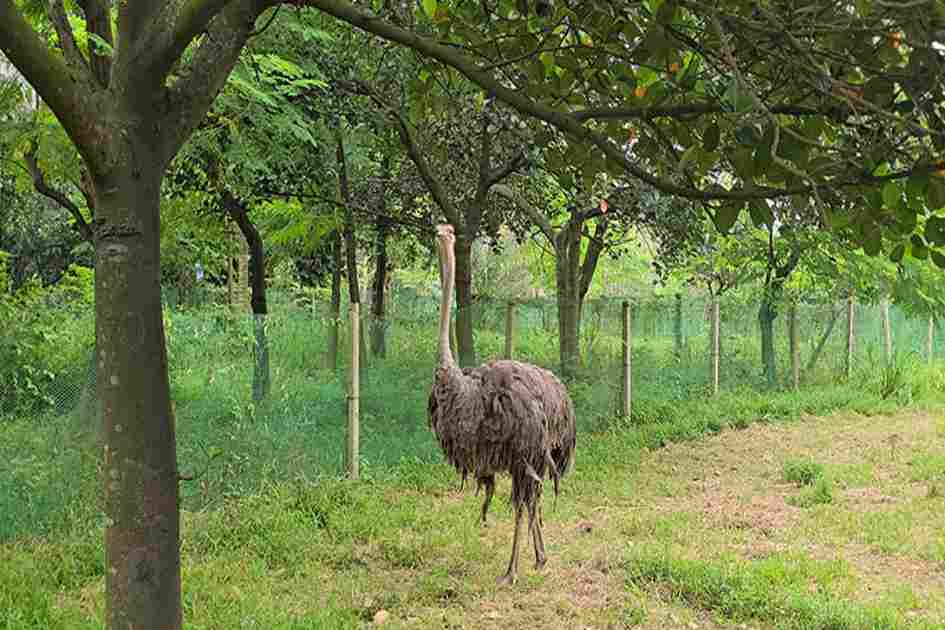

Imported ostriches meant to test commercial farming have become the centre of questions over research ethics, project spending and alleged irregularities at the Savar institute.
Just two ostriches now roam a quiet shed at the Bangladesh Livestock Research Institute in Savar, down from a flock of 22 African ostriches that once ran through the facility a few years ago.
At the time, researchers claimed the bird could one day be farmed commercially in Bangladesh as an alternative to beef and mutton, leading to the development of new breeds adapted to local conditions and boosting meat production.
Six years later, as a 1.34 billion taka research project comes to an end, those ambitions face severe scrutiny. The project has produced no visible results and no initiatives for commercial expansion, while most of the ostriches brought in for research are no longer alive. Fifteen were slaughtered, three died, two are missing, and the remaining two are being used in the final phase of research.
In addition to the lack of progress, project director Dr. Sajedul Karim Sarkar, a principal scientific officer at the institute, faces allegations of nepotism, recruitment irregularities and misuse of project funds.
The institute launched the Poultry Research and Development Strengthening Project in the 2019-20 fiscal year to improve domestic poultry species, innovate new technologies and transfer them to farmers. A major highlight was acclimating African ostriches to Bangladesh’s climate to pave the way for commercial farming and provide an alternative meat source.
Twenty-two ostriches were imported from Africa in two phases, starting with seven in 2020 followed by 15 juveniles for further research.
At the start of the project, Sarkar said the birds could be easily raised in local weather conditions. He noted that an adult ostrich weighs between 100 and 150 kilograms, starts laying 20 to 25 eggs a year at two and a half years old, and can meet the meat demand equivalent to at least two local cows. He also promised commercial marketing of the meat, but those commitments bear little resemblance to reality six years later.
According to data from the institute, 15 of the 22 ostriches were slaughtered for sensory evaluation to test meat quality and taste, three died, two are missing and two remain.
The decision has raised questions among experts about the scientific foundation and ethics of the study, given that most of the animals were slaughtered mid-way through a project aimed at adapting a new species to the local environment.
Dr Kamrul Hasan, a wildlife researcher and professor in the Department of Zoology at Jahangirnagar University, said that while the idea of raising the birds and developing new breeds was far-sighted, ostriches are not native to Bangladesh. He noted that hatching eggs and meeting meat demand would be difficult, adding that while slaughtering animals can be necessary in research, questions remain over whether slaughtering 15 out of 22 birds was logical.
Others have questioned the profitability and feasibility of ostrich farming considering Bangladesh’s climate, agricultural economy and consumer demand. Observers note that the success of a research project should be measured by its field outcomes rather than its budget, though those involved argue that research can involve failure alongside success.
Khandakar Tauhidul Islam, a former student at Hajee Mohammad Danesh Science and Technology University who completed his PhD on ostriches under Sarkar, said research does not always guarantee success. Because ostriches are not native, achieving success requires multiple stages of work rather than a single attempt, he said.
Addressing the slaughter of the 15 ostriches, Islam said it was done to test meat taste for research purposes, referring further details to Sarkar.
Sarkar faces major allegations of nepotism, including purchasing expensive laboratory equipment and making his wife the lab in-charge strictly on paper without any operational activity. He is also accused of hiring around 18 close relatives for the project, including his brother-in-law, niece’s husband, sister’s nephew-in-law, niece’s husband, nephew, cousin’s wife, cousin and wife’s sister’s brother-in-law.
Dr Shakila Faruque, acting director general of the institute, acknowledged these issues, saying the research focused on how the imported birds adapt, what they eat, which environments suit them best and the taste of their meat, which required slaughtering several birds. She added that because ostriches are not native to Bangladesh, it will take time to see results.
The institute has faced other controversies as well. In 2023, allegations surfaced that 38 roosters under research were slaughtered and consumed, despite initial claims that they were stolen. An investigation was launched, but its findings were never made public.
When brought to his attention, Sultan Salahuddin Tuku, state minister for fisheries and livestock, assured that action would be taken. He said an investigation committee has been formed to look into the irregularities at the institute and that a report will be published after probing the matter.
This article is republished from the The Daily Banik Barta.




