


An estimated 7,573 families living in 47 settlements in Satkhira face prolonged displacement, prompting calls for legal protection, essential services and inclusion in urban planning.
Climate-displaced families in Bangladesh’s southwestern district of Satkhira have demanded permanent housing on government-owned land, food and nutrition security and employment opportunities as part of an 11-point charter seeking to protect their rights and improve living conditions.
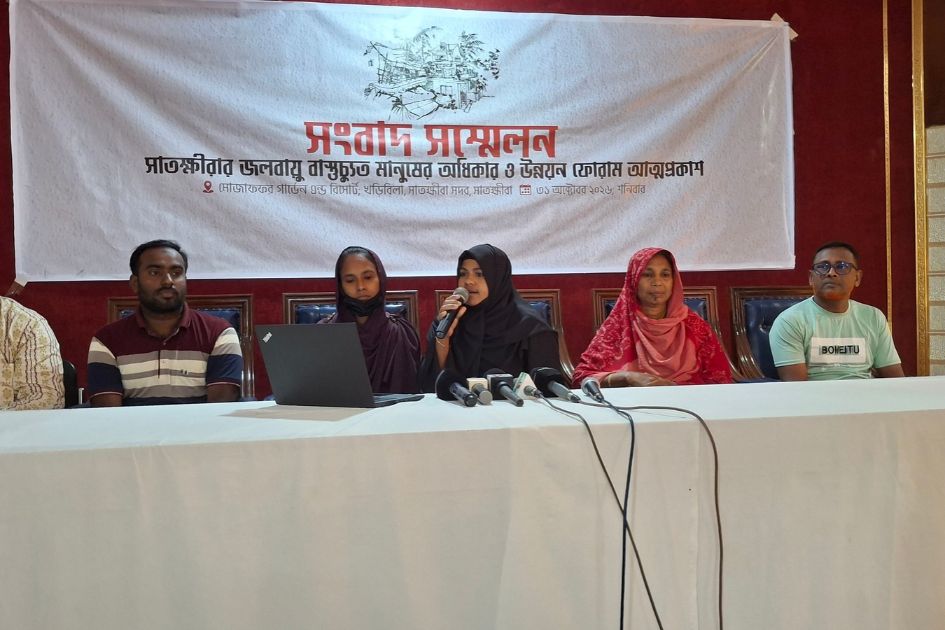
The demands were presented at a press conference in Satkhira on October 30 by the Satkhira District Forum for the Rights and Development of Climate-Displaced People.
The forum said thousands of families forced from their homes by floods, waterlogging, storm surges, cyclones, riverbank erosion and increasing salinity had sought refuge in Satkhira town after losing their homes, land and livelihoods.
An estimated 7,573 displaced families are living in 47 settlements across Satkhira municipality, according to the forum, which described their prolonged displacement as a growing human rights and development crisis.
The group called for permanent housing on government-owned khas land, which is land under state ownership, alongside measures to ensure food security, adequate nutrition and sustainable livelihoods.
It also demanded vocational training tailored to labour market needs for displaced women, men and young people, as well as employment opportunities, access to loans on easy terms, financial services and decent incomes.
The press conference was chaired by forum president Fatema Begum, while member secretary Sonia Khatun presented the written statement outlining the demands.
The charter called for emergency food assistance and the inclusion of displaced families in affordable food programmes and social protection schemes.
It also urged authorities to ensure adequate nutrition services for children and mothers, access to safe drinking water and sanitation facilities and improvements in basic living conditions.
The forum demanded formal recognition of climate-displaced communities in urban development and climate adaptation plans, with affected residents given opportunities to participate in planning and decision-making.
It called for an end to evictions without rehabilitation, improvements to existing settlements and legal protection for displaced residents.
Other demands included access to national identity cards and voter registration, education for displaced children, mobile healthcare services and evidence-based planning and budget allocations that reflect the circumstances of displaced families.
The forum also stressed the need to address the economic vulnerability of displaced communities through skills development, financial inclusion and sustainable employment.
Responding to questions from journalists, speakers said climate-displaced people should not be treated merely as recipients of relief or humanitarian assistance.
They said displaced families were citizens of Bangladesh with legitimate rights to safe and permanent housing, livelihoods, decent incomes, food, nutrition, water, healthcare, education and social protection.
The press conference was moderated by Madhab Dutta, executive director of Swadesh, a local development organisation.
Among those attending were disaster expert Gawher Nayeem Wahra, founder of the National Disaster Forum, Nurul Alam Mosharraf, chief executive of Participatory Research and Network (PRAN), and Gouranga Nandy, chief executive of CEPR.
Representatives of civil society organisations, rights activists and climate-displaced communities also participated in the event.