

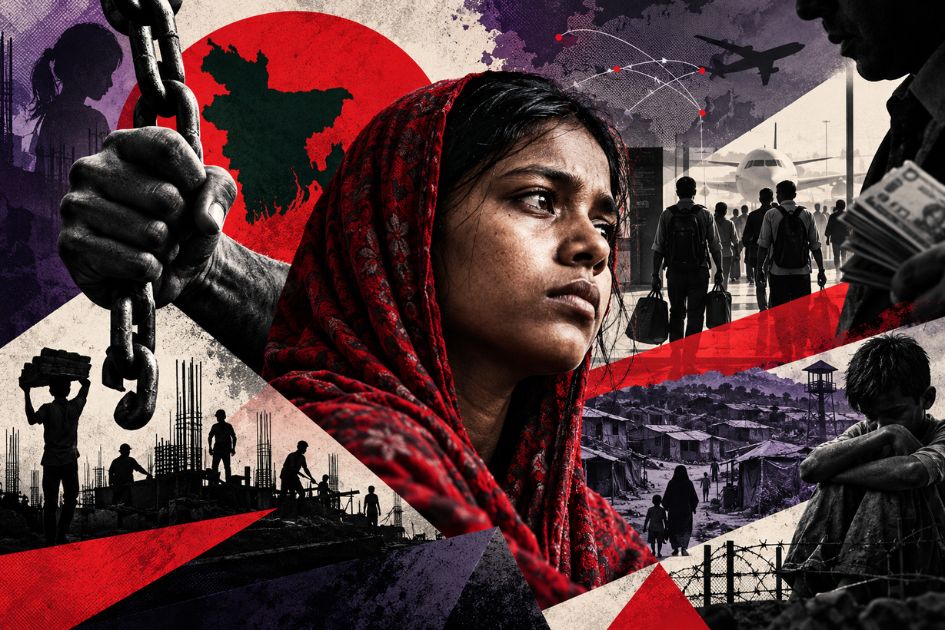



The report highlights declining convictions and victim identification, inadequate protection for Rohingya refugees, and recruitment fees that leave migrant workers vulnerable to exploitation.
Bangladesh remained in Tier 2 in the US Department of State’s 2026 Trafficking in Persons Report, which said the government had made significant efforts to combat human trafficking but still failed to meet minimum standards in several key areas.
The report said Bangladesh had increased investigations and prosecutions, strengthened its legal framework and improved systems for identifying and referring trafficking victims. But it also said the government convicted fewer traffickers, did not take adequate action against pervasive internal trafficking and identified fewer victims than in the previous reporting period.
The government also continued to allow worker-paid recruitment fees that can leave migrant workers heavily indebted and more vulnerable to trafficking, the report said.
Bangladesh remained in Tier 2 because the government demonstrated overall increasing efforts compared with the previous reporting period. Among the measures cited were the passage of the Prevention and Suppression of Human Trafficking and Smuggling of Migrants Ordinance 2026, updated guidelines on trafficking crimes and victim identification and a pilot digital National Referral Mechanism, or NRM, intended to make referrals to protection services faster and better coordinated.
The government also strengthened protections for migrant workers, although victim protection and reintegration remained insufficient, particularly for Rohingya refugees and returning Bangladeshi migrant workers.
Prosecution
The government increased anti-trafficking law enforcement efforts during the reporting period, according to the report.
Bangladesh’s 2012 Prevention and Suppression of Human Trafficking Act criminalizes sex trafficking and labor trafficking, with penalties ranging from five years to life imprisonment and a fine of at least 50,000 Bangladeshi taka ($407). Bonded labor is treated as a separate offence carrying five to 12 years in prison and a fine of at least 50,000 taka.
In January 2026, the government introduced the Prevention and Suppression of Human Trafficking and Smuggling of Migrants Ordinance 2026. The measure created a separate chapter on migrant smuggling, expanded the definition of exploitation to include forced criminality and updated investigation procedures.
Parliament passed the Prevention and Suppression of Human Trafficking and Migrant Smuggling Bill into law just after the reporting period ended in April 2026, retaining the text of the ordinance.
Bangladesh police, including the Criminal Investigation Department, Police Bureau of Investigation and Dhaka Metropolitan Police’s Counterterrorism and Transnational Crime Unit, were responsible for investigating trafficking crimes. A central monitoring cell coordinated investigations.
Anti-Human Trafficking Tribunals, made up of judges and special prosecutors assigned to hear trafficking cases and address substantial backlogs, handled cases in seven of Bangladesh’s eight divisional capitals. Judges responsible for 80 women and children courts heard cases involving violence against women and children, including trafficking, in 57 of the country’s 64 districts.
During the reporting period, the government said it investigated 961 cases involving 5,263 suspects. These included 137 sex trafficking cases, 443 forced labor cases and 381 cases involving unspecified forms of trafficking. It continued to investigate 1,135 cases.
The 961 investigations represented an increase from 811 cases in the previous reporting period.
The government reported initiating prosecutions against 1,795 suspects, including 604 for sex trafficking, 600 for forced labor and 591 for unspecified forms of trafficking. It continued prosecutions against 1,683 suspects from the previous reporting period.
The number of suspects prosecuted was a significant increase from 452 in the previous year.
However, courts and tribunals convicted 76 traffickers, down from 103 in 2024 and 407 in 2023.
Courts sentenced 35 traffickers to between three months and life imprisonment and imposed fines ranging from 5,000 to 500,000 taka ($41 to $4,065). The government did not provide sentencing information for the remaining traffickers.
The report said the imposition of fines instead of proportionate prison sentences weakened deterrence and undercut the government’s broader anti-trafficking efforts. It also said the government likely reported some crimes as trafficking that fell outside the international definition of trafficking.
During the reporting period, the government worked with an international organization to develop a “bench book” on human trafficking cases, providing guidance on court procedures and judicial handling of trafficking cases. It also offered practical guidance for law enforcement agencies on victim-centered and trauma-informed approaches during investigations.
Limited expertise in anti-trafficking investigations, inadequate evidence and reliance on victim-witnesses in criminal proceedings continued to hamper law enforcement, the report said. Police and prosecutors often failed to collaborate effectively, resulting in delays and weak cases.
Observers also reported that tribunal judges often disposed of trafficking cases and that judgments did not always follow sentencing guidelines.
The government continued to train police officers through an anti-trafficking module at the police academy and provided training for judges and prosecutors. It also signed a memorandum of understanding with an international organization and an NGO to provide training on trafficking case adjudication.
Observers said tribunal judges and prosecutors needed further anti-trafficking training.
Bangladesh cooperated with other governments on law enforcement operations through mutual legal assistance pacts and extradition treaties to support investigations into ongoing trafficking cases.
The government did not sufficiently investigate or prosecute trafficking cases involving Rohingya refugees, despite continued reports of their exploitation in Bangladesh.
Although the trafficking law allows non-citizens to file trafficking cases, the government had not established clear legal reporting mechanisms in refugee camps. This impeded Rohingya access to the criminal justice system and increased impunity for offenders.
Police and international humanitarian actors maintained multiple help desks in refugee camps to provide legal assistance to women and child refugee crime victims. But public distrust of police and security services discouraged many victims from seeking assistance.
Corruption and official complicity in trafficking crimes remained significant concerns, inhibiting law enforcement action, the report said.
The government did not report any investigations, prosecutions or convictions of government employees accused of complicity in trafficking crimes. Media reports said the government had filed charges against nearly 100 recruitment agencies for charging workers excessive recruitment fees, with all the cases still ongoing.
The government also did not provide updates on previous media reports involving the owners of 12 recruitment agencies, including a former government official and family members, accused of charging workers recruitment fees nearly five times higher than the legal maximum.
Some trafficking victims reported that border officials facilitated their travel through the airport.
Protection
The government maintained efforts to protect trafficking victims, but the number of victims identified and referred to services fell during the reporting period.
The government identified 1,135 victims, including 199 victims of sex trafficking, 510 victims of forced labor and 426 victims of unspecified trafficking. That was down from 1,462 victims in the previous reporting period.
Civil society and international organizations identified an additional 4,758 trafficking victims.
The Ministry of Home Affairs updated the human trafficking crime and victim identification guidelines by adding new questions intended to improve the accuracy of victim identification. The guidelines also provided structured guidance for detectives and frontline officials to ensure ethical standards during interviews with potential victims.
The ministry directed the police, Border Guard Bangladesh, Ministry of Social Welfare and Ministry of Women and Children Affairs to incorporate the guidelines into their respective training manuals.
Despite these measures, law enforcement needed more training to identify trafficking victims among vulnerable groups, including people engaged in commercial sex.
The report said inadequate screening meant the government did not effectively prevent the inappropriate punishment of potential trafficking victims for unlawful acts committed as a direct result of being trafficked.
Police operations at commercial sex establishments resulted in the arrest of potential sex trafficking victims without screening for trafficking indicators.
Bangladesh had a National Referral Mechanism and referred 745 victims to care, down from 1,607 in the previous reporting period.
The government piloted a digital platform for the mechanism and streamlined the process to make referrals to services more timely and coordinated. The Ministry of Home Affairs trained government officials and relevant NGO and private-sector staff in seven districts to use the digital system.
The government reported that trafficking victims could receive health care, legal services, shelter, vocational training and other assistance through support centres operated by the Ministry of Expatriates’ Welfare and Overseas Employment, the Ministry of Women and Children Affairs and other government ministries, as well as through partnerships with civil society organizations.
The government provided services to 111 victims, down from 883 in the previous reporting period.
It allocated 212.78 million taka ($1,729,940) for victim services. However, NGO contacts said the figure likely included funds spent on managing Rohingya refugees, meaning actual government spending on trafficking victim care was probably much lower.
Six NGOs, working with the Ministry of Social Welfare and the Department of Social Services, provided shelter and services to male and female trafficking victims.
The Ministry of Women and Children Affairs operated six shelter homes for women and children, including trafficking victims. The Department of Social Services operated six additional shelter homes for women and children and three child development centres, although none provided specialized services for trafficking victims.
Observers said additional safe houses were needed, particularly for victims participating in criminal proceedings.
Police operated multiple centres for women and child victims of violence, including trafficking, in each of Bangladesh’s eight divisions. The centres offered short-term shelter, medical services and counselling.
The Department of Social Services operated four centres providing education and vocational training to women seeking alternatives to commercial sex, including trafficking victims.
Government shelters remained limited, particularly for men, and accommodation was even more restricted outside Dhaka.
The government reported that construction had begun during the reporting period on a specialized shelter for trafficking victims at the border with India.
Under the National Referral Mechanism, victims did not require a court order to access government services. However, trafficking victims, particularly those without legal residency in Bangladesh, were required to remain in shelters until repatriation to their countries of origin. Women and children in shelters reportedly did not have freedom of movement.
Bangladeshi law provides victims with protection during judicial proceedings, including police security, and allows testimony by video conference. Observers said many courts were not equipped to handle video testimony.
Trafficking victims often did not testify because of fears of retaliation or reprisals from traffickers and inadequate police protection.
Law enforcement officials, prosecutors and judicial officers lacked victim-centered and trauma-informed approaches when dealing with trafficking victims during trials.
The government provided victim-witness assistance to support participation in criminal proceedings, including financial assistance for transportation to testify and free legal services.
It did not provide legal alternatives to the removal of foreign trafficking victims to countries where they might face retribution or hardship.
Trafficking victims were entitled to court-ordered restitution from traffickers or compensation from a government-established fund. But the fund had not received allocations during the reporting period.
Courts ordered 48 convicted traffickers to pay 1.32 million taka ($10,748) in restitution to victims. All of the convicted traffickers appealed to higher courts, with the outcomes pending at the end of the reporting period.
Victims could also file civil suits seeking compensation. Compensation from the victim fund was rarely awarded in criminal cases and many civil suits were subject to lengthy delays.
Out-of-court settlements between victims and traffickers remained common. Most settlements required victims to withdraw their testimony, effectively eliminating the possibility of a criminal conviction.
The government reported that arbitration of trafficking cases through the Bureau of Manpower Employment and Training was more common than criminal charges under the Prevention and Suppression of Human Trafficking Act.
Officials typically encouraged the relevant recruitment agency to offer the victim money to resolve a complaint. The report said potential trafficking cases could therefore be handled as labor disputes through negotiation and arbitration rather than as criminal offences, with civil penalties less severe than those under the trafficking law.
The government said it funded the repatriation of 168 victims during the reporting period. However, it remained largely dependent on civil society and international organizations to assist with repatriation and provide support after victims returned.
The Ministry of Home Affairs and the Government of India continued to finalize previously drafted victim identification and repatriation standard operating procedures under a 2015 memorandum of understanding.
The two governments facilitated the repatriation of trafficking victims from India, while civil society organizations often funded the process. Without formal procedures, the lengthy and complex approval process left some Bangladeshi victims in Indian shelters for years.
Prevention
The government increased its prevention efforts during the reporting period.
The National Anti-Human Trafficking Authority, under the Ministry of Home Affairs, served as the main coordinating body for government anti-trafficking efforts and met quarterly.
The authority reviewed progress and extended the 2022-2025 National Action Plan through June 2026.
The government allocated 80.85 million taka ($657,344) for prevention efforts, down from 621.49 million taka ($5.05 million) in the previous reporting period.
The government conducted public awareness activities directly and in partnership with NGOs and international organizations. Campaigns targeted vulnerable populations, were delivered in local languages and were accessible in braille.
The government also worked with the Inter-Sector Coordination Group, which coordinates humanitarian activities in the Rohingya refugee response, to distribute anti-trafficking messages among Rohingya populations and host communities.
It facilitated access for international organizations and civil society groups conducting awareness activities in Rohingya camps and operated and funded several hotlines for trafficking victims.
The 2013 Overseas Employment and Migrants Act criminalizes fraudulent recruitment and unlawful recruitment fees. However, the government continued to set legal recruitment fees between 85,000 and 262,000 taka ($691-$2,130), amounts the report said were high enough to leave many migrant workers indebted and vulnerable to trafficking through debt-based coercion.
Many migrants also paid more than the legally permitted rates.
The government had fixed recruitment fees for 18 countries receiving the largest numbers of Bangladeshi workers.
Bangladesh had implemented more than 20 bilateral labour agreements, partly to protect Bangladeshi workers abroad. During the reporting period, it signed additional labour agreements and memorandums of understanding with Saudi Arabia, Italy, South Korea and Japan.
The Ministry of Expatriates’ Welfare and Overseas Employment maintained 30 labour offices in embassies and consulates in 27 major destination countries.
Workers nevertheless continued to pay large fees above the fixed amounts for service charges, airfares, passports, visas, medical fees and other expenses.
The ministry acknowledged that migrant workers frequently paid fees to sub-agents, known locally as dalals, in addition to legal recruitment fees.
Dalals also directly connected workers with overseas jobs by providing fake visas and other documents and, in some cases, false or deceptive information about the migration process and jobs in destination countries.
The Bangladesh Association of International Recruiting Agencies oversaw more than 2,400 licensed labour recruitment agencies and collected recruitment fees.
In October 2025, the Ministry of Expatriates’ Welfare and Overseas Employment published amended rules for classifying recruitment agencies. The changes included prioritizing skilled migration, implementing a complaint mechanism and introducing an employer-pay model for recruitment fees.
The classification changes had not been implemented by the end of the reporting period. Agencies that prioritized the measures would likely receive higher scores, allowing faster government processing of paperwork and licences and less stringent monitoring.
The ministry had authority to register recruiting dalals and required brokers to register sub-agents and representatives. In July 2025, it published rules governing recruiting agents’ sub-agents.
The rules set out licensing requirements and responsibilities for sub-agents, including prohibitions on making false promises to workers and charging excessive fees. But they still allowed sub-agents to collect between six and eight months’ salary from migrant workers as a “service fee”.
The ministry did not report how it was enforcing the rules for sub-agents or whether recruitment agencies had been suspended for violations. This compared with 126 agencies suspended in 2023.
In December 2025, the ministry introduced an overseas employment platform, a digital system developed with an international organization to streamline the employment process. It also eliminated the previously mandatory migration fee of 1,350 taka ($11) per worker.
The government’s Vigilance Task Force, a multi-agency effort to monitor compliance with migration rules and prevent illegal immigration, continued operations against corrupt recruitment agencies, travel agencies and dalals operating in rural areas and connecting prospective migrant workers with licensed employment agencies.
The Ministry of Labour and Employment’s Department of Inspection for Factories and Establishments removed 5,122 children from hazardous conditions through inspections during the reporting period, including potential trafficking victims. The figure was up from 3,697 children in the previous reporting period.
The department had authority to file cases in labour courts. In November 2025, the government amended its Labour Act, increasing civil penalties for employing child labour from 5,000 taka ($41) to between 20,000 and 50,000 taka ($163-$407).
However, staffing and resources for labour inspections, including inspections for forced and child labour, remained severely inadequate.
The department could conduct unannounced inspections only at factories outside designated export processing zones. Inspectors were not authorized to monitor the informal sector, where an estimated 93 percent of child labour, including forced child labour, occurred.
The Labour Act amendment also prohibited forced labour and introduced fines for the offence, but labour inspectors did not receive sufficient training on forced labour.
The government took some measures to prevent forced and child labour, including in supply chains, in violation of international standards.
In February 2026, Bangladesh signed an agreement on reciprocal trade with the United States that includes an obligation to prohibit the import of goods produced using forced labour.
The government also took steps to reduce demand for commercial sex acts.
It did not take measures to reduce demand for extraterritorial child sexual exploitation and abuse by Bangladeshi citizens abroad or foreign tourists visiting Bangladesh. However, it cooperated with a foreign government in the extradition of a Bangladeshi citizen accused of sexually exploiting children abroad.
The government provided basic anti-trafficking training to Bangladeshi military and police personnel before their deployment as peacekeepers and reported providing anti-trafficking training to diplomatic personnel.
Trafficking profile
The report said human traffickers exploit domestic and foreign victims in Bangladesh and Bangladeshi victims abroad.
Groups considered particularly vulnerable included victims of child marriage and violence against women and girls, low-income households, historically vulnerable castes including Dalit and Harijan communities, seasonal labourers, poorly educated and unemployed youth and students, people with disabilities, people affected by natural disasters, Rohingya refugees and illegal migrants.
Women and girls from low-income backgrounds remained vulnerable to sex trafficking, while men and boys from low-income backgrounds faced heightened risks of labour trafficking in construction, agriculture, fishing, domestic work and other informal sectors.
Bangladesh facilitates the migration of hundreds of thousands of skilled and semi-skilled workers each year. Men make up the majority of migrant workers, while women are increasingly travelling for domestic work and employment in other sectors.
Most Bangladeshi workers migrate to the Middle East, while others travel to India, Maldives, Pakistan, European countries and Southeast Asian countries.
Most migrants are low-skilled or unskilled workers who use middlemen and private recruitment agencies to arrange overseas employment and travel.
Many workers take on debt to pay high recruitment fees, whether imposed legally by recruitment agencies or illegally by unlicensed sub-agents, placing them at risk of debt-based coercion.
Most Bangladeshi migrant workers report experiencing some form of labour exploitation, including fraudulent contracts, discrepancies in wages or working hours and low or unpaid wages.
Traffickers exploit Bangladeshi men in forced labour abroad, particularly in agriculture and construction. Bangladeshi women and girls are exploited in forced labour and sex trafficking abroad, including in India, Pakistan and Gulf countries.
Female migrants seeking domestic work reportedly face significant trafficking risks, particularly in Gulf states and Southeast Asia.
Bangladeshi nationals are also fraudulently recruited into forced criminality in online scam operations, primarily in Southeast Asian countries, through social media, messaging applications and online job portals.
Traffickers primarily target young, educated men with fake offers of high-paying jobs abroad and coerce them into cyber-enabled crimes by withholding identity documents and wages, restricting movement and using debt bondage.
Traffickers frequently exploit people from rural communities migrating to urban areas or abroad.
They use coercive debt to force Bangladeshi families and Indian migrants to work in aluminium production, brick kilns, garment factories, dried fish production, shrimp and fish processing, shipbreaking and tea plantations.
Bangladeshi children face risks of forced labour mainly in the informal sector and industries including agriculture, bidi production, brickmaking, construction, domestic work, fishing, dried fish processing, furniture production, garment manufacturing for the domestic market, hospitality, restaurants, street-based work, tanneries, tea plantations and welding.
An estimated 3.4 million children are homeless in Bangladesh. Traffickers coerce some into forced criminality or forced begging and force children, particularly in border areas, to produce and transport drugs, especially yaba, a methamphetamine-caffeine drug.
Traffickers continue to exploit adults and children from all regions of Bangladesh in legal brothels, illegal brothels and private hotels.
Child sex trafficking remained widespread, with an estimated 30,000 girls exploited in Bangladesh. Homeless children were particularly vulnerable to sexual exploitation, including trafficking, while Dalit and Indigenous children faced heightened risks.
Bangladesh hosts more than one million Rohingya refugees in 34 camps in the Cox’s Bazar district and on the island of Bhasan Char.
Traffickers exploit Rohingya refugees from the camps in sex and labour trafficking in Bangladesh and across borders to India, Malaysia and Nepal. In some cases, traffickers use false promises of jobs or marriage.
Rohingya girls and boys are recruited from camps and forced to work as shop hands, fishers, rickshaw pullers and domestic workers.
Armed groups and criminal gangs forcibly recruit Rohingya refugees, including children. Refugees are further exposed to trafficking, including forced recruitment, because of limited economic opportunities, insufficient oversight in camps, corrupt policing and distrust of the government.
Tourists have increased demand for extraterritorial sexual exploitation and abuse, including the exploitation of Rohingya girls, near Cox’s Bazar.
Government restrictions on legal employment and increasingly limited educational opportunities have pushed many Rohingya to migrate through illegal channels, including maritime routes such as the Andaman Sea. Smugglers are notorious for extracting further payments through extortion and physical abuse, increasing refugees’ risk of trafficking.




