

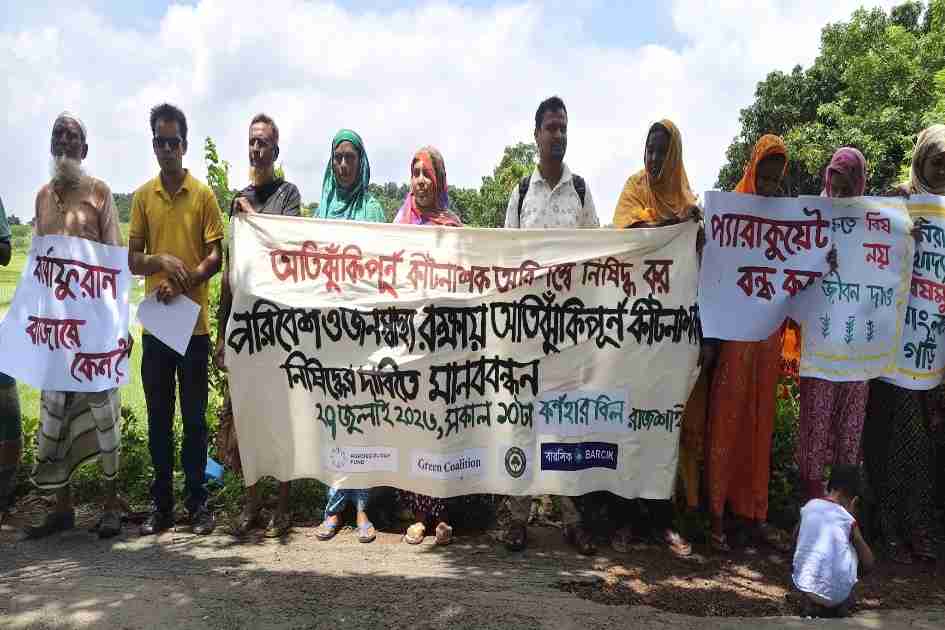



The Rajshahi human chain linked pesticide use to threats facing native fish, pollinators, soil life and rural livelihoods, while calling for safer farming systems.
Farmers, fisherfolk, researchers, youth organisers and environmental activists urged Bangladesh to immediately ban paraquat and other highly hazardous pesticides, saying the move was essential to protect public health, safe food and biodiversity.
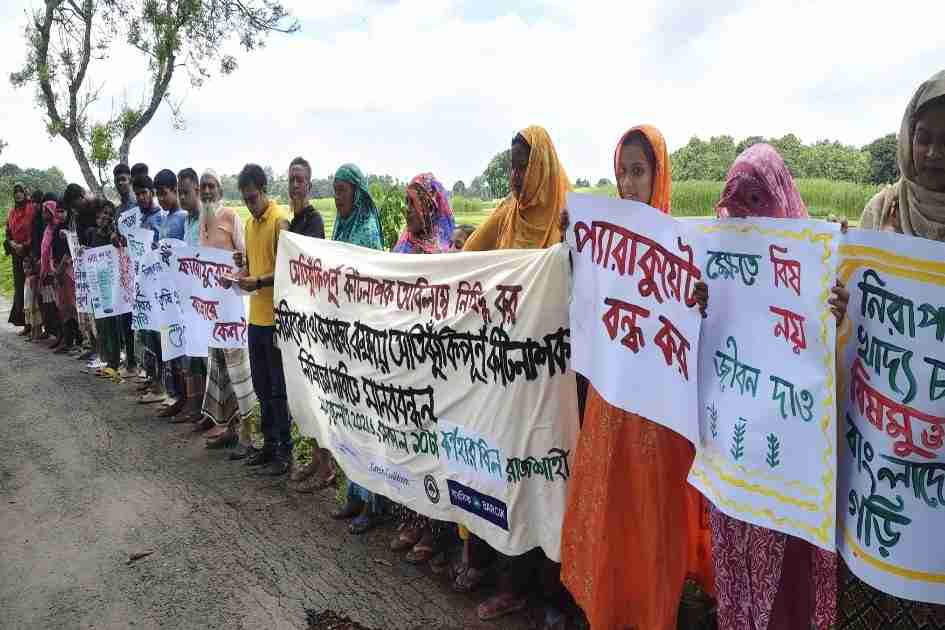
The call was made at a human chain held on Monday in the Kornahar Beel area of Paba upazila in Rajshahi, organised jointly by development research organisation BARCIK, Barendra Youth Forum and the Green Coalition .
Speakers said paraquat, which they said has been banned in around 70 countries, is still being used freely in Bangladesh, posing long-term risks to public health, agriculture and the environment.
Farmers, fisherfolk, agriculturists, youth representatives, environmental activists and members of civil society joined the programme.
Speakers said excessive use of chemical pesticides in the name of increasing agricultural production had become a silent crisis for public health and the environment.
They said highly hazardous pesticides, including paraquat, were increasing health risks for people while severely affecting native fish, bees, pollinating insects, soil microorganisms and aquatic and terrestrial biodiversity.
As a result, they said, safe food production, farmers’ health and the country’s food system were being threatened.
The speakers cited a 2025 study by PAN Asia Pacific, which identified 53 of 96 pesticides used in Bangladesh and three other Asian countries as highly hazardous pesticides.
They also said the World Health Organization and the Food and Agriculture Organization had long recommended the gradual withdrawal of such pesticides and the expansion of safer alternative farming systems.
Bangladesh, as a party to the Rotterdam Convention and the Stockholm Convention, bears responsibility for taking effective steps to implement its international commitments, they said.
Speakers at the human chain said banning paraquat was not a position against agriculture, but a scientific and responsible decision in favour of farmers, consumers and the environment.
They said safe food could not be ensured without increased government investment, training and market support for farmers in safe alternative technologies, integrated pest management, biological pest management and agroecology-based farming practices.
Fisherfolk, farmers and researchers who took part in the programme said excessive pesticide use was rapidly damaging native fish diversity, traditional food diversity among Indigenous communities, pollinating species and agricultural ecosystems.
They said the crisis was not only environmental, but also a crisis for food security, nutrition and rural livelihoods.
The human chain demanded the phased ban of paraquat and all highly hazardous pesticides in line with the standards of the Food and Agriculture Organization and the World Health Organization.
The participants also called for a scientific reassessment of all registered pesticides, stronger national programmes to test pesticide residues in food, subsidies and training for farmers in safe alternative technologies, conservation of bees and pollinating species, the launch of a national poisoning surveillance system and the adoption of a national agroecology transition programme.
“The demand to ban paraquat is not the demand of any single organisation; it is a national demand to secure people’s lives, the right to safe food, farmers’ health, conservation of the environment and biodiversity and the safety of future generations,” the speakers said.
They urged the government to “quickly take a policy decision to ban paraquat and other highly hazardous pesticides, ensure safe alternatives for farmers and adopt agroecology as a central priority in the national agricultural development strategy”.
They said Bangladesh could build the foundation for safe food, farmers’ fair rights, biodiversity conservation and a climate-resilient future not through pesticide- and chemical-dependent agriculture, but through agroecology-based farming.




