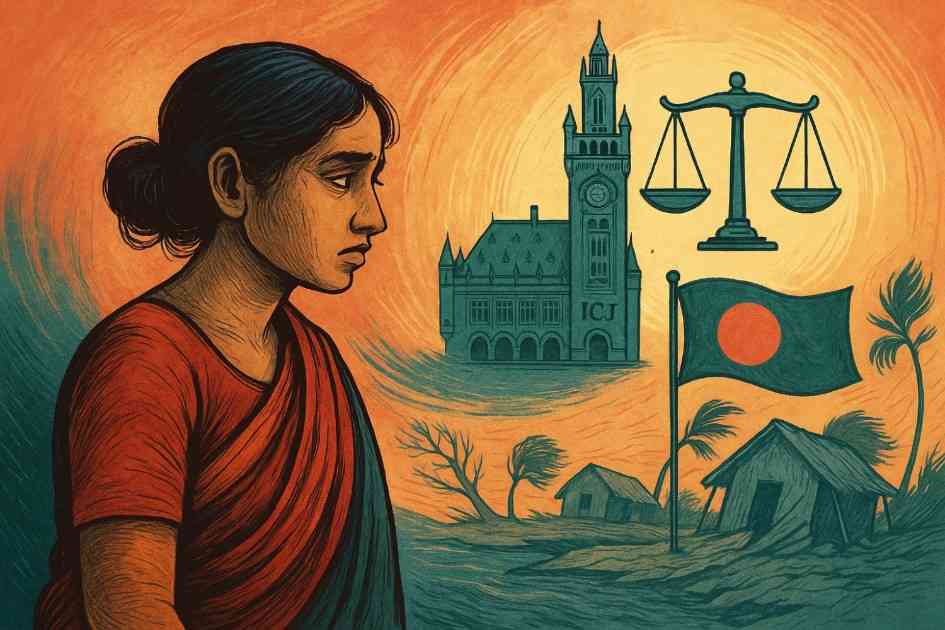



The International Court of Justice’s (ICJ) landmark ruling has turned climate justice from moral plea to legal duty, empowering vulnerable nations like Bangladesh to demand enforceable, grant-based climate finance as a right, not charity, for those suffering irreversible loss, damage and debt.
When Cyclone Amphan struck Mongla in May 2020, it didn’t just flatten homes – it upended lives. For families like Akhi Aktar’s, the storm’s aftermath meant more than physical destruction. It brought relentless hardship and impossible choices.
At 14, Akhi’s world changed irrevocably. Her family’s home was destroyed, their land submerged, and their livelihood vanished. With limited resources and mounting societal pressures, her parents believed marrying her off would secure her future.
But safety never came. Before the cyclone, Akhi was an eighth-grade student with dreams of becoming a teacher. Post-disaster, schools were closed or relocated, making education inaccessible.
The long journeys to distant schools posed risks of harassment, and the community’s focus shifted to survival. In this environment, early marriage was seen not as a choice but as a necessity.
Akhi’s marriage introduced new forms of violence. Her husband, unemployed and frustrated, demanded money from her family to seek work abroad. Her parents, daily wage earners already struggling after losing everything to Amphan, could not meet these demands.
In response, Akhi faced physical abuse from her in-laws and was eventually sent back to her parents.
Initially, she remained silent. Her parents, hoping that the marriage could be salvaged, considered borrowing money to appease her husband. It was only then that Akhi revealed the extent of the abuse.
Her mother refused to send money, leading to further beatings. Her husband stood by, indifferent.
At 16, overwhelmed by despair, Akhi attempted to take her own life. She survived, but her in-laws, instead of offering care, scolded her for bringing shame and sent her back to her native home.
Now Akhi lives with her parents, bearing the emotional and physical scars of her experiences. Her father, once believing that marriage would protect his daughter, now grapples with guilt and frustration, often lashing out in their tense household.
Akhi’s story is not an isolated tragedy. It reflects systemic failures exacerbated by climate disasters. The cyclone did not just destroy homes; it dismantled support systems, disrupted education, and left families vulnerable to societal pressures and violence.
This is the face of non-economic loss and damage. It is not just about the loss of assets but the loss of dreams, safety, and dignity.
Akhi’s resilience amidst adversity is a testament to the strength of those who endure – and her story underscores the urgent need for comprehensive support systems that address both the tangible and intangible impacts of climate change.
Erosion of identity
For most of his life, Abu Bakar Dhali walked with his head held high. Born in the riverine district of Shariatpur, Abu Bakar was the youngest among several siblings—the one who left home to chase something more.
As a teenager, he went to Dhaka and built himself up from the streets, selling USB drives, phone chargers, and small electronic items to passersby under the blazing sun.
Abu Bakar worked tirelessly for eleven years, saving every possible penny. He made it on his own.
He returned to his village with pride and purpose. Using his savings, he started a business selling electronics and bought several autorickshaws to rent out – one of the first in the village to do so. Abu Bakar also ran a small bookshop in Dhaka’s Bangla Bazar.
He built three homes on his family land. He helped marry off his elder siblings, and when he married himself, it was from a position of strength.
Abu Bakar was no longer the boy from the margins. He was the man others came to for help.
Then the river came. It did not arrive with sudden fury, but with slow devastation, eating away his land inch by inch.
Abu Bakar was in Dhaka when he heard about the erosion near his village. He returned home, only to watch helplessly as the land he had built his life on slipped into the water.
He could not bring himself to dismantle the home he built with his own hands. To him, selling the land or salvaging the house felt like surrendering. Within three months, everything was gone – not just his house, not just his land, but the foundation of who he believed himself to be.
The collapse was not just material. It was emotional, psychological, spiritual. For the next 13 months, Abu Bakar lived in a fog of grief and confusion. He became mentally unstable. His wife worked as a housemaid to keep them afloat.
They lived in a relative’s house without rent. He received aid from NGOs.
But the man who once gave others work now felt shame in being helped. He tried to rebuild. He took loans. He worked as a daily wage woodworker – a job unthinkable to those who once knew him.
He returned to Dhaka and reopened a small electronics shop, this time burdened with debt and doubt. He slept poorly. He smoked more. Stress gripped his body until one day he suffered a stroke.
The money he had saved to rebuild a home went instead into medical treatment. Medication brought side effects. He no longer recognized himself – physically or emotionally.
And yet, he endures. Despite everything – despite the erosion of land, livelihood, identity, and health – Abu Bakar still dreams of rebuilding his shop, his home, his life. He credits the birth of his daughter as the turning point that pulled him back from despair.
He believes in a better tomorrow. He holds onto his faith, even when everything else has slipped away.
Turning justice into law
The recent International Court of Justice (ICJ) ruling on climate change could become a landmark moment for climate finance justice.
For countries like Bangladesh, long on the frontlines of climate impacts, it strengthens the call for a clear definition of climate finance and establishes that developed countries have a legally binding obligation to deliver the funds they pledged.
The ruling could enforce accountability, push for timely, sufficient, and predictable finance, and reshape global negotiations to prioritize climate justice for the most vulnerable nations.
The ICJ issued a landmark advisory opinion in July 2025, affirming that countries have legal obligations to prevent and remedy climate change damage – making climate finance a legal obligation for responsible states.
The case was initiated in 2023 when Vanuatu, backed by a coalition of Small Island Developing States (SIDS) and Least Developed Countries (LDCs), petitioned the United Nations to seek an advisory opinion from the ICJ on states’ legal obligations to address climate change.
“The ICJ ruling makes climate inaction a breach of international law, transforming the right to a healthy environment into a duty,” said Zakir Hossain Khan, chief executive of Change Initiative.
He pointed out, “For LDCs, it opens new grounds to demand reparations and fair finance, aligning with Natural Rights Led Governance where protecting nature and lives is a binding obligation, not an option.”
Moral and legal turning point
Dr Shamsuddoha, chief executive of the Centre for Participatory Research and Development (CPRD), said the ICJ ruling redefines the moral landscape of global climate politics.
“Though the ICJ ruling is merely a directive to the Parties, it nonetheless challenges the present global leadership for their inaction and wrongful deeds,” he said. “For decades, vulnerable countries like Bangladesh have been made to plead for finance that was already promised.
“The ICJ opinion shifts that imbalance – it turns moral expectations into legal accountability. Developed countries can no longer hide behind voluntary pledges or undefined commitments.”
He added that the ruling strengthens the demand for a new global financial architecture – one that recognizes climate justice not as assistance but as restitution.
“Bangladesh’s lived reality shows that climate change is not an abstract future risk but a present-day injustice. When children are married off or entrepreneurs lose everything to floods, it’s not charity we seek – it is compensation rooted in law and fairness,” Shamsuddoha said.
He noted that the ruling could also influence how the Loss and Damage Fund operates, ensuring that resources flow automatically and transparently to affected communities instead of being trapped in bureaucratic cycles.
“This opinion gives negotiators from the Global South a stronger moral and legal mandate. It’s not just a victory in The Hague – it is a tool for justice in every COP negotiation going forward,” he said.
A breakthrough for Bangladesh
The ICJ ruling is a breakthrough moment for Bangladesh, one of the most climate-vulnerable nations in the world. For the first time, the Court has confirmed that climate finance is not charity but a legally binding obligation under international law.
This provides a legal foundation for Bangladesh’s demand that finance must be timely, predictable, and sufficient.
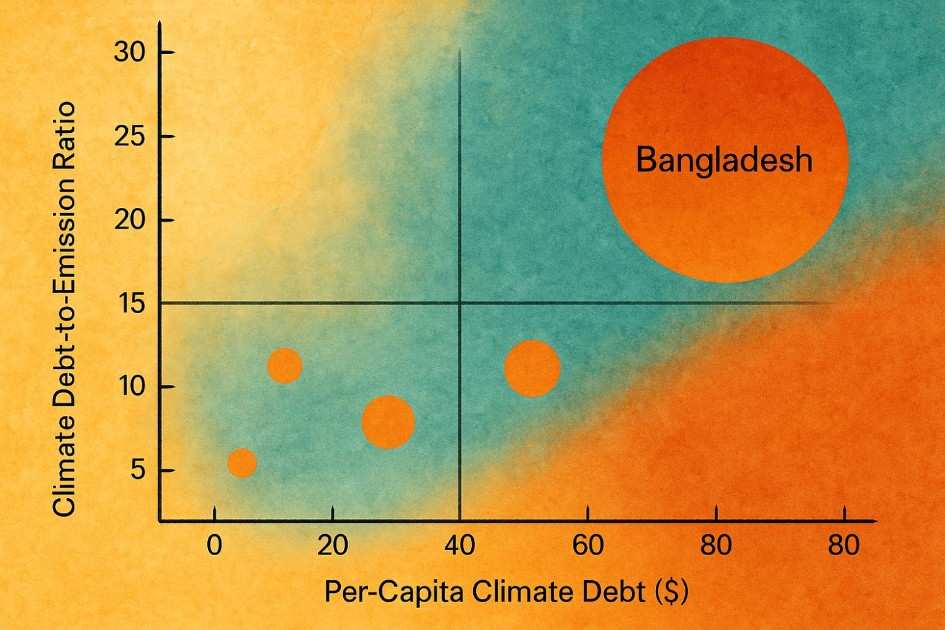
The CDRI-2025 shows that Bangladesh already carries a Climate Debt Risk score of 65.37 and a Debt-Grant Ratio of 2.70 – meaning most support arrives as loans rather than grants.
By affirming the polluter-pays principle and binding duties of assistance, the ruling empowers Bangladesh to argue that loan-heavy finance contradicts the very spirit of climate justice, locking the country further into a debt trap.
The ruling transforms Bangladesh’s advocacy from political bargaining to a matter of enforceable rights.
From pledges to accountability
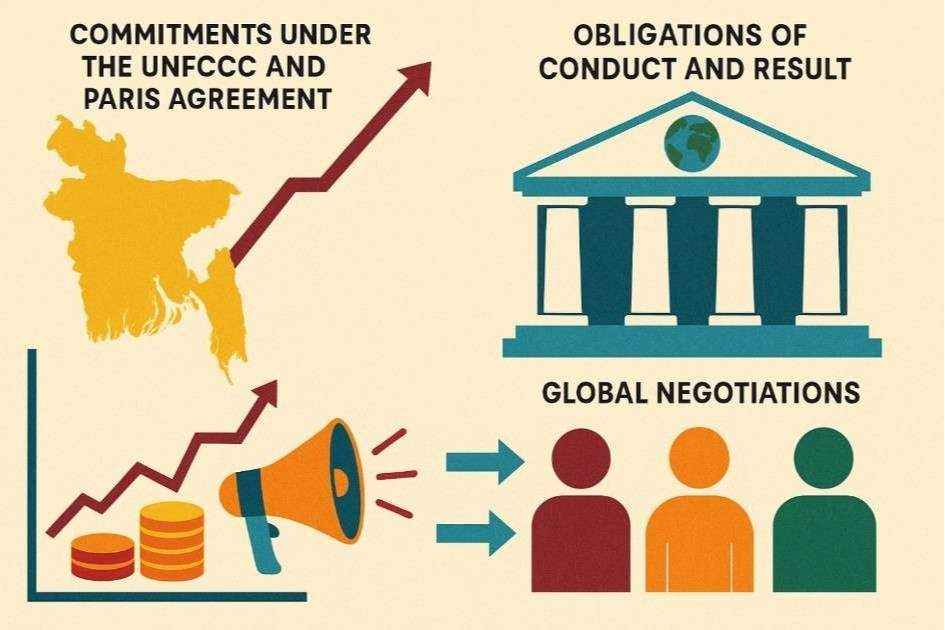
The ICJ makes clear that developed countries’ pledges under the UNFCCC and Paris Agreement are obligations of conduct and result—failure to deliver finance can constitute a breach of international law.
For Bangladesh, where MDB data shows only 32% of committed multilateral climate finance has been disbursed, this ruling is pivotal. It strengthens Dhaka’s ability to demand not just pledges, but actual disbursement on time.
The erga omnes character of these obligations – owed to the international community as a whole – means Bangladesh is not alone in its claim. The entire LDC group, SIDS, and even other States may demand accountability from developed countries for under-delivery.
Reshaping global negotiations
The ruling will ripple through UNFCCC negotiations, reaffirming common but differentiated responsibilities and respective capabilities (CBDR-RC) as binding law.
It strengthens the negotiating position of Bangladesh and its peers to demand a legally anchored definition of climate finance, along with binding timetables under the New Collective Quantified Goal (NCQG).
Bangladesh faces a mitigation finance gap of USD 140.3 billion by 2030—a shortfall now tied directly to States’ legal duties. This shifts negotiations away from voluntary pledges toward enforceable commitments.
For the first time, Bangladesh can enter COP30 negotiations not as a petitioner but as a rights-holder with legal authority to demand delivery.
From loans to justice
One of the most powerful contributions of the ICJ ruling is its explicit endorsement of the polluter-pays principle.
This directly challenges the current loan-heavy model of climate finance, which, as CDRI-2025 data shows, leaves Bangladesh with per-capita climate debt of $80 and a climate debt-to-emission ratio of 29.53 – among the highest globally.
Loans for resilience projects such as embankments, flood shelters, or saline-proof drinking water create fiscal burdens without generating revenue.
The ruling supports Bangladesh’s claim that adaptation and loss-and-damage finance must be grant-based, not loan-based, since these interventions are global public goods.
It marks a shift from a system that “cures by weakening the patient” to one where finance truly strengthens resilience without exacerbating debt distress.
Beyond the courtroom
Although advisory, the ICJ opinion codifies climate finance obligations as binding, opening several legal avenues. Breaches may trigger restitution, compensation, or satisfaction. Because the obligations are erga omnes, any State may invoke responsibility – not just those directly injured.
Bangladesh can use this ruling to press for compliance through UNFCCC COP decisions, peer pressure in multilateral negotiations, or even domestic litigation in donor countries, where civil society may invoke the ICJ’s findings to force governments to honor their pledges.
The ruling also strengthens arguments for grant conversion of existing loans, debt-for-climate swaps, and automatic disbursement triggers when donors fail to uphold their responsibilities.
From vulnerability to voice
The ICJ has reframed climate finance as part of the human rights and justice agenda, linking finance obligations directly to the rights to life, food, water, health, and a safe environment.
This dovetails with the CDRI-2025’s evidence that vulnerable countries like Bangladesh are disproportionately burdened – while contributing little to global emissions, they carry unsustainable climate debt loads.
By confirming that obligations extend to present and future generations, the Court aligns international law with the principle of intergenerational equity.
For Bangladesh, this means its long-standing appeal for timely, sufficient, and predictable finance is now not only morally compelling but legally grounded.
Global priorities will increasingly shift from vague pledges to justice-oriented finance delivery, with grant-based, quick-release adaptation finance at the center of the agenda.
The ICJ ruling and the CDRI-2025 findings together give Bangladesh both the legal authority and the empirical evidence to demand climate finance that is adequate, predictable, timely, and overwhelmingly grant-based.
It transforms climate finance from a discretionary act of goodwill into a matter of justice, responsibility, and enforceable obligation.
For Akhi, Abu Bakar, and millions of others on the frontlines, this ruling carries the promise that their suffering – and their resilience – will no longer be invisible in the world’s balance sheets.