




As climate change reshapes livelihoods in the Sundarbans, coastal women face growing economic and health burdens, exposing the urgent need for climate justice, gender-responsive adaptation and a truly just transition.
The government of Bangladesh strives to conserve the Sundarbans and adapt to climate change. However, the costs and responsibilities have been unevenly shared and have fallen largely on the shoulders of coastal women.
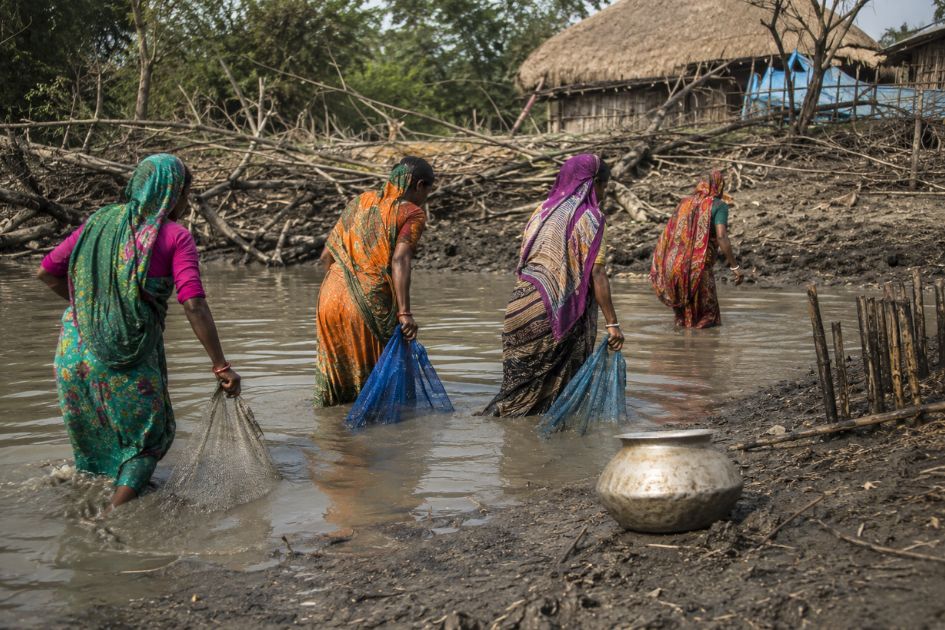
In Datinakhali, Shyamnagar, women leave for the river at sunrise with nets in their hands. The Sundarbans is no longer the source of income it once was. They can earn only a few hundred taka after spending long days in saline water collecting shrimp fry. Expenses are high, debts continue to rise and children often cannot receive a proper education.
These struggles are familiar to thousands of women in Datinakhali, Gabura, Munshiganj and Burigoalini, villages located in the coastal areas of the country.
From Fields to Forests
The Sundarbans, a vast mangrove delta shared between India and Bangladesh, is known for its mysterious rivers, dense forests and the majestic Bengal tiger. Beyond its natural beauty, however, the Sundarbans is also home to millions of people living on the frontlines of climate change.
Many families once depended on agriculture for their livelihoods. However, repeated cyclones such as Sidr, Aila, Amphan and Yaas, along with soil erosion and salinity intrusion, forced them to change their way of life and seek alternative sources of income. Fish collection, crab gathering, honey harvesting and golpata cutting have become essential means of survival. Women from poor families now participate in all of these activities alongside men as climate change continues to worsen living conditions.
Rising sea levels, persistent salinity and devastating cyclones have severely damaged traditional agriculture in Bangladesh’s coastal belt. Left with barren land and declining opportunities, vulnerable communities have increasingly turned to forest-based livelihoods in the Sundarbans. This shift highlights both the severe socioeconomic impacts of climate change and the critical role women play in sustaining household resilience.
Salinity: An Invisible Public Health Problem
Saltwater intrusion affects not only the environment and drinking water sources but also poses serious health risks, particularly for women. According to a study published in BMC Women’s Health in 2025, women involved in fishing and shrimp fry collection face a higher risk of reproductive health problems, including menstrual disorders, miscarriages and infertility.
The study also found that pregnant women living near rivers and consuming saline-contaminated water experienced higher rates of hypertension and pre-eclampsia.
Transition for Whom?
The Sundarbans is a UNESCO World Heritage Site that deserves protection. To support fish breeding and ecosystem conservation, authorities restrict access to parts of the forest for several months each year.
While these measures help preserve biodiversity, they also create significant financial hardship for the millions of people who depend directly on forest resources. The consequences can be particularly severe for coastal women who rely on these resources and perform essential pre- and post-harvest activities. Unlike workers in formal sectors, these women rarely receive adequate relief or compensation during periods when access to the forest is restricted.
A Just Transition Principle
In the era of climate change, the principle of a just transition has become increasingly important. In parts of Europe and South Africa, workers affected by economic and environmental transitions have been offered new employment opportunities and training in renewable energy and other emerging sectors.
By contrast, Bangladesh’s current adaptation and conservation policies often overlook the specific economic and social realities of coastal women. Applying a just transition approach would involve creating structured vocational training programmes, expanding access to financial support and developing alternative livelihood opportunities for women during seasonal restrictions.
Community-based adaptation strategies offer a practical pathway for addressing the interconnected climate and socioeconomic challenges facing the Sundarbans. Empowering women through locally driven ecological and economic initiatives can help replace vulnerable forest-dependent livelihoods with more stable and climate-resilient alternatives.
Unsuccessful Attempts to Achieve Transition
Despite major commitments made to the Loss and Damage Fund at COP28 and continued discussions at COP29 and COP30, international climate finance remains far below what is needed to support effective adaptation in vulnerable coastal regions.
According to Bangladesh’s National Climate Finance Strategy, the country requires approximately $26 billion annually for climate action. However, available funding remains insufficient. Although projects financed by the Green Climate Fund in Khulna and Satkhira have supported women’s livelihood groups and improved access to safe water, questions remain regarding their long-term sustainability and the extent to which women participate in decision-making processes.
What Bangladesh Needs
Climate-resilient livelihood opportunities, safe water systems and stronger economic empowerment for women are essential for building climate resilience and advancing climate justice in Bangladesh. A dedicated share of climate finance should be allocated to women and marginalized communities. Addressing the health impacts of salinity must also become a priority.
Most importantly, coastal women should move from being passive recipients of policy decisions to active participants in policymaking.
The experiences of coastal women remind us that climate justice should not be discussed only in conference halls. It must be reflected in people’s daily lives. The Sundarbans must be protected. The fight against climate change must continue. However, if that fight undermines women’s livelihoods, the transition cannot be considered just. True climate justice is achieved when environmental protection and the right to a dignified life are valued equally.
Writer Shanjida Khan Ripa is a development activist and serves as Program Manager at ALRD.




