

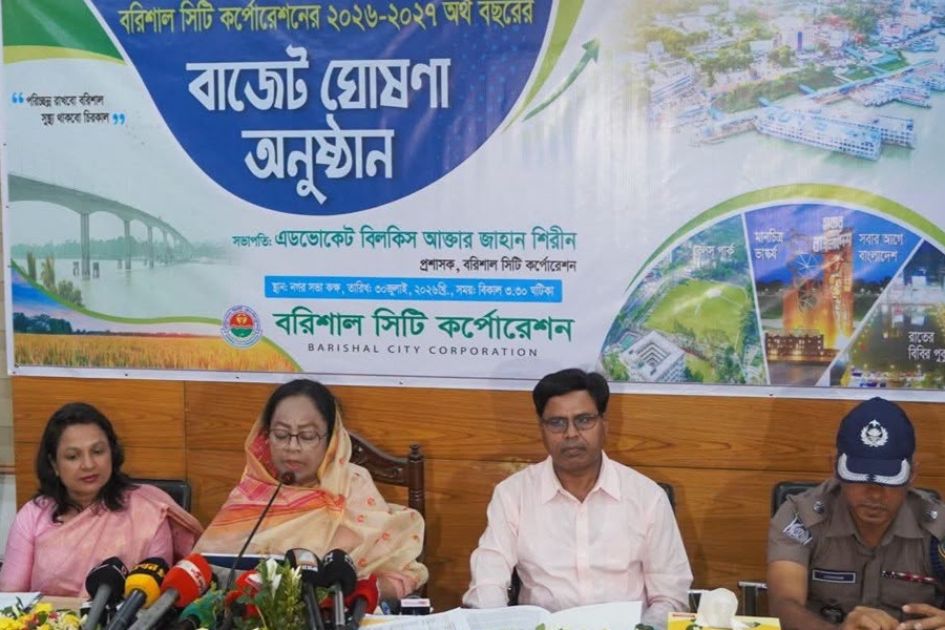



From canal restoration and flood protection to safe water and green infrastructure, Barishal’s spending plan signals a shift towards locally led resilience and inclusive urban development.
Bangladesh’s riverine city prioritises climate adaptation, green infrastructure, clean water and inclusive urban development.
Bangladesh’s riverine city of Barishal has announced a Tk 647.53 crore budget for the 2026–2027 fiscal year, prioritising climate adaptation, environmental protection, resilient urban services and inclusive development without imposing any new taxes on residents.
Located in southern Bangladesh, Barishal is a climate-exposed urban centre surrounded by rivers and waterways. The city faces increasing challenges from flooding, waterlogging, river erosion and extreme weather events, making climate resilience a growing priority for local governance.
The 24th budget of Barishal City Corporation (BCC), the local government authority responsible for administering the city, was announced on Thursday afternoon by Administrator Advocate Bilkis Akter Jahan Shirin at the Nagar Bhaban. She said the budget was prepared with a focus on improving public services through efficient resource management, reducing wastage and preventing corruption while keeping the tax burden unchanged.
“Our goal is to build a planned, green, clean, women- and child-friendly smart city for future generations,” Shirin said while presenting the budget.
The proposed budget is higher than the previous year’s original budget of Tk 520.86 crore. The revised budget for the 2025–2026 fiscal year stands at Tk 462.86 crore.
Climate vulnerability drives new urban priorities
Bangladesh is among the world’s most climate-vulnerable countries, where rising sea levels, river erosion, floods and extreme weather increasingly threaten coastal and riverine communities. For cities like Barishal, climate adaptation has become central to long-term urban planning.
The new budget reflects a broader shift among climate-exposed cities in the Global South, where locally led adaptation is increasingly being recognised as essential for protecting communities, strengthening infrastructure and ensuring sustainable development.
Climate activists welcomed the focus on resilience and sustainability. Sohanur Rahman, Executive Coordinator of YouthNet Global, said, “Cities on the frontline of the climate crisis need budgets that go beyond traditional infrastructure and invest in resilience, inclusion and environmental sustainability.”
He said climate investments must ensure that vulnerable communities benefit from adaptation efforts while creating sustainable opportunities for future generations.
Tk 309 crore allocated for climate adaptation and green transformation
BCC has earmarked Tk 309 crore for climate adaptation-related initiatives as part of its broader development priorities. The allocation includes measures focused on environmental protection, urban greenery and resilience-building.
The city administration has announced plans to plant 50,000 trees across Barishal in the coming fiscal year and develop an eco-park to improve urban environmental management.
The initiative also reflects a growing conversation around a just transition in urban development, ensuring that climate investments improve livelihoods and social inclusion rather than focusing only on infrastructure upgrades.
Canal restoration and flood protection projects target waterlogging crisis
Addressing Barishal’s long-standing waterlogging problem has been identified as a major priority under the new budget.
BCC has submitted a Tk 769.40 crore project proposal to the relevant ministry for the restoration, excavation and protection of major canals, including Jelkhal, Amanatganj, Sagardi and Lakutia canals.
The proposed project aims to restore natural water flow, improve drainage capacity and reduce the impacts of urban flooding.
The city has also submitted a Tk 533 crore proposal for constructing a protective embankment along the western bank of the Kirtankhola River to strengthen flood protection. The project is awaiting government approval.
Another proposed Tk 797 crore initiative focuses on improving drainage systems and developing modern waste management facilities.
Expanding safe water access through new treatment plants and digital services
Ensuring access to safe drinking water has been identified as another key priority.
The Rupatali Surface Water Treatment Plant has already started operations, while preparations are underway to launch the Beltala Treatment Plant. BCC has also prepared a development proposal for a new Kirtankhola Surface Water Treatment Plant to meet future demand.
Municipal officials said 1,064 new water connections were approved in the previous fiscal year. Online application and approval systems have also been introduced to improve transparency and reduce delays.
The city plans to establish water ATM booths in different areas to expand access to safe drinking water.
Modern waste management and waste-to-energy plans take shape
Waste management has received significant attention in the new budget. Barishal currently collects around 200 tonnes of waste every day.
BCC plans to introduce modern waste management technologies and explore waste-to-energy solutions through cooperation with a South Korean organisation.
The city has already acquired four dump trucks, a medical waste compactor truck and a vacuum truck to improve waste collection and disposal services.
During the recent Eid-ul-Azha festival, BCC reported that sacrificial animal waste was removed within six hours, compared with the government’s 12-hour timeframe.
Women, children and vulnerable communities placed at the centre of urban planning
The budget includes several initiatives aimed at creating a more inclusive city.
Plans include modern public toilets for women, a dedicated market for women entrepreneurs, legal assistance for disadvantaged women and the construction of a hostel for working women.
For marginalised communities, including members of the Dom community, BCC has proposed two six-storey residential buildings.
The city also plans to renovate Green City Park, install new recreational facilities and support sports activities for children and young people.
Digital governance aims to improve transparency and citizen services
Digital transformation is another major priority.
BCC has announced plans to expand online public services, including tax collection, trade licences, building approvals and land-use clearance.
The administration expects digitalisation to improve efficiency, increase transparency and reduce difficulties faced by citizens.
Infrastructure investment seeks to build a resilient urban future
The proposed budget allocates Tk 498 crore for development expenditure and Tk 149 crore for operational costs.
Since taking responsibility, the city administration has completed or initiated work on 42 kilometres of bituminous roads, 4.5 kilometres of RCC roads, 8.5 kilometres of concrete roads and 16.5 kilometres of RCC drainage systems.
A Tk 24.75 crore lighting project has also been submitted for approval. If approved, more than 16,000 electric poles and over 20,000 new street lights will be installed across the city.
BCC has also proposed a Tk 1,900 crore integrated physical infrastructure development project aimed at improving urban facilities and strengthening long-term resilience.
Budget financing combines local revenue, government support and development partnerships
The Tk 647.53 crore budget will be financed through multiple sources.
BCC expects Tk 169.71 crore from its own revenue sources, Tk 310 crore from government development assistance, Tk 118 crore from government block and special block grants and Tk 29 crore from development partners. Additional income will come from the city’s water supply division.
Health services and social protection receive continued attention
Health and social services have also been included among the budget priorities.
BCC reported that 10,479 women and children received routine vaccinations in the previous fiscal year. The measles-rubella vaccination campaign covered 43,850 people, while 58,557 children received Vitamin A supplements.
From the next fiscal year, the city plans to provide free medical services and medicines for women and children in three city zones.
From disaster response to climate resilience: Barishal’s urban transformation agenda
Closing her budget speech, Administrator Shirin emphasised accountability, transparency and citizen participation.
“Even without increasing taxes, citizens will receive better services than before through preventing wastage, controlling corruption and ensuring the best use of limited resources,” she said.
She called for cooperation from residents, journalists, government agencies, civil society organisations and private sector stakeholders to ensure effective implementation.
However, successful implementation will depend on timely approval of major projects, transparent procurement, effective maintenance and meaningful participation of local communities.
The budget represents Barishal’s effort to move from reactive disaster response towards planned climate resilience. For a climate-exposed city in the Global South, the initiative highlights the growing importance of locally led adaptation, where infrastructure investment, environmental protection and social inclusion come together to build a safer and more sustainable urban future.




