

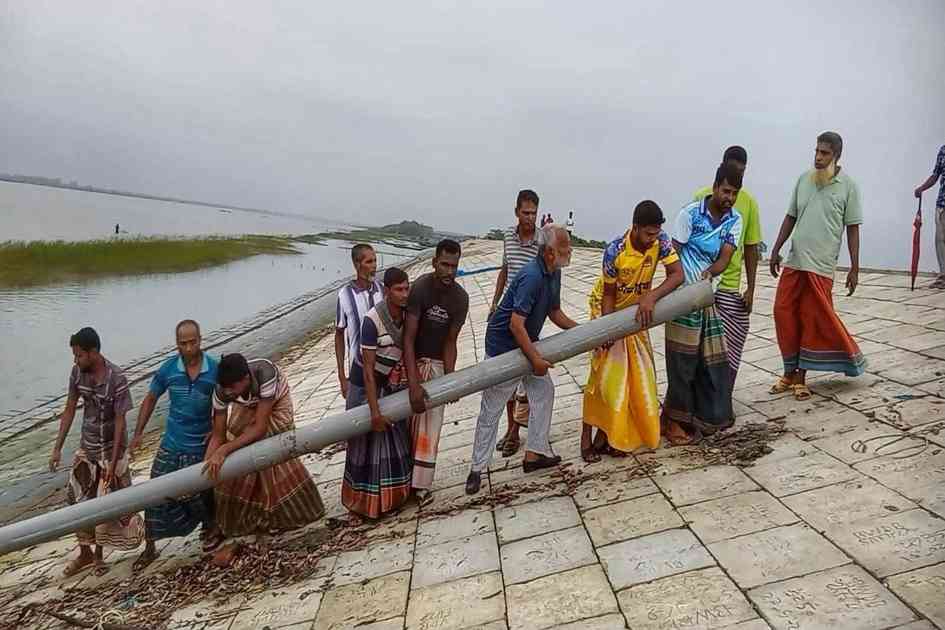

Authorities have begun removing unauthorized pipes in Gabura after residents warned private shrimp water access could undermine a public embankment built to protect cyclone- and erosion-prone communities.
A $100 million coastal protection project in southwestern Bangladesh is facing a new challenge as illegal saltwater pipes installed by some shrimp farm operators have weakened a newly built embankment designed to protect climate-vulnerable communities from cyclones, tidal surges and river erosion.
In Gabura, an island union surrounded by rivers in Shyamnagar Upazila of Satkhira district, some shrimp farm owners have allegedly cut through a newly constructed coastal embankment to install locally known “Ninety” pipes for bringing saline water into shrimp enclosures. The unauthorized installations have created weak points in the embankment, raising concerns over the safety and durability of a major climate adaptation investment.
The embankment is part of a mega coastal resilience project under the Bangladesh Water Development Board (BWDB) in the 15th Polder, with a total investment of Tk 1,023.67 crore, equivalent to more than $100 million. The project aims to construct a sustainable embankment system to protect Gabura and surrounding communities from climate-related disasters.
Launched in 2022, the project is being implemented in one of Bangladesh’s most climate-exposed coastal regions, where communities face repeated threats from cyclones, tidal flooding, saline intrusion and river erosion. More than half of the construction work has already become visible, but residents and environmental activists say illegal modifications before completion are putting the infrastructure at risk.
For people living in Gabura, the embankment is not only a government project; it is a lifeline protecting homes, farmland, livelihoods and public safety. The area suffered devastating impacts during Cyclone Aila in 2009, when embankment breaches caused widespread flooding and severe losses for local communities.
Md Ashikur Rahman, a local resident, said, “For coastal families, the embankment is not only a structure; it is our protection from the next disaster.” Residents and activists have called for stronger monitoring and enforcement to prevent damage to public climate infrastructure.
Local communities and environmental groups have questioned how unauthorized modifications continued on a major government-funded climate adaptation project, calling for stronger oversight, accountability and community participation. They said repeated illegal interventions have continued despite previous commitments by authorities to prevent such activities.
According to local sources, at least 20 to 30 illegal pipe installations were identified along a three-kilometre stretch between Chandnimukha Bazar and Parshamari areas near the Kholpetua and Kopotakkho rivers. Several additional pipes were found in the Sora and Chakbara areas, including locations previously damaged during Cyclone Aila.
The locally known “Ninety” pipes allow saline water to enter shrimp farms. While shrimp aquaculture remains an important source of income for many coastal residents, authorities and environmental groups say illegal modifications to public embankments for private water access threaten community safety, environmental balance and long-term climate resilience.
Following growing public concern, authorities launched an operation on July 7 to remove illegal installations from the embankment in Gabura Union. Several pipes were removed during the drive led by local representatives, with further action planned.
Gabura Union Parishad Chairman G.M. Masudul Alam said the removal campaign had started and warned that no one would be allowed to install illegal pipes on embankments or public spaces in the future.
“Existing mini sluice gates and sluice gate systems must be used for shrimp farming. Anyone violating the law or using influence to install illegal pipes will face legal action,” he said.
Gazi Nazrul Islam, the Bangladesh parliament member for Satkhira 4 constituency, said protecting the embankment and ensuring public safety would remain the priority regardless of political identity.
“No illegal activity that threatens a major coastal protection project costing thousands of crores of taka will be tolerated,” he said, adding that local representatives and authorities had been instructed to coordinate action against illegal installations.
Bangladesh Water Development Board Sub-Divisional Engineer Imran Sarder said installing illegal pipes by cutting embankments was completely unlawful and posed a serious threat to the project’s sustainability as well as the safety of coastal communities.
“The issue has come to our attention. We are coordinating with local administration, representatives and relevant stakeholders to remove illegal installations and take action against those responsible,” he said.
Climate advocates say the Gabura situation reflects a broader challenge facing climate-vulnerable countries: infrastructure investment alone cannot guarantee resilience unless it is supported by accountability, effective governance and community ownership.
Sohanur Rahman, executive coordinator of YouthNet Global, said, “Climate adaptation is not only about building infrastructure; it is also about ensuring accountability, transparency and good governance. Public investments in climate resilience must remain protected from political influence and short-term interests.” He added, “When accountability is weak, the communities most vulnerable to climate impacts become the ones who suffer the consequences. A just adaptation approach must put people, public interest and community participation at the centre of decision making.”
The case highlights a wider climate justice concern faced by frontline communities in developing countries: while billions are invested in adaptation, weak governance and lack of enforcement can threaten whether those investments actually deliver protection for vulnerable populations.
As Bangladesh continues to invest in climate adaptation, Gabura’s experience demonstrates that resilience is not built only with concrete and engineering. It also depends on protecting public resources, enforcing regulations and ensuring that communities themselves become partners in safeguarding the infrastructure that protects their future.




