

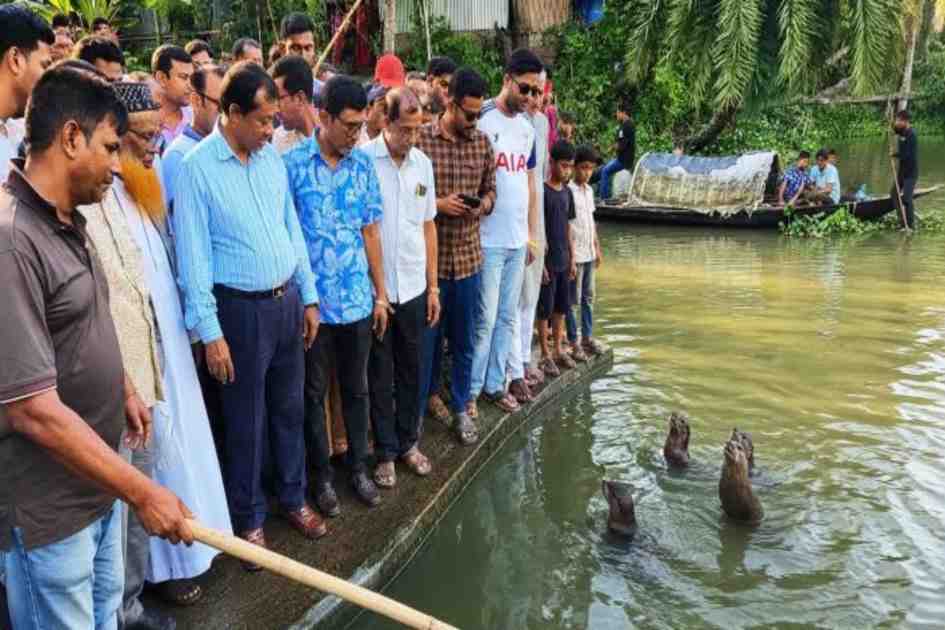

Narail observed World Otter Day on the Chitra River, highlighting otter-assisted fishing,malo community heritage, declining river biodiversity, and calls for stronger conservation and livelihood support.
World Otter Day was observed with a focus on otter conservation, river livelihood protection, and cultural heritage on the banks of the Chitra River in Goailbari village. The event on Saturday (27 June) brought together the Malo Community, researchers, students, and local stakeholders to reflect on the future of a rare, centuries-old practice of otter-assisted fishing.
A Living Heritage Under Pressure
For centuries, the Malo Community of this riverine landscape has maintained a close working relationship with otters. Fishermen raise otters from infancy, feeding them milk in their early stages and fish as they grow, gradually training them to assist in fishing. During the observance, trained otters were released into the Chitra River to help drive fish toward waiting nets, offering a rare glimpse of a living tradition that younger generations are increasingly witnessing for the first time.
For centuries, the Malo Community of this riverine landscape has maintained a close working relationship with otters. Fishermen raise otters from infancy, feeding them milk in their early stages and fish as they grow, gradually training them to assist in fishing. During the observance, trained otters were released into the Chitra River to help drive fish toward waiting nets, offering a rare glimpse of a living tradition that younger generations are increasingly witnessing for the first time.
Despite its deep cultural significance, the practice is now under severe strain. Once supported by a larger number of trained otters, local fishers report that only a few remain, reflecting a sharp decline in both the animals and the tradition itself.
Drivers of Decline
The community links this erosion of their livelihood and heritage to several interconnected challenges. Depleted fish habitats have made it increasingly difficult for fishing families to sustain their livelihoods, forcing many to abandon the practice. Destructive fishing practices, including locally known “China doars” and current-generating nets, have further damaged aquatic life and reduced biodiversity. Alongside these pressures, growing economic hardship and the labor-intensive care required to raise and train otters have made it increasingly difficult for younger generations to continue the tradition amid limited livelihood alternatives.
Conservation and Community Action
The observance was initiated by researcher, flimmaker Samsul Islam Shopon, who has spent years studying otter-assisted fishing and the river-based culture of the Malo Community. “This isn’t just a fishing practice, it’s a living relationship between people, otters, and the river. If the river is lost, this culture disappears with it,” he said.
His long-term engagement with the area contributed to bringing the celebration directly to Goailbari, ensuring the event reflected the lived reality of the community where this tradition continues.
The program jointly organised by Otter Fishing Community Foundation, Bangladesh and SM Sultan Children’s Art And Craft Foundation cooperation with International Otter Survival Fund, UNICEF, Otter Foundation Bangladesh helping broaden awareness of otter conservation and the need for healthier river ecosystems. Rather than focusing solely on celebration, the event also served as a call for coordinated conservation efforts to support otter populations and strengthen the ecological health of the Chitra River system.
Local Leadership and Engagement
Following growing attention to the event, Chief guest and Member of Parliament for Narail-1, Biswas Jahangir Alam, attended and engaged with community members. He expressed support for preserving the cultural identity of the region and said he would explore development initiatives for the area. He also acknowledged long-standing community concerns related to infrastructure and identity recognition, indicating that discussions with relevant authorities would be pursued.
A Living Demonstration and Closing Reflection
A central highlight of the day was a live demonstration of traditional otter-assisted fishing in the Chitra River, where trained otters were released to guide fish toward nets. The demonstration offered participants a rare, firsthand view of a system shaped by long-term coexistence between people, animals, and the river ecosystem.
The program also featured cultural performances, children’s drawing competitions, and pot songs depicting river life and the Malo Community’s heritage. These activities helped connect younger generations with both ecological awareness and cultural memory.
As the event concluded, organizers expressed hope that World Otter Day in Narail would move beyond symbolic observance to become a sustained effort for restoring the Chitra River ecosystem, saving biodiversity , revitalizing endangered otter populations, and carrying forward the Malo Community’s river-based heritage for generations to come.




