

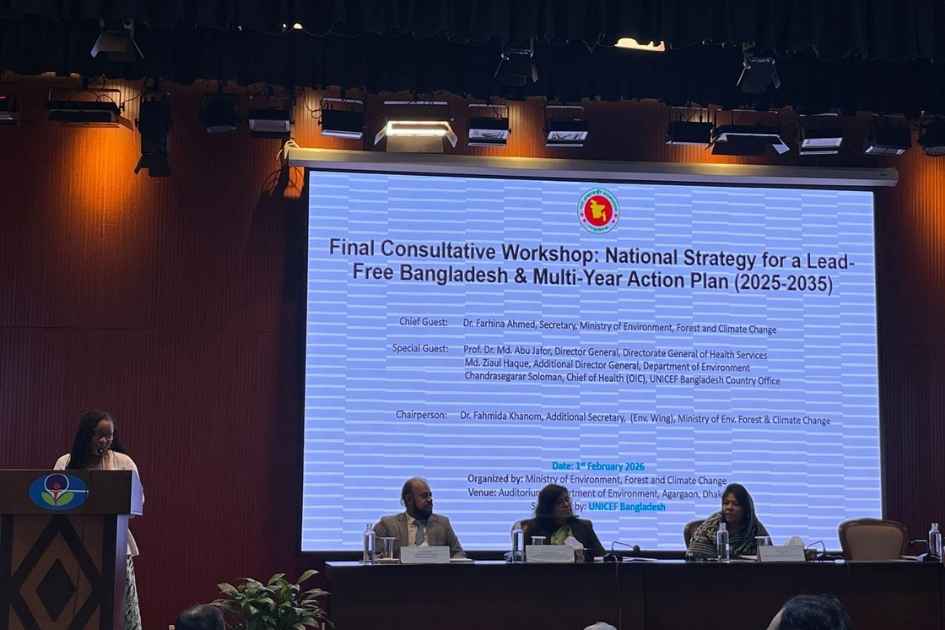



Bangladesh has unveiled a final draft of the national strategy and action plan to eliminate lead poisoning by 2035, focusing on stricter regulation, safer recycling and coordinated measures to protect children, workers and communities.
Bangladesh is grappling with one of the highest burdens of lead poisoning globally, a silent yet entirely preventable public health crisis that disproportionately affects children and workers in informal sectors. To address this urgent challenge, the Ministry of Environment, Forest and Climate Change (MoEFCC), in partnership with UNICEF Bangladesh, convened a workshop on Sunday morning at the Department of Environment (DoE) Auditorium to review the near-final draft of the National Strategy for a Lead-Free Bangladesh and its accompanying Multi-Year Action Plan (2025–2035).
Bangladesh currently has the fourth-highest lead poisoning mortality rate in the world. While many countries have successfully reduced lead exposure through regulation, safe recycling and strict enforcement, experts stress that Bangladesh must urgently accelerate similar measures to protect children, reduce long-term economic losses and meet its public health commitments.
According to national and global estimates, lead poisoning affects around 36 million children in Bangladesh, with an average blood lead level of 6.8 micrograms per decilitre. This exposure is linked to the loss of an estimated 20 million IQ points and approximately 140,000 adult cardiac deaths each year. The combined health and productivity impacts are estimated to cost the country between 6 and 9 percent of its gross domestic product annually.
Environmental and public health experts warn that without urgent and coordinated action, lead contamination will continue to undermine public health, strain already overburdened healthcare systems and impede sustainable development in one of the world’s most densely populated countries.
The National Strategy aims to establish a coordinated and effective framework to reduce lead exposure, protect public health and ensure long-term environmental security. It proposes strict measures to control major sources of lead contamination, including lead-based paints, unauthorized recycling of used lead-acid batteries, lead-contaminated cookware and toys, industrial products and the rapidly growing flow of e-waste from electric rickshaws and other battery-powered vehicles.
“Lead pollution is advancing faster than our interventions,” said Dr Farhina Ahmed, Secretary of MoEFCC and chief guest at the workshop. “If we do not regulate battery recycling immediately, we are inviting a national health crisis within the next decade.” She added that once finalized, the strategy would play a pivotal role in protecting children, workers and vulnerable communities. “This National Strategy marks a significant milestone toward ensuring a safe, healthy and sustainable future for all.”
Workshop participants reviewed the near-final draft, assessed governance and delivery mechanisms and refined priority actions for 2025–26, including key performance indicators and costing. The strategy seeks to harmonise ongoing efforts across multiple ministries and agencies by integrating health screening, curriculum revisions, industrial policy, labour protection, environmental regulation and waste management into a unified national framework.
Dr Fahmida Khanom, Additional Secretary of MoEFCC, said the ministry expects the strategy and action plan to move into implementation by February, following inter-ministerial consultations and cabinet approval. She noted that MoEFCC and relevant agencies have already initiated short-term actions aligned with the proposed framework.
Highlighting the scale of the crisis, Dr Khanom said the strategy will strengthen surveillance, monitoring and enforcement mechanisms to ensure timely follow-up care for children identified with elevated blood lead levels in the Bangladesh Multiple Indicator Cluster Survey (MICS) 2025. The survey found that 38.3 percent of children aged 12 to 59 months and 7.5 percent of pregnant women have elevated blood lead levels, with major hotspots in Dhaka and Chattogram.
Dr Mohammad Enayet Hossain, consultant to MoEFCC, presented the strategy’s eight pillars, which include institutional strengthening, research and innovation, private sector engagement, awareness and behaviour change and multi-sectoral collaboration. The workshop underscored the importance of cross-sector accountability by defining clear roles for line ministries, development partners, civil society organisations and private sector stakeholders. Follow-up actions will include continued blood lead surveillance, environmental investigations and remediation for children with blood lead levels above 5 micrograms per decilitre.
UNICEF and national experts highlighted multiple exposure pathways, including informal battery recycling, contaminated food and spices, household dust, unsafe consumer products and industrial emissions, reinforcing the need for urgent, coordinated and multi-sectoral action.
Sohanur Rahman, Executive Coordinator of YouthNet Global, said the silent health crisis caused by lead pollution primarily threatens children and working populations. “Lead exposure irreversibly damages children’s learning and neurodevelopment and creates daily, invisible health risks for workers,” he said. He emphasised that the strategy must provide clear guidance to control major sources of lead, ensure a safe and just transition for affected workers and integrate initiatives across health, education, industry, labour protection, environmental regulation and waste management.
Officials said the National Strategy for a Lead-Free Bangladesh demonstrates how evidence-based policy, community engagement and coordinated action across government and non-government actors can address one of the most severe environmental health crises in South Asia.
Environment, Forest and Climate Change Adviser Syeda Rizwana Hasan described lead and heavy metal pollution as a “silent crisis” and called for immediate action. Reaffirming the government’s commitment to eliminating lead poisoning by 2035, she said a comprehensive action plan must identify, regulate and control the major sources of toxic metal exposure.
“The responsibility of pollution control cannot rest solely with the government. Industries must actively participate in cleaning up pollution,” she said. While acknowledging that immediate action against all polluting industries may not be feasible, she stressed the need to prioritise those operating without environmental clearance.
“The goal is not to shut down industries, but to ensure compliance through proper clearance, location assessment and remediation,” she added. Environmental clearance certificates, she said, should include mandatory periodic remediation requirements within a clearly defined timeframe to ensure accountability and sustained impact.




