

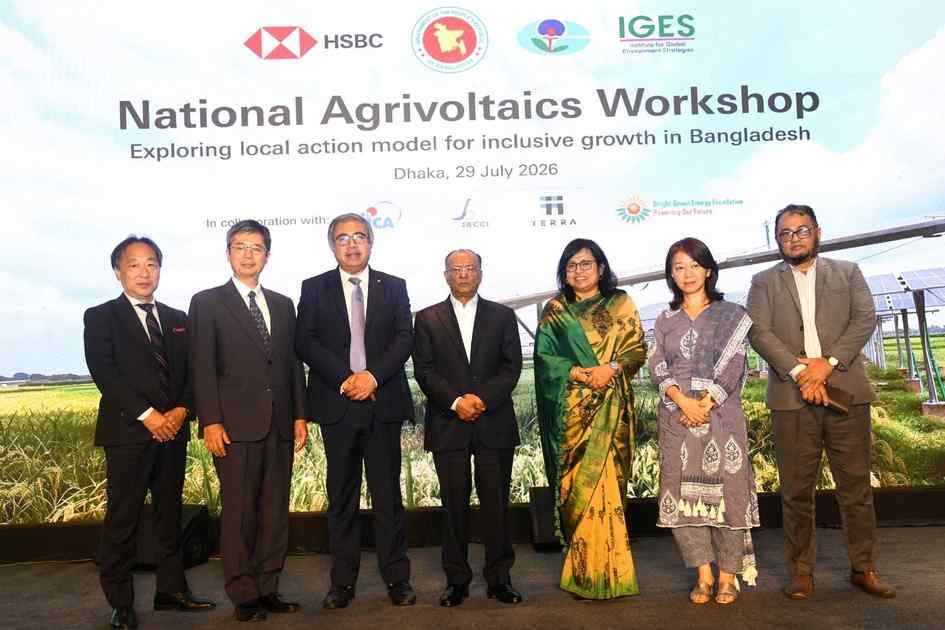



Officials and experts discussed how solar panels on farmland could support irrigation, cold storage and rural incomes while keeping farmers central to project benefits.
As Bangladesh races to expand renewable energy while protecting one of the world’s most densely populated agricultural landscapes, policymakers are turning to agrivoltaics, a technology that combines solar power generation with crop cultivation, as a potential solution to balance clean energy ambitions with food security.
At a national workshop in Dhaka on Wednesday, Environment, Forest and Climate Change Minister Abdul Awal Mintoo said agrivoltaics could play a crucial role in expanding renewable energy without taking productive agricultural land out of use.
“Food security, farmers’ rights, environmental safeguards and fair benefit sharing must remain at the centre of all agrivoltaic initiatives,” the minister said while addressing the National Agrivoltaics Workshop: “Exploring Local Action Model for Inclusive Growth in Bangladesh” at The Westin Dhaka.
The event brought together government representatives, researchers, renewable energy experts, technology providers, financial institutions, development partners and private sector leaders to discuss the opportunities and challenges of introducing agrivoltaics in Bangladesh.
Bangladesh, a frontline country in the climate crisis, is facing increasing pressure from floods, cyclones, salinity intrusion, droughts, extreme heat and changing rainfall patterns. These climate impacts are putting growing pressure on agriculture, water resources, infrastructure and rural livelihoods.
At the same time, the country’s demand for reliable and affordable electricity is increasing rapidly as it seeks to achieve a cleaner and more resilient energy future.
Under its updated Nationally Determined Contribution (NDC 3.0), Bangladesh has set a target of achieving 25 percent renewable energy by 2035. However, with limited land availability and one of the highest population densities in the world, policymakers face the challenge of expanding solar power without creating unnecessary competition with farmland.
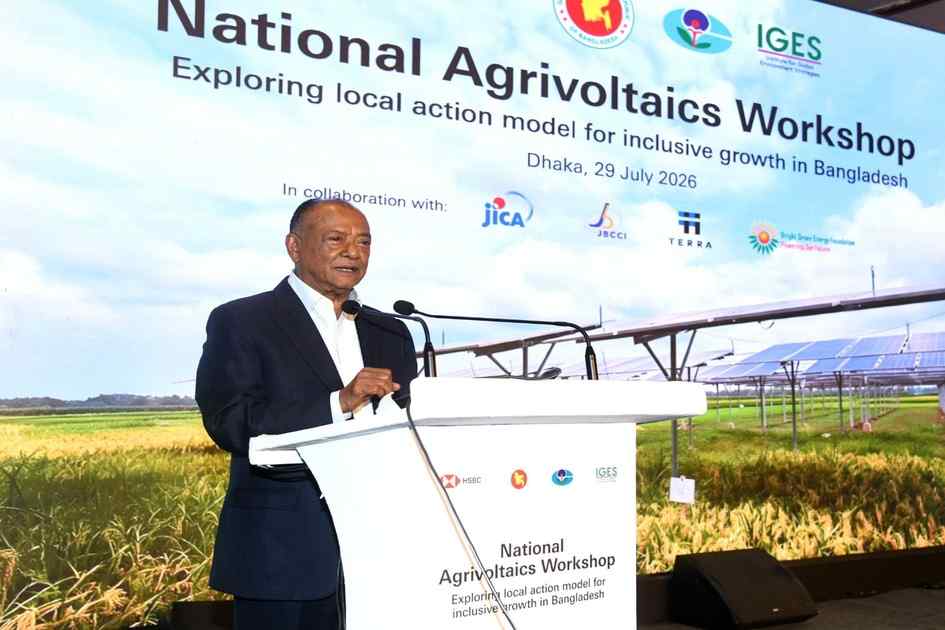
“Agrivoltaics offers a promising solution because solar photovoltaic systems and agricultural production can operate on the same land,” Mintoo said. “Properly designed systems can generate clean electricity while allowing continued crop cultivation.”
The technology allows solar panels to be installed above or alongside agricultural fields, enabling farmers to continue cultivation while producing renewable electricity. Experts say well designed agrivoltaic systems can also reduce evaporation, improve water use efficiency and create additional income opportunities for farmers.
Countries including Japan, Germany, France and the United States have expanded agrivoltaic pilot projects as part of efforts to increase solar capacity while protecting agricultural productivity. Bangladesh is now exploring how similar approaches can be adapted to its own land, climate and farming conditions.
The government has recognised agrivoltaics as a promising renewable energy option under Bangladesh’s Renewable Energy Policy 2025. Officials said future projects must ensure that agricultural activities remain meaningful and that solar panel height, spacing and orientation are designed to support crop production.
The environment minister stressed that farmers must remain at the centre of agrivoltaic development. He warned against approaches where farmers lose access to their land while receiving only short term or limited financial benefits.
“Farmers should not become passive recipients of temporary payments while others capture the majority of the benefits,” he said, calling for models that protect agricultural livelihoods and provide predictable additional income.
According to the minister, electricity generated through agrivoltaic systems could support solar irrigation, cold storage, crop drying, food processing and other productive rural activities. Decentralised renewable energy could also strengthen the resilience of communities where access to reliable electricity remains limited.
Chairing the workshop, Ministry of Environment, Forest and Climate Change Secretary Dr. Fahmida Khanom said appropriate financial and business models would be essential for scaling up agrivoltaics in Bangladesh.
She said carbon finance mechanisms, including cooperative approaches under Article 6 of the Paris Agreement and initiatives such as the Joint Crediting Mechanism, could provide additional support for renewable energy expansion. However, she stressed that all carbon market activities must ensure environmental integrity, transparent monitoring, additionality and prevention of double counting.
The workshop was organised by the Institute for Global Environmental Strategies and HSBC Bangladesh in collaboration with the Department of Environment, TERRA Japan and the Bright Green Energy Foundation.
Representatives from the Ministry of Environment, Forest and Climate Change, the Embassy of Japan, JICA, the Japan Bangladesh Chamber of Commerce and Industry, research organisations, financial institutions, private companies and development partners attended the event.
For Bangladesh, the success of agrivoltaics will depend not only on how much clean electricity it can generate, but also on whether it protects farmers, strengthens rural economies and creates a model for climate resilient development in other land constrained countries.




