

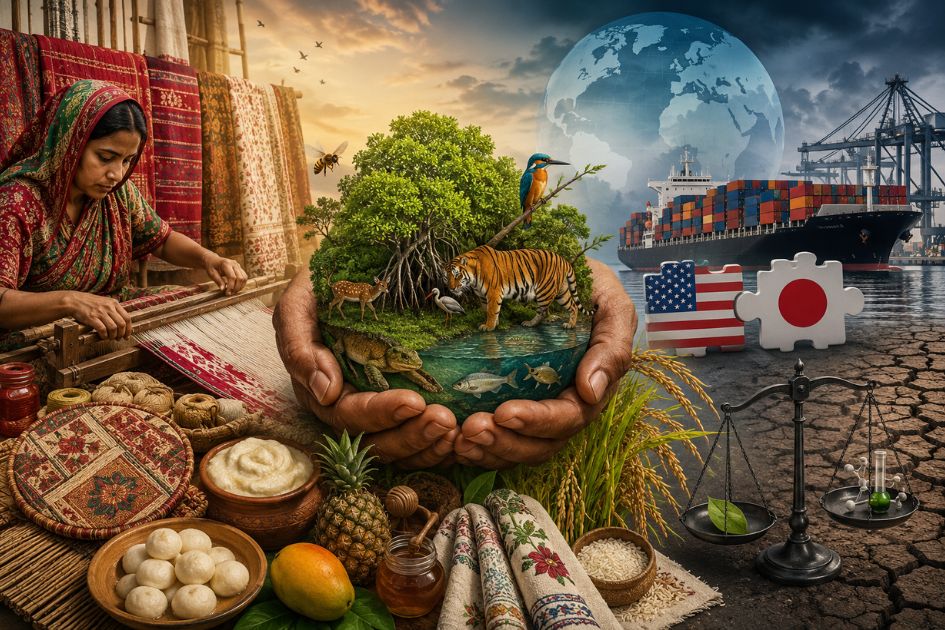

Researchers and activists warn Bangladesh’s recent trade agreements with the US and Japan could threaten biodiversity, geographical indication protections, indigenous knowledge systems and farmers’ rights through stricter intellectual property rules.
Two trade agreements signed by Bangladesh with the United States and Japan during the final phase of the interim government have sparked concerns among researchers and activists over possible threats to the country’s biodiversity, indigenous knowledge systems and geographical indication products.
Writer and researcher Pavel Partha said the agreements could expose Bangladesh’s biological resources and traditional knowledge to new risks linked to intellectual property rules, patent control and unequal global trade systems.
Partha traced the debate back to Bangladesh’s struggle to secure geographical indication, or GI, recognition for products such as Jamdani sarees and Tangail sarees. He said Bangladesh had long failed to establish effective public participation and legal protection for its biodiversity-linked cultural heritage despite enacting the Geographical Indication Products (Registration and Protection) Act in 2013.
India had previously registered Jamdani as its own GI product, prompting Bangladesh to fight for recognition of the traditional fabric. Researchers and activists visited weaving villages along the Shitalakshya River basin in Narayanganj to document the ecological foundations of Jamdani weaving.
According to Partha, traditional Jamdani sarees were originally woven with yarn made from Phuti Karpas cotton while the weaving process depended on the Shitalakshya’s water and a local rice variety known as Tilbazal. The motifs were also inspired by local plants, flowers, birds and fish species, making biodiversity central to the product’s unique identity.
He said Bangladesh’s GI products, including Sylhet’s Shitalpati mats, Nakshi Kantha embroidery, Bogura yogurt, Hilsa from the Padma River, Sundarbans honey, Bandarban Bom shawls and Tangail sarees, all emerged from specific ecosystems and local biodiversity.
Partha warned that biodiversity loss driven by structural inequality, colonial legacies, neoliberal trade policies, climate change and multinational commercial interests now threatens those ecosystems and the livelihoods tied to them.
“From tiny bees to elephants, no species is truly safe anymore,” he wrote, adding that biodiversity destruction directly affects local economies, food systems and cultural identities.
The article raised concerns over the Bangladesh-US Reciprocal Trade Agreement and the Japan-Bangladesh Economic Partnership Agreement, saying both deals were signed without public consent and could intensify pressure on the country’s biodiversity and traditional knowledge systems.
Partha said the agreements placed intellectual property rights under the framework of the World Trade Organization’s Agreement on Trade-Related Aspects of Intellectual Property Rights, commonly known as TRIPS.
Under Article 27.3(b) of the TRIPS agreement, biological resources, traditional knowledge and technologies can be patented, he noted. Although countries are allowed to create their own “sui generis” legal systems for protection, Bangladesh still lacks an effective framework to safeguard biodiversity-based indigenous knowledge and community intellectual property rights.
He warned that bioprospecting or biopiracy involving local species or traditional knowledge could undermine both intellectual property rights and biodiversity conservation.
The article also criticized clauses in both agreements requiring Bangladesh to implement the International Union for the Protection of New Varieties of Plants, or UPOV. Partha argued that UPOV protects plant breeders rather than farmers.
He questioned how farmers such as Satkhira’s Dilip Torofdar, who developed the salt-tolerant Charulata rice variety, or Rajshahi farmer Noor Mohammad, known for the drought-resistant Noor rice, would receive recognition for their innovations under such systems.
Partha also revisited the controversy surrounding Tangail sarees after India registered the product as its own GI item in 2024. Bangladesh later granted GI recognition to Tangail sarees on April 25 that year.
He described the ecological and cultural foundations of Tangail sarees, including the use of puffed rice paste made from local Porabinni rice and motifs inspired by birds, fish, bees and rural life.
The article warned that clauses in the US agreement requiring “transparency and fairness” in GI protection could weaken Bangladesh’s control over products such as Jamdani, Tangail sarees, Fazli mangoes and Sundarbans honey if the United States disputes their “essential characteristics.”
The Japan agreement similarly requires GI protection to align with TRIPS rules, which Partha said effectively strengthens patent authority over biodiversity and traditional knowledge without addressing disputes over dual registrations of GI products.
Partha further criticized the absence of references to the 1992 Convention on Biological Diversity, or CBD, in either agreement. The CBD recognizes access and benefit-sharing mechanisms designed to protect biological resources and indigenous knowledge from exploitation.
Bangladesh has yet to establish such a framework, he said.
The article argued that environmental provisions in the US agreement mainly support “non-reciprocal” trade interests while overlooking critical environmental concerns such as fossil fuel dependence, carbon emissions, plastic pollution, toxic seed systems and risks linked to genetic engineering.
Partha said Bangladesh should not feel obligated to comply with environmental conditions imposed by the United States, which he described as a violator of the CBD and Paris climate agreement commitments.
He also warned that provisions requiring Bangladesh to import large volumes of US wheat, cotton, soybeans, Boeing aircraft, liquefied natural gas and military equipment could undermine local agriculture and biodiversity-based food systems.
Preferential access for US agricultural products, he said, could reduce crop diversity and weaken traditional farming practices while increased imports of meat and dairy products could gradually erode the country’s livestock diversity.
The article also criticized provisions legitimizing biotechnology and genetically modified crops, citing Bangladesh’s controversial approval of Bt brinjal. Partha recalled that open trials of Bt brinjal had been conducted in regions considered native sources of local eggplant varieties, including Khotkhotiya, Dohazari and Islampuri, despite what he described as violations of global research standards.
He said the same commercial and political interests behind the Bt brinjal debate were now being reinforced through the US trade agreement.
Partha concluded by stressing that biodiversity protection must remain central to Bangladesh’s trade and development policies.
He pointed to the recognition of Sylhet’s Shitalpati weaving tradition by UNESCO and argued that discussions around such heritage products often ignore the biodiversity underpinning them, including Murta plants, local vines, rice varieties, trees and seasonal water systems essential to production.
He urged Bangladesh not to abandon commitments made under biodiversity conventions, national strategies and climate pledges because of pressure from the US and Japanese trade agreements.
The article was published ahead of International Day for Biological Diversity observed annually on May 22. This year’s theme is “Acting Locally for Global Impact.”
This post is republished from Prothom Alo.




