


The study finds a wide gap between official cost estimates and actual solar spending
A TIB study finds Bangladesh’s solar plants plagued by inflated costs, graft and land abuses, draining public funds, hurting investors and slowing the shift to clean energy nationwide and urgently.
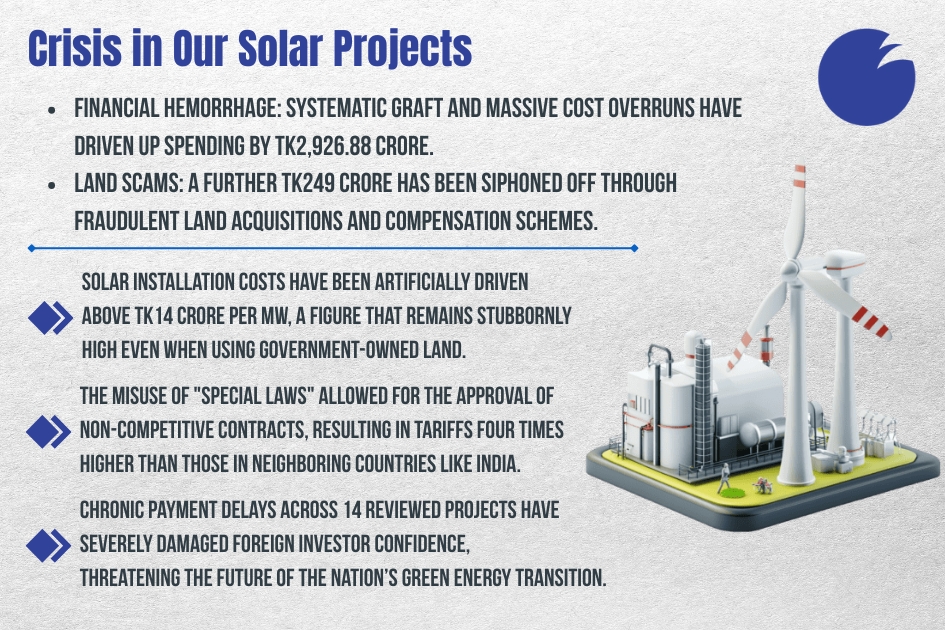
Bangladesh’s push into solar power has been undermined by soaring project costs and what an anti-corruption watchdog described as “collusive corruption”, burdening public finances with nearly Tk2,927 crore in excess spending, according to a study released on Wednesday.
Transparency International Bangladesh (TIB) unveiled the findings at a press conference at the Midas Centre in Dhaka, publishing a report titled Electricity Generation from Renewable Energy in Bangladesh: Challenges of Good Governance and the Way Forward.
The study found a wide gap between official estimates and actual expenditures on solar power plants. While the Bangladesh Power Development Board (BPDB) estimates the cost of producing one megawatt of solar electricity at around Tk8 crore, six solar projects with a combined capacity of 505.4 megawatts spent an average of Tk13.80 crore per megawatt.
TIB Executive Director Dr Iftekharuzzaman said energy planning in Bangladesh continued to favour fossil fuels, allowing governance problems seen in conventional power generation to spread into renewables.
“The power sector is among the most corruption-prone,” he told reporters. “The same pattern of irregularities seen in the fossil fuel sector, including misuse of capacity charges, is now visible in renewable energy.”
The watchdog also criticised the interim government’s decision to cancel 31 unsolicited renewable energy projects, involving an estimated $6 billion in investment. TIB warned that the move could undermine investor confidence at a time when Bangladesh urgently needs foreign capital to support its clean energy transition.
According to the report, Bangladesh’s renewable energy ambitions remain stalled because policymakers have failed to place clean energy at the centre of national planning, leaving the country’s vast renewable potential largely untapped despite repeated commitments.
The study documented more than Tk249 crore in corruption linked to land acquisition and compensation across five renewable energy projects. It found that several government-owned projects built on public land, where no acquisition costs should have applied, recorded installation costs exceeding Tk14 crore per megawatt.
TIB alleged the existence of a coordinated syndicate involving officials from BPDB, land registration offices, sections of the local administration and political figures. Reported malpractices included inflating mouza land prices, reclassifying agricultural land to bypass regulations and misusing the Quick Enhancement of Electricity and Energy Supply (Special Provisions) Act 2010 to sign power purchase agreements at tariffs allegedly up to four times higher than those in neighbouring countries.
The report also cited cases of forced land acquisition, where privately owned land was falsely labelled as public property. In some instances, landowners were evicted or pressured and intimidated into selling land at prices far below market value.
On the financial side, TIB found that many power contracts were denominated in US dollars, increasing pressure on the sector after the taka depreciated. Some projects proceeded without mandatory environmental clearances, the report said.
Covering 14 renewable energy projects between October 2023 and November 2024, the study noted that payment delays to private power producers further weakened foreign investor confidence.
Asked about the possibility of cancelling controversial agreements such as the Adani power deal, Iftekharuzzaman said an immediate withdrawal would be difficult due to existing legal and financial commitments.
“Pulling out could lead to international arbitration, with outcomes that are uncertain,” he said.
The report concluded that a lack of transparency and accountability remains the main obstacle to meeting Bangladesh’s renewable energy targets, adding that without modern grid integration and sufficient technical readiness, renewable energy remains inconvenient and financially unattractive for households.




