

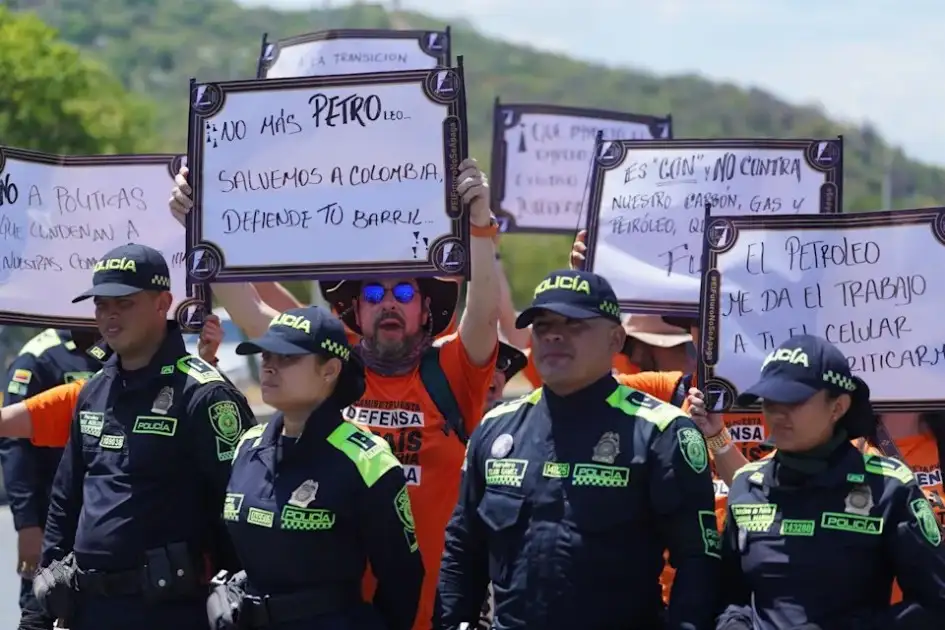

A landmark conference on phasing out fossil fuels ended in Colombia with modest progress, exposing divisions over justice, corporate influence and finance, as activists warned the transition risks entrenching inequality without deeper structural reforms and stronger global accountability mechanisms.
The first global conference dedicated to transitioning away from fossil fuels closed in Colombia on Friday with limited progress, as governments pledged to continue negotiations but left major questions on equity, finance and corporate power unresolved.
The gathering in Santa Marta brought together more than 60 countries alongside civil society groups, unions and Indigenous representatives, marking one of the most ambitious efforts yet to shape a global pathway beyond coal, oil and gas.
While participants agreed to sustain a process aimed at phasing out fossil fuels, the final outcomes stopped short of defining binding targets or concrete mechanisms to ensure a “just” transition, a central demand from grassroots movements.
Activists and campaigners who had convened earlier at a parallel People’s Summit for a Fossil Free Future said their proposals, including stronger protections for vulnerable communities and limits on corporate influence were only marginally reflected in the official negotiations.
“The agreement to continue the process comes at a critical point in history,” said Kirtana Chandrasekaran of Friends of the Earth International, pointing to what she described as a worsening climate crisis alongside geopolitical tensions and expanding corporate control over energy systems.
She argued that a meaningful transition would require “systemic change” away from privatised, corporate-dominated energy models toward decentralised renewable systems focused on energy sovereignty.
Observers noted that while major fossil fuel companies such as Chevron and Total have increasingly positioned themselves as backers of the energy transition, critics say their involvement risks promoting so-called “false solutions” that prolong dependence on fossil fuels.
A key concern raised by civil society groups was the continued use of Investor-State Dispute Settlement (ISDS) mechanisms, which allow corporations to sue governments over policy changes affecting their investments.
“ISDS allows corporations to challenge collective decisions on energy and resources,” said Frances Verkamp of Friends of the Earth Europe, warning that such systems disproportionately favour investors from wealthier nations and constrain policy space in the Global South.
The conference outcomes made no explicit reference to reforming or phasing out ISDS, a gap campaigners described as a major setback for climate justice.
Delegates from developing countries also criticised what they called the growing reliance on market-based approaches, including carbon trading and private climate finance, which they say risk sidelining community-led solutions.
Wahyu Eka of Indonesia’s WALHI environmental group said the push for technologies such as biomass and nuclear energy, alongside carbon markets, could “entrench fossil fuel dependence” rather than accelerate its phase-out.
“Opening the door for private finance to drive the transition creates a lifeline for big polluters,” she said, warning that such approaches could deepen inequalities and undermine local control.
Another contentious issue, largely absent from the final text, was the race for critical minerals such as lithium, cobalt and nickel, essential for renewable technologies but often linked to environmental degradation and social conflict.
Siphesihle Mvundla of South Africa’s groundWork organisation said the transition risks replicating patterns of extraction and exploitation unless governments confront the broader economic model underpinning resource use.
“The same forces driving fossil fuel expansion are now turning to critical minerals,” she said, arguing that any just transition must address unequal consumption and end extractive practices.
Despite the criticisms, some participants said the conference had helped elevate debates that had previously struggled to gain international attention.
“This process brings visibility to an urgent discussion,” said Catalina Caro of Colombia’s CENSAT, though she acknowledged that the outcomes failed to establish new frameworks or mechanisms capable of driving transformative change.
Analysts said the meeting underscored the growing tension between state-led climate diplomacy and grassroots demands for systemic reform, particularly as countries face mounting pressure to balance energy security, economic growth and climate commitments.
With no binding roadmap agreed, the Santa Marta conference leaves the global transition effort at a crossroads advancing dialogue on fossil fuel phase-out while exposing deep divisions over how, and for whom, that transition should unfold.




