

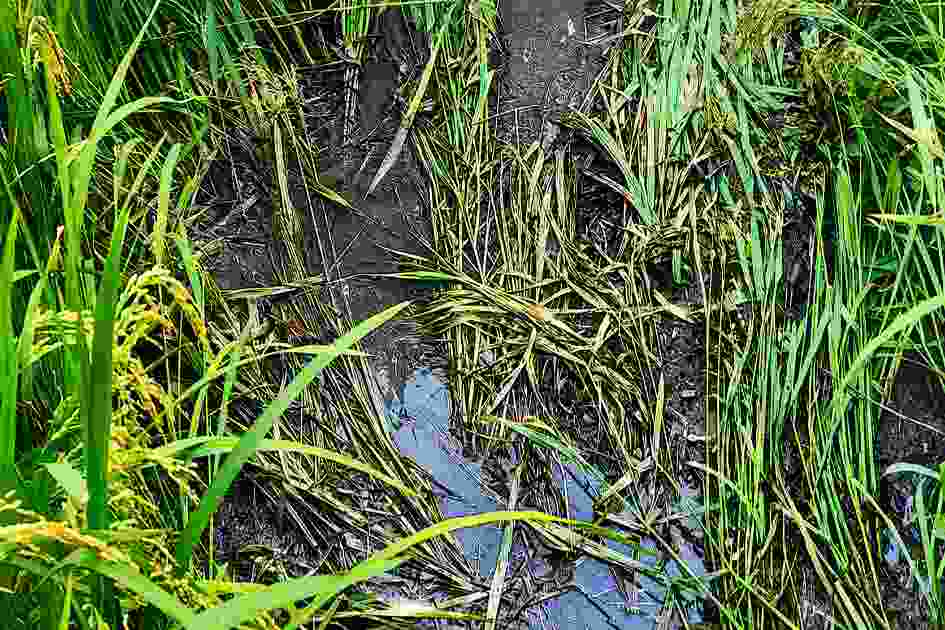



Toxic poultry waste from a fertiliser plant in Tangail has flooded paddy fields, ruining crops, threatening cattle feed and triggering foul odours, skin irritation and health concerns among villagers.
Farmers in a village in Bangladesh‘s Tangail district say toxic waste from an organic fertilizer plant has inundated ripe paddy fields, leaving them unable to harvest their crop because of the stench and severe itching, while more than 100 bighas of farmland face ruin.
The incident took place in Lakkhindar village under Ghatail upazila, where residents say the factory has not only taken food from their mouths but also deprived their cattle of fodder.
The plant stands on elevated land above a low-lying double-crop farming area where rice is known to grow well. The land sits beside the village and the factory was set up there in 2024. There is no signboard on the premises, but locals said it belongs to a company under Oasis Group. Poultry droppings are used as the main raw material for organic fertiliser, mixed with ash and wood dust.
During a visit to the site on Saturday, workers were seen drying and mixing poultry waste in the open. Local residents said several days of heavy rain washed piled-up chicken droppings into adjacent paddy fields.
Farmer Abdul Halim said he had been unable to harvest rice from nearly three bighas of land because the field was submerged in knee-deep poultry waste. He said he could neither cut the rice nor use the straw afterward because cattle would not eat it. He had hired labourers for 5,000 taka to harvest rice from seven decimals of land, but they left the field within five minutes because of the foul smell and itching.
Another farmer, Mamun Mia, said no one from the factory directly responds when people speak out against it, but threats come from a local man named Abdul Gafur. Inquiries found that Gafur had played the key role in setting up the factory at the site.
Farmer Habibur Rahman said all their paddy was finished and the base of the rice plants had already started rotting. He said the stalks would collapse within a day or two and then could no longer be harvested.
The factory stands next to the home of Firoza Begum, who said the stench had led to a rise in flies and mosquitoes around her house. She said her daughter suffers from diarrhoea every two days and that she herself also fell ill while caring for her. A visit to her house found flies swarming inside. Another local resident, China Begum, said the smell was so overpowering that she could not eat properly three times a day.
Factory admin Abdul Hasan said the company had environmental clearance from the Department of Environment to produce organic fertiliser and that the operation was being run in line with regulations. He acknowledged that poultry waste had flowed into the paddy fields with rainwater.
Union Parishad chairman Saidur Rahman said the factory was located beside the council’s temporary office and that the odour was unbearable. He said farmers had suffered major losses.
Ghatail Upazila Health and Family Planning Officer Dr Abu Nayeem Mohammad Sohel said diarrhoea could be caused when flies and mosquitoes sit on food. He said foul odours could trigger breathing problems, asthma and skin diseases. Poultry waste also contains heavy metals which can lead to cancer-like illnesses, he added.
Tangail Deputy Director of the Department of Environment Jahirul Islam said the factory had environmental clearance and that it had been renewed one month ago after an on-site inspection. At that time, he said, no local residents had lodged any complaint. He added that if farmers had suffered losses and if the odour continued to spread, the site would be inspected again and action would be taken.
Ghatail Upazila Agriculture Officer Dilshad Jahan said waste from the factory had caused significant rotting at the base of the rice plants. She said farmers suffer losses every year because of the plant and had been advised to submit a written complaint to the upazila executive officer.




