

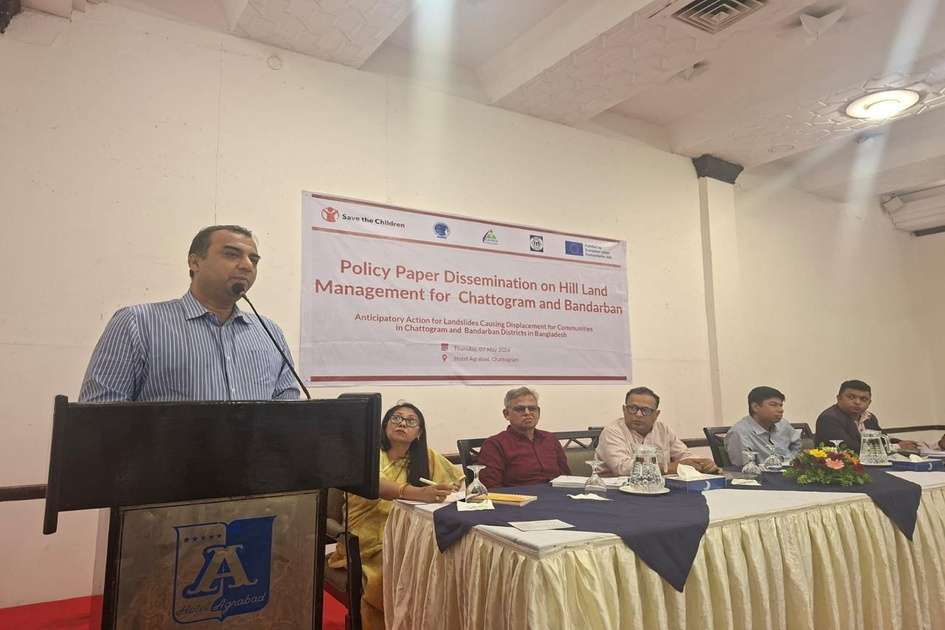

A new policy paper warns that unchecked hill cutting, deforestation and unplanned urbanisation are worsening landslide risks in Chattogram and Bandarban, urging risk-sensitive land use planning and stronger enforcement measures.
A new policy paper unveiled in Chattogram on Wednesday called for risk-sensitive land use planning to be institutionalised in hill management in Chattogram and Bandarban, warning that unchecked hill cutting, unplanned urbanisation and deforestation are driving up landslide risks in the two districts.
The policy dissemination event, titled “Risk-Sensitive Land Use Planning and Integration of Landslide Risk in Hill Management in Chattogram and Bandarban Districts”, was held at Hotel Agrabad in Chattogram under an initiative of Save the Children with financial support from the European Civil Protection and Humanitarian Aid Operations (ECHO).
The event, organised with technical support from YPSA, ASHIKA and RIMES, highlighted key challenges in hill management and disaster risk reduction.
Presenting the main paper, Professor Dr Md Akhtar Mahmud of the Department of Urban and Regional Planning at Jahangirnagar University said landslides in Chattogram and Bandarban were increasing mainly because of human-induced factors such as uncontrolled hill cutting, unplanned urbanisation and deforestation.
He said the policy paper strongly advocates institutionalising Risk-Sensitive Land Use Planning, or RSLUP, as the central framework for hill management. It places emphasis on hazard-based zoning, mandatory geotechnical assessment and ecosystem-based slope stabilisation.
The study also found that landslide risks peak during the monsoon months of June and July, underscoring the need for an early warning system based on specific rainfall thresholds to trigger timely evacuation.
Chief guest Mohammad Ashraful Amin, chief executive officer of Chattogram City Corporation, said the city remained highly vulnerable to landslides ahead of the coming monsoon.
“This policy paper will play an important role in developing a detailed hill management method to professionally manage vulnerable hills,” he said.
He said the city corporation did not encourage settlement on hills, but the lives and economic dependence of people already living there also had to be taken into account. He expressed hope that the discussion would help ensure more professional management of hill settlements.
During the panel discussion, experts elaborated on the policy paper’s multi-dimensional findings.
Professor Dr Iqbal Sarowar of the University of Chittagong highlighted the environmental consequences of landslides, saying they were causing extensive loss of biodiversity and topsoil. He said the destruction of natural forests was reducing the soil’s water retention capacity, which is essential for slope stability.
Associate Professor A.T.M. Shahjahan of Chittagong University of Engineering and Technology focused on infrastructure-related flaws. He said poor engineering and the failure to stabilise slopes using scientific methods were among the key causes of landslides. He added that illegal commercial activities such as brick kilns near hills were making the fragile hill structure even more unstable.
Shahinul Islam, action plan specialist at the Chattogram Development Authority, stressed the need to integrate disaster risks into the master plan. He said risky activities were continuing because of weak enforcement of laws and a lack of institutional coordination.
At the closing session, organisers presented a structured 10-year action plan or roadmap.
The short-term plan calls for forming a special task force to stop illegal hill cutting and producing high-resolution hazard maps. The long-term goals include launching planned rehabilitation programmes for people living in vulnerable settlements and expanding the RSLUP model to hill districts across the country so that national planning gives priority to human safety and environmental restoration.




