

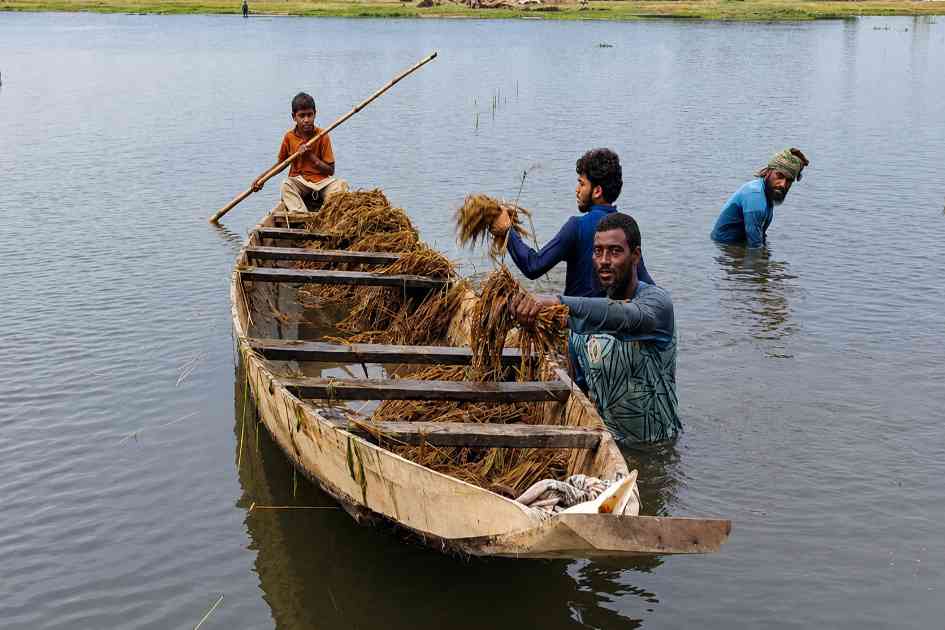



Flash floods and failed embankments devastated Sunamganj’s haors, leaving farmers facing crop losses, rising debt, food insecurity and growing anger over governance failures in Bangladesh’s climate-vulnerable wetland farming communities.
In Bangladesh’s vast haor wetlands, the harvest season is usually a celebration. During the Bengali month of Boishakh, the air is meant to carry the sweet scent of freshly cut paddy while farming families work through sleepless nights to bring home the year’s most important crop.
This year, however, the wind carries the stench of rotting rice.
Across the submerged haors of Sunamganj, golden fields have disappeared beneath endless stretches of silver floodwater. What should have been a harvest festival has turned into a scene of despair, exposing not only the growing brutality of climate extremes but also allegations of poor planning, weak governance and failures in flood management.
In Dirai and Shalla upazilas, including Udgal and Chhayar Haor, thousands of farmers are counting catastrophic losses after sudden heavy rainfall and prolonged waterlogging destroyed mature Boro rice just days before harvest.
On the roadside near Shalla Milonbazar, farmers desperately spread spoiled rice under the blazing sun, hoping to save at least part of their crops. But many grains have already sprouted after remaining underwater for days, turning soft and powdery during drying.
“I cultivated nine kear of land. Most of it is gone,” said farmer Ali Noor from Nachirpur village in Dirai. “The little rice I managed to cut has already spoiled. Farming is the only work I know. I have no savings left and now even food for my family is uncertain.”
For small and marginal farmers across the haor basin, the disaster is rapidly becoming a survival crisis.
Nirapad Das, a medium-scale farmer from Hashimpur village, invested nearly Tk 250,000 from his family savings into cultivating 16 kear of land. Nearly half is now underwater.
“If my wife did not have a small school job, we would face hunger this year,” he said quietly.
Local residents say the disaster was not caused by rainfall alone.
Farmers and environmental activists allege that poorly designed embankments and unplanned flood control infrastructure trapped rainwater inside the haor system, preventing natural drainage and accelerating crop destruction.
In Chakua village of Shalla, farmers directly blamed the recently built Joypur embankment for worsening waterlogging.
“Last year there was no embankment here and water drained naturally,” said farmer Ranu Chandra Das. “This year public money was spent on a structure that protected nothing and destroyed our crops instead.”
The allegations have intensified public anger over accountability and the alleged misuse of public funds in climate-vulnerable regions already struggling with repeated disasters.
Activists say the crisis reflects a dangerous combination of climate vulnerability, governance failure and a lack of long-term adaptation planning in one of Bangladesh’s most important food-producing regions.
“This is not only a natural disaster. It is also a human-made disaster,” said Mohammad Obaidul Haque, general secretary of the Haor and River Protection Movement.
“The figures being published from air-conditioned offices do not match the reality in the fields. More than half the crops in many haors are damaged. Hiding the true scale of losses means real farmers may never receive proper support.”
He also questioned the effectiveness of embankment projects reportedly costing around Tk 1.5 billion, arguing that many structures failed to protect farmland and instead worsened flooding by blocking natural water movement.
Sohanur Rahman, executive coordinator of YouthNet Global, said the disaster highlights the growing intersection of climate injustice, weak local governance and rural economic vulnerability in Bangladesh’s climate frontline regions.
“Haor farmers are paying the price for a climate crisis they did not create,” he said. “Without climate-resilient infrastructure, transparent governance, early warning systems and long-term adaptation investment, these recurring disasters will deepen poverty, food insecurity and forced migration in vulnerable communities.”
The controversy deepened after local farmers accused authorities of preparing politically biased compensation lists.
“They ask local representatives to prepare the names and relatives get priority,” alleged farmer Gani Mia from Loular Char village. “We want direct field verification so real victims receive assistance.”
Official statistics have further fueled distrust.
According to the Department of Agricultural Extension, nearly 84 percent of the district’s paddy has already been harvested while official estimates currently recognize damage to only around 20,120 hectares out of more than 223,000 hectares cultivated this season.
But farmers, activists and local observers say the numbers dramatically understate the scale of destruction, especially considering rainfall this year was reportedly almost double that of the previous season.
The growing gap between official claims and field realities has intensified criticism of disaster reporting and agricultural governance in Bangladesh’s climate frontline regions.
Meanwhile, Member of Parliament Kamruzzaman Kamrul said the Prime Minister’s Office is monitoring the situation closely. High-level government teams have already visited affected haors while pressure is mounting on local administrations to provide accurate assessments of crop losses.
For generations, the haor wetlands of northeastern Bangladesh have been one of the country’s critical rice-producing zones, feeding millions and sustaining fragile rural economies.
But climate change is making these ecosystems increasingly unstable. Erratic rainfall, flash floods, rising temperatures, weak infrastructure management and delayed adaptation measures are now pushing farming communities deeper into uncertainty every year.
Experts warn that repeated crop failures in the haor region are no longer isolated local disasters. They are becoming part of a broader climate-driven food security threat facing Bangladesh and much of South Asia.
What now floats across Sunamganj is not only ruined rice, but the collapse of countless rural dreams.
Unless Bangladesh strengthens climate adaptation, ensures transparent disaster governance, invests in nature-sensitive water management and delivers justice for affected farming communities, the country’s frontline food producers may continue paying the highest price for a crisis they did little to create.




