

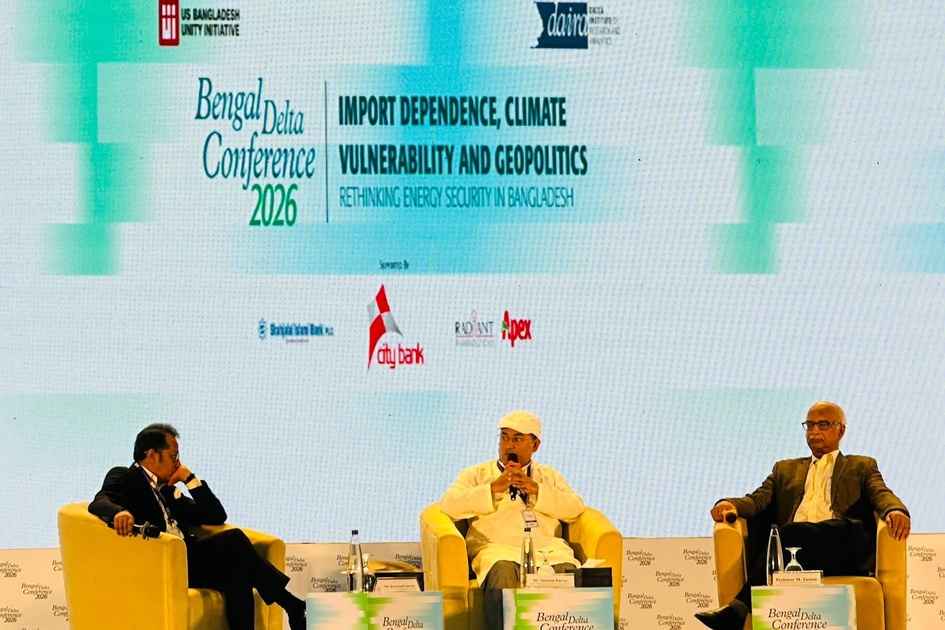

Bangladesh’s growing reliance on imported fuels is increasing exposure to global market and geopolitical risks, underscoring the need for a more resilient, diversified and sustainable approach to long-term energy planning.
Bangladesh must redefine energy security beyond electricity-generation capacity as the country faces mounting climate risks and growing dependence on imported fuels, Dr Saimum Parvez, Special Assistant to the Prime Minister of Bangladesh for Environment, Forest and Climate Change, said at the Bengal Delta Conference 2026 in Dhaka.
Dr Parvez made the remarks while participating in a panel discussion titled “Import Dependence, Climate Vulnerability and Geopolitics: Rethinking Energy Security in Bangladesh.”
During the discussion, he said energy security could no longer be understood merely in terms of electricity-generation capacity, noting that Bangladesh’s reliance on imported fuels leaves the country exposed to global price volatility, supply chain disruptions, foreign exchange pressures and geopolitical conflicts.
He said these risks are particularly significant for Bangladesh as the country seeks to meet its growing energy demand while simultaneously confronting severe climate vulnerability. Energy planning, he said, must therefore integrate economic security, environmental sustainability and national resilience.
Dr Parvez also stressed the need to accelerate the transition to renewable and cleaner energy, improve energy efficiency, diversify energy sources and strengthen the resilience of national energy infrastructure.
He said Bangladesh’s clean energy transition must be practical, inclusive and just, protecting vulnerable communities, creating employment opportunities and ensuring that the benefits of sustainable development reach all sections of society.
For Bangladesh, rethinking energy security means building a diversified, climate-resilient and increasingly low-carbon energy system capable of withstanding both environmental shocks and an increasingly uncertain geopolitical order, he said.




