




As Bangladesh advances a 2025–2035 lead-free roadmap, experts warn enforcement, testing and safer recycling will determine whether children, workers and communities are protected.
Unsafe lead acid battery recycling threatens children’s health as country moves to build a cleaner economy.
More than 8,800 schools in Bangladesh are located near documented toxic sites, many linked to lead pollution from informal used lead-acid battery recycling, according to a new study by the Center for Global Development (CGD), as the country moves to implement its first national roadmap to eliminate lead exposure.
The Center for Global Development (CGD), a Washington, DC- and London-based nonprofit research organisation focused on international development, found that around 82 percent of the identified toxic sites near schools are associated with lead pollution, particularly from informal battery recycling activities.
The study was led by Lee Crawfurd, Senior Research Fellow at CGD Europe, who said the findings should not trigger panic or prompt parents to withdraw children from schools. Rather, he said, the research should serve as a warning that authorities need to identify where genuine risks exist and take targeted action.
“We don’t know that children are being exposed through all of these sites,” Crawfurd said. “What we do know is that these are places where there may be risks, and they deserve proper environmental testing.”
Lead exposure is particularly concerning because there is no known safe level for children. Informal used lead-acid battery recycling often involves dismantling and melting batteries in open environments with little or no pollution control. Tiny lead particles can become airborne, settle into surrounding soil, contaminate crops and eventually enter children’s bodies through inhalation or hand-to-mouth contact.
“Children are especially vulnerable because lead affects brain development,” Crawfurd explained. “Particles can travel through the air, settle on the ground where children play, and even contaminate food grown kilometres away.”
The study also highlights growing international evidence linking lead pollution with poorer educational outcomes. Previous research in Kenya, Mexico and Indonesia has shown that children living near lead-processing facilities perform worse in school. In Bangladesh, earlier studies have already documented elevated blood lead levels among children living close to battery recycling operations.
Crawfurd said Bangladesh’s immediate priority should be low-cost environmental testing, particularly in the 887 schools located within one kilometre of documented toxic sites. Soil testing, followed by blood lead screening where contamination is suspected, would help identify communities requiring urgent intervention.
He added that stronger regulation, safer recycling practices and better industrial planning, including relocating hazardous industries away from densely populated areas, would significantly reduce long-term risks.
Importantly, Crawfurd emphasised that schools themselves are not the problem. The goal, he said, is to ensure that children can learn in safe environments while authorities use available data to improve industrial zoning decisions and future school construction.
The findings come as Bangladesh reviews the draft National Strategy for Lead-Free Bangladesh and Multi-Year Action Plan (2025–2035) with support from UNICEF, aiming to reduce lead exposure through stronger regulations, safer industrial practices, improved monitoring, public awareness and coordinated action across government agencies.
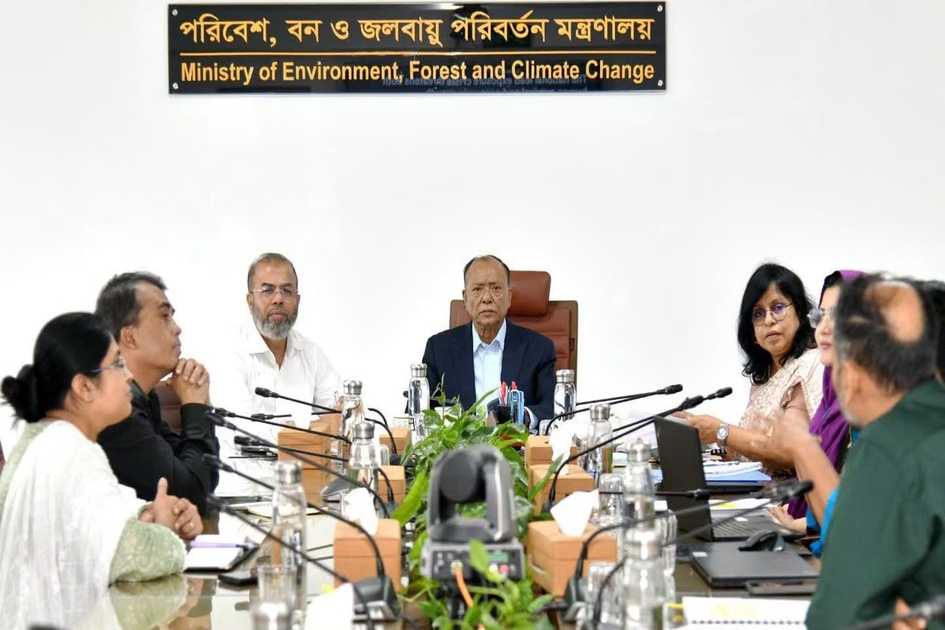
At a high-level review meeting on Monday, Environment Minister Abdul Awal Mintoo, approved the submission of the strategy to the Cabinet for final approval.
“Protecting public health from lead exposure requires effective implementation, coordinated action and strong partnerships,” Abdul Awal Mintoo said.
The meeting was attended by State Minister Shaikh Faridul Islam, acting secretary Dr Fahmida Khanam, senior government officials and UNICEF representatives. UNICEF reaffirmed its continued partnership with Bangladesh in reducing lead exposure and supporting implementation of the national roadmap.
According to UNICEF and Pure Earth estimates, around 36 million children in Bangladesh are affected by elevated blood lead levels, placing the country among those facing some of the highest childhood lead exposure burdens globally.
Environmental researchers say adopting the strategy will be only the beginning. They stress that success will depend on enforcement capacity, regular inspections, reliable environmental testing, transparent data systems and coordination among the Department of Environment, labour authorities, local administrations and public health institutions.
Experts say Bangladesh’s challenge reflects a wider global concern: as countries accelerate renewable energy deployment, battery storage and electric mobility, battery demand is increasing across developing economies. Without responsible recycling systems, the clean energy transition could shift pollution burdens onto vulnerable communities.
Unsafe Battery Recycling Remains a National Challenge
Recent incidents across Bangladesh highlight the difficulty of turning environmental regulations into effective protection for communities.
Lead-acid batteries remain widely used in vehicles, solar energy systems and backup power solutions. However, much of the recycling sector operates informally, where used batteries are dismantled and melted without adequate pollution control systems.
Such practices can release toxic fumes, contaminated dust and hazardous waste into surrounding communities, affecting workers, children, agricultural land and ecosystems.
Across Dhaka, Savar, Dhamrai, Gazipur and other industrial areas, residents have repeatedly raised concerns over unsafe lead extraction and recycling activities.
In Savar’s Bhakurta area, residents alleged that smoke from nighttime battery burning spread across nearby communities and farmland. They claimed that some informal facilities resumed operations despite previous enforcement actions.
On July 1, the Department of Environment conducted an operation in the area and demolished six furnaces from three alleged illegal factories. Residents later claimed that new furnaces were rebuilt within days and production resumed.
Authorities have not independently confirmed the allegations.
Similar concerns have emerged in Mymensingh’s Munshipara area under South Tangab Union of Gafargaon Upazila, where residents alleged that an illegal lead-processing facility was operating close to residential areas.
Local communities claimed that toxic smoke and industrial waste were affecting public health, agriculture and the surrounding environment, particularly placing children, pregnant women and other vulnerable groups at greater risk.
Residents called for independent investigations, environmental assessments and stronger regulatory oversight.
The allegations require proper investigation, and authorities and factory representatives should have the opportunity to respond regarding compliance measures and operational status.
Communities and Workers on the Frontline
In Narsingdi’s Fulbaria village, residents say their long campaign against pollution risks from a used lead-acid battery recycling facility has resulted in legal challenges.
Villagers stated that they had raised concerns for more than a decade over alleged pollution from a recycling plant located near homes and agricultural land. Following court-directed enforcement measures, the factory eventually stopped operations.
Residents claim that 19 villagers, including two children, were later named in a criminal case after the factory closure. They allege the case was intended to discourage community opposition to pollution.
The accused have denied the allegations, and the matter remains subject to legal proceedings.
Environmental advocates say communities reporting pollution must be protected because they often provide the earliest warning about environmental and public health risks.
The risks associated with hazardous battery practices were further highlighted following the death of a worker at a lead-acid battery factory in Dhamrai near Dhaka.
Sujit Sarkar died following an explosion at the Shubho Power factory that caused acid and chemical substances to spill onto his body. He was taken to hospital but later died during treatment.
Officials said the factory had previously faced enforcement action and was fined Tk100,000 by a mobile court for allegedly operating without required environmental clearance and standards approval.
Labour and environmental experts say battery manufacturing and recycling require strict occupational safety standards, including proper waste management, emergency response systems, worker training, protective equipment and regular health monitoring.
A Just Transition for a Safer Battery Economy
Experts say Bangladesh must address unsafe recycling through a just transition approach that protects workers while transforming the battery sector into a safer and more sustainable industry.
Many informal workers depend on hazardous recycling activities for their livelihoods. Simply shutting down unsafe facilities without alternative employment pathways could deepen economic hardship.
A successful transition requires skills development, decent employment opportunities, social protection and pathways for workers to move into safer jobs.
Experts recommend establishing formal recycling facilities, safe battery collection networks, stronger workplace standards, community-based monitoring and corporate responsibility throughout the battery lifecycle.
Battery producers and importers should also follow extended producer responsibility principles, ensuring accountability from production and collection to recycling and final disposal.
“Sustainable growth cannot be achieved while workers and communities are exposed to hazardous pollution. Bangladesh’s green transition cannot be built on toxic pollution and unsafe workplaces. A lead-free future must protect workers, communities and environmental defenders,” said Sohanur Rahman, Executive Coordinator of YouthNet Global.
Experts also emphasise that lead pollution policies must be gender-responsive and inclusive, recognising that women, children, persons with disabilities and other vulnerable groups may face disproportionate risks in affected communities.




