




In Bangladesh’s haor region, early floods, upstream sediment and restricted fishing are wiping out rice and fish livelihoods, forcing men to migrate to India as culture and food security erode.
Villages along Bangladesh’s border with India’s Meghalaya were once alive with indigenous festivals during the harvest months of Kartik and Agrahayan. Today, those same villages fall into an unsettling silence. In recent years, entire communities have become almost male-less, with families waiting at home for relatives who may never return.
Traditional celebrations such as Chormaga, Diwali, Wangala and Bastu Puja have largely disappeared from indigenous villages in Tahirpur, Madhyanagar, Bishwambharpur and Sunamganj Sadar in Sunamganj district as well as Durgapur and Kalmakanda in Netrokona. Local residents say festivals lose their meaning when most working-age men are absent.
The absence is driven by a collapse of livelihoods in the haor wetlands. Each year, sand, stones and waste flowing down from the hills of Meghalaya bury farmlands and choke natural waterways. At the same time, many wetlands are leased out and effectively controlled by wealthy and politically influential groups, limiting access for local fishers. With no crops to harvest and no water flow for fishing, work disappears for months.
“This migration is not a choice; it is forced by hunger,” said Md Mudassir Alam, head teacher of Tahirpur. “Families are leaving our villages one by one. Our fields are fertile, but people can no longer survive here.”
Faced with few options, many residents cross the border into north-eastern India to work illegally in stone and coal mines, often under dangerous conditions. “I have seen men return with broken backs or missing limbs,” Alam added. “Some never return at all. Children grow up without their fathers and mothers bear the burden alone.”
The crisis threatens Bangladesh’s food security. The haor region is one of the country’s largest food-producing areas, supplying rice and fish to millions. Yet people are now migrating in search of food and income while biodiversity and centuries-old indigenous cultures steadily disappear.
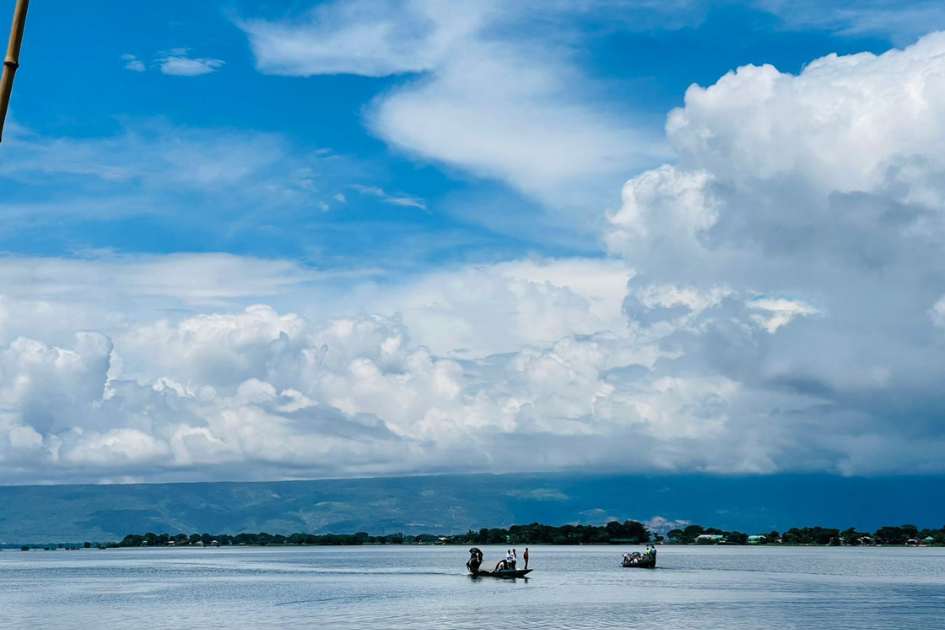
Haor wetlands cover nearly one-sixth of Bangladesh’s total land area. Official documents list between 414 and 423 haors spread across 539 unions in 60 upazilas of seven districts: Sunamganj, Sylhet, Moulvibazar, Habiganj, Netrokona, Kishoreganj and Brahmanbaria. Around 20 million people live in these floodplain wetlands, which play a critical role in national food production.
Farmers in Tanguar Haor have traditionally depended on a single annual harvest of Boro rice, planted during the dry season from October to March and harvested just before the monsoon. That once-predictable cycle has broken down.
“We used to rely on a single Boro rice harvest. Now even that has become uncertain,” said Tofazzal Hossain, a farmer from Badaghat, Tahirpur upazila. “The floods come too early. Sometimes all the crops are gone in a single night. We are scared each season, not hopeful.”
Climate change is compounding the crisis. Rainfall patterns have shifted dramatically, with flash floods arriving weeks earlier than in previous decades and dry spells becoming more prolonged. “We now see floods in March or April, destroying nearly mature crops,” explained Md Noman Ahmed, headmaster of Satgaon Jibdara High School in Shantiganj upazila. “At the same time, the dry season lasts longer and harsher, making it nearly impossible to plan farming or fishing.”
Human activity worsens the impact. “Houses and farmland are built over canals and ponds. The water has nowhere to go. Every year, the floods destroy more land,” Ahmed added. “Rivers like the Surma and Kushiara are shrinking because of silt and our embankments are too weak to hold back heavy rainfall.”
The damage extends beyond agriculture. Fishermen struggle as fish populations decline due to disrupted breeding cycles, polluted waters and shrinking habitats. “Each season, we chase fish deeper into the haor. They are fewer now and finding them has become a struggle that threatens our families’ survival,” said Md Eyasin, a veteran fisherman from Tanguar Haor.
Non-economic losses are also severe. Communities face cultural erosion as festivals vanish, knowledge of traditional fishing and farming techniques is lost and social cohesion weakens. “Our festivals are gone, our children no longer know the songs or dances of our ancestors. This hurts us more than losing a harvest,” said Md Mudassir Alam.
Education suffers during peak floods. Schools become inaccessible, forcing children to miss classes for months. “During floods, our school closes and we cannot study for three to four months,” said Subarna Akter Jui, a ninth-grade student at Janata High School. “Before board exams, we panic. We forget everything we studied. It is frightening not knowing if we can catch up.”
Infrastructure failures add to the hardship. “Every year, embankments collapse, roads disappear and the floods sweep everything away,” said Md Ali Hyder, Union Parishad chairman of Sreepur North in Tahirpur. “Our people suffer, our crops are destroyed and our homes are damaged. We need long-term solutions, not promises.”
Farmers also face rising labor costs, adding to financial stress. In Tahirpur, daily wages for transplanting Boro rice have jumped from 500–550 taka ($5–$5.50) to 750–800 taka ($7.50–$8) within days due to a labor shortage. Nurul Abedin, a farmer from Shani Haor, said, “Even at this high wage, it is difficult to find workers. Costs for fertilizers, pesticides and irrigation are also rising. We worry whether we will make a profit this season.”
Two master plans for haor development were prepared in 2012 and again in 2025 by the Ministry of Water Resources and the Bangladesh Haor and Wetland Development Board. Environmental experts note that neither plan adequately addresses one of the region’s biggest threats: unregulated mining, deforestation, dams and hydropower projects in upstream areas of north-eastern India. Official records show that the 2012–2032 plan has achieved only about one percent progress in more than a decade.
Historically, seasonal floods were part of the haor’s natural rhythm. Today, flash floods strike unpredictably. Extensive deforestation and hill cutting in Meghalaya have stripped hillsides of vegetation, sending sediment into Bangladesh’s wetlands and destroying farmland.
In Netrokona, rivers such as the Someshwari, Mahadeo, Lengura, Kangsha and Ubodakhali remain dry for up to eight months a year, turning into sandbars vulnerable to encroachment. In Sunamganj and Sylhet, wetlands including Pachashol, Nayachhara and Patharchawl haors have been severely damaged. Near Tanguar Haor, Bangladesh’s second Ramsar site, mining activities continue across the border alongside plans for a uranium mining project in India’s West Khasi Hills, raising further environmental concerns.
Policy analysts say Bangladesh must prioritize the protection of its wetlands and the people who depend on them through stronger planning, infrastructure, climate adaptation strategies and regional diplomacy.
Civil society groups recommend several measures. Rivers should be regularly dredged and connecting canals reopened to ensure natural water flow. Seasonal lockdowns should allow fish and other species to breed and grow properly. Infrastructure investment should focus on embankments, flood-resistant roads and solar-powered water purification systems. Education and vocational training tailored to local needs must be rolled out urgently. Public awareness campaigns are also crucial to protect biodiversity and preserve cultural heritage.
Sohanur Rahman, executive coordinator of YouthNet Global, said, “We cannot stand by while the haor and its people disappear. Climate change, environmental degradation and social neglect are pushing communities to the brink. Protecting this ecosystem is a shared responsibility and it is the state’s duty to ensure justice, survival and cultural preservation for its people.”




